Ordinary Meeting Agenda 24 July 2025
Agenda
Ordinary Meeting
Thursday, 24 July 2025
commencing at 9:00am
Sunshine Coast City Hall Chamber, 54 First Avenue, Maroochydore
TABLE OF CONTENTS
ITEM SUBJECT PAGE NO
3 Record of Attendance and Leave of Absence
4 Receipt and Confirmation Of Minutes
6 Informing of Conflicts of Interest
6.1 PRESCRIBED CONFLICTS OF INTEREST
6.2 DECLARABLE CONFLICTS OF INTEREST
7 Presentations / Councillor Reports
8.3 Stretch Reconciliation Action Plan 2025-2028
8.4 Sunshine Coast Public Art Plan 2025-2030
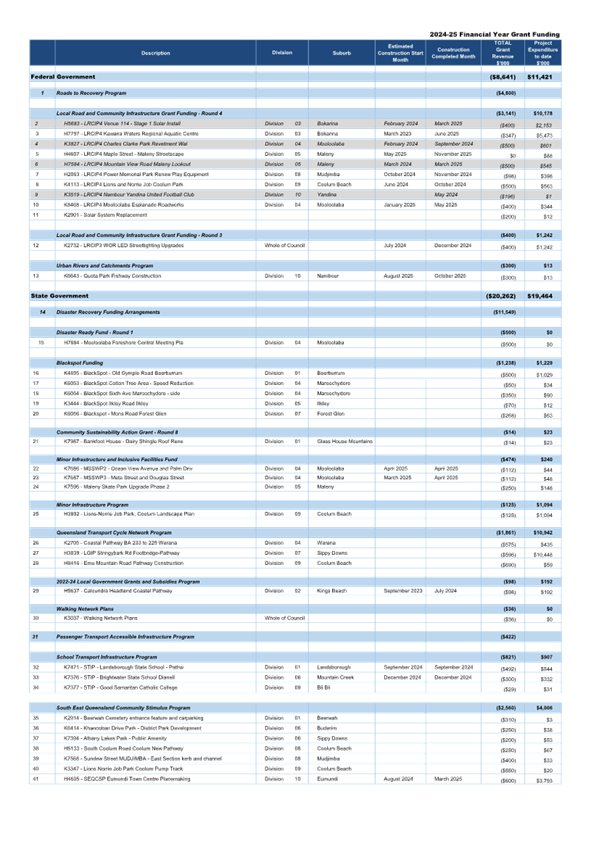
8.6 Interim June 2025 Financial Performance Report.
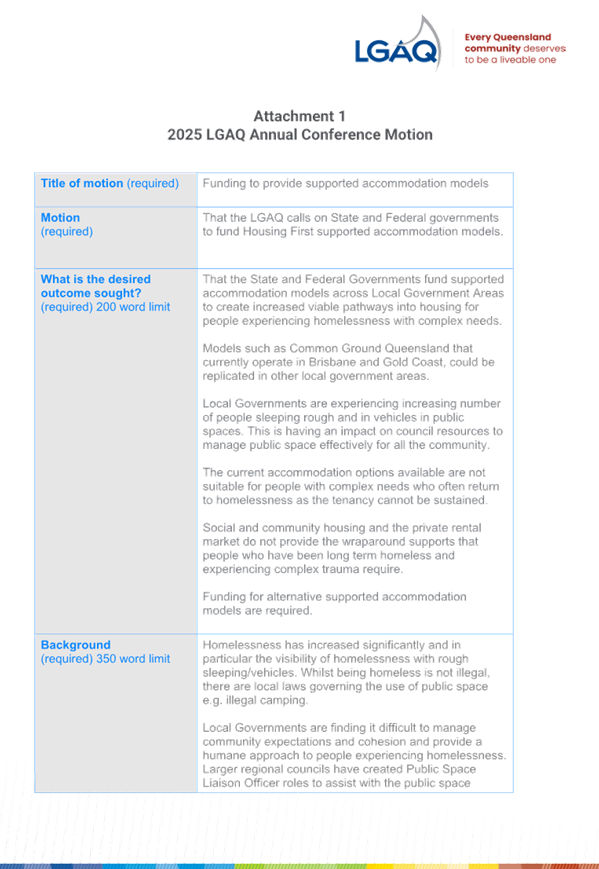
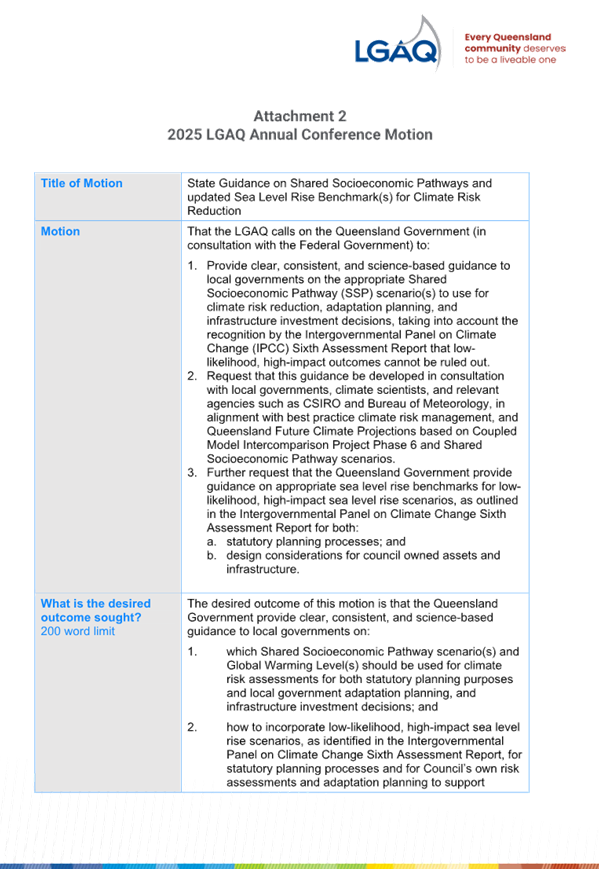
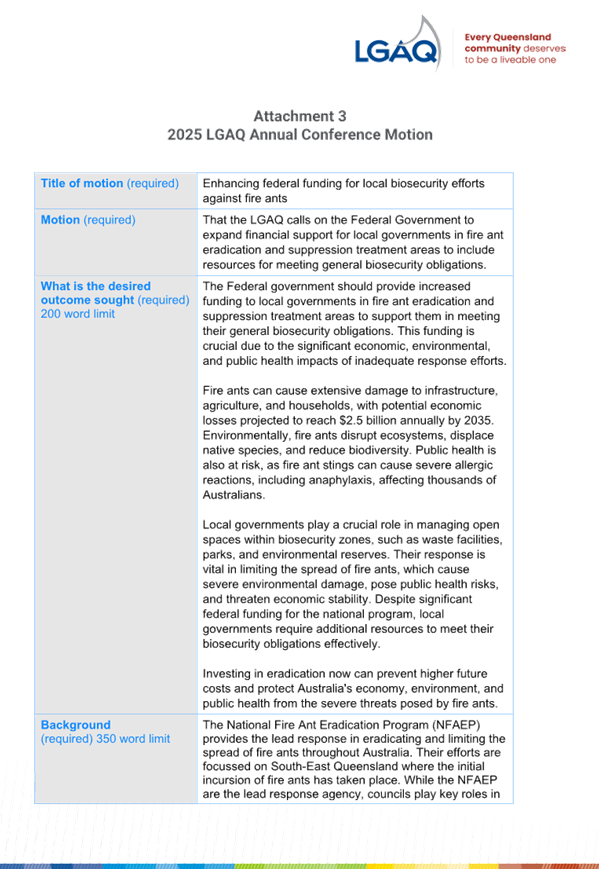
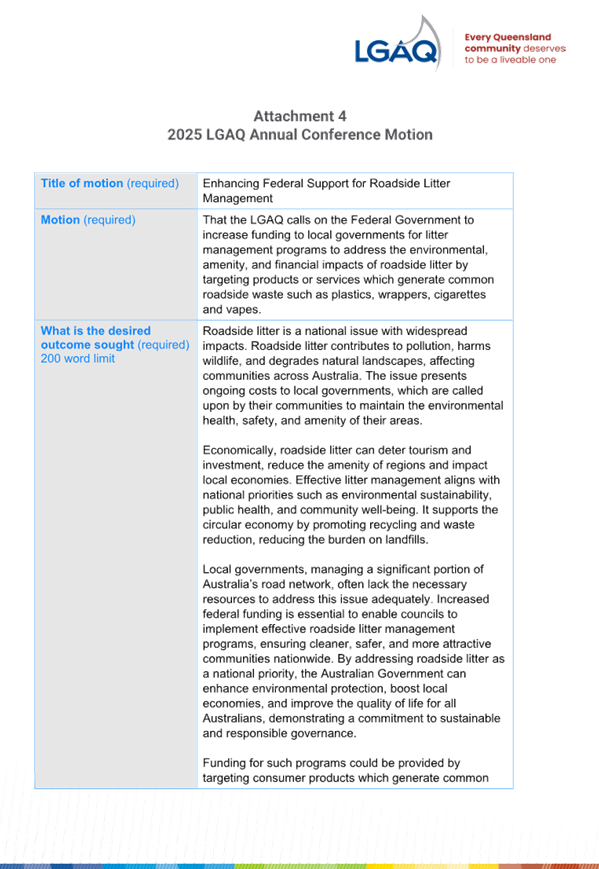
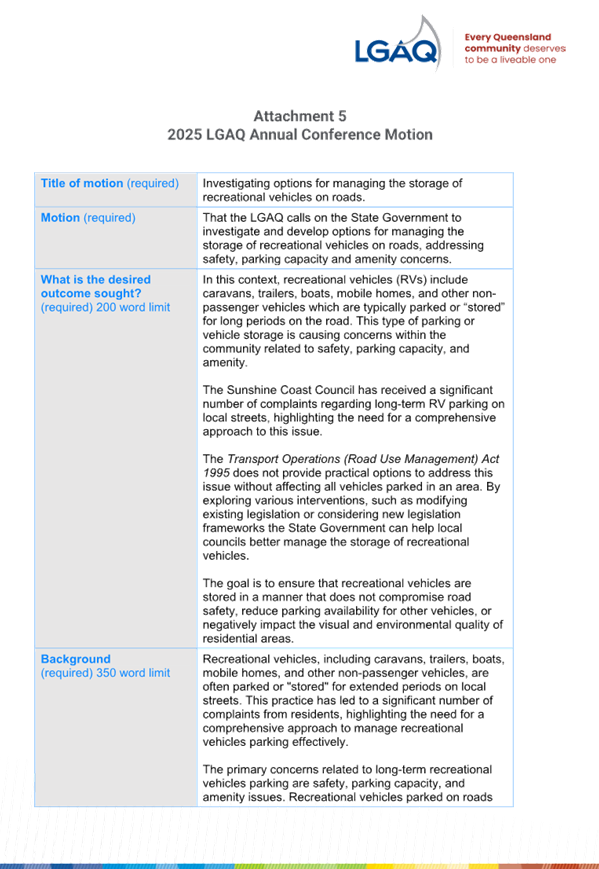
8.7 Motions for the 2025 Local Government Association of Queensland Annual Conference
11.1 Confidential - not for public release - Acquisition of Land - Buderim
11.2 Confidential - not for public release - Disposal (lease) to State of Queensland in Caloundra
Ordinary Meeting Agenda 24 July 2025
1 Declaration of Opening
On establishing there is a quorum, the Chair will declare the meeting open.
2 Welcome and Opening
3 Record of Attendance and Leave of Absence
4 Receipt and Confirmation Of Minutes
That the Minutes of the Ordinary Meeting held on 19 June 2025 and the Special Meeting held on 7 July 2025 be received and confirmed.
6 Informing of Conflicts of Interest
6.1 PRESCRIBED CONFLICTS OF INTEREST
Pursuant to section 150EL of the Local Government Act 2009 (the Act), a Councillor who has a prescribed conflict of interest in an issue to be considered at a meeting of the local government must –
(a) immediately inform the meeting of the prescribed conflict of interest including the particulars stated in section 150EL(4) of the Act and
(b) pursuant to section 150EM(2) of the Act must leave the place at which the meeting is being held, including any area set aside for the public, and stay away from the place while the matter is being discussed and voted on.
6.2 DECLARABLE CONFLICTS OF INTEREST
Pursuant to section 150EQ of the Local Government Act 2009, a Councillor who has a declarable conflict of interest in a matter to be considered at a meeting of the local government, must stop participating in the meeting and immediately inform the meeting of the declarable conflict of interest including the particulars stated in section 150EQ(4) of the Act.
If the Councillor with a declarable conflict of interest does not voluntarily decide not to participate in the decision, pursuant to section 150ES(3)(a) of the Act the eligible Councillors must, by resolution, decide
(a) whether the Councillor may participate in the decision despite the Councillors conflict of interest or
(b) that the Councillor must not participate in the decision and must leave the place at which the meeting is being held, including any area set aside for the public and stay away while the eligible Councillors discuss and vote on the matter.
The Councillor with the declarable conflict of interest must comply with any conditions the eligible Councillors impose per section 150ES(4) and (5) of the Act.
7 Presentations / Councillor Reports
8.1 Development Application for Material Change of Use of Premises to Establish a Telecommunications Facility - 1-9 Campbell St, Woombye
File No: MCU23/0264
Author: Development Planner
Customer & Planning Services Group
Attachments: Att
1 - Detailed Assessment Report ....................................  5/142
5/142
Att 2 - Proposal
Plans ......................................................... 67/142
Att 3 - Applicants
Digital Photography and Photomontage Methodology Report 71/142
Att 4 - Council
3D Model View Analysis ........................... 97/142
Att 5 - Submitter
Maps ..................................................... 141/142
Link to Development.i - MCU23/0264
purpose
The purpose of this report is to seek Council’s determination of a development application for a Development Permit for a Material Change of Use of Premises to establish a Telecommunications Facility at 1-9 Campbell Street, Woombye. The application is before Council due to the level of community interest regarding the proposed development.
Executive Summary
The application seeks a Development Permit for a Material Change of Use of Premises to establish a Telecommunications Facility at 1-9 Campbell Street, Woombye.
The proposed development seeks to establish a 31.3 metre tall monopole and ground-based equipment, located on land included within the Rural zone at the western edge of the Woombye township and located in close proximity to residential zones and residential uses. The applicant has acquired Optus as the carrier to provide network services to Woombye and surrounds.
The application does not comply with, nor can it be conditioned to comply with, a number of the assessment benchmarks contained within the Sunshine Coast Planning Scheme 2014, including the Strategic Framework, the Rural zone code, the Woombye local plan code and the Telecommunications facility code. The areas of conflict relate to impacts on visual amenity and rural character.
A total of 443 properly made submissions, including 6 petitions containing 253 signatures, were received during the public notification period for the application. All but 3 of these submissions oppose the proposal.
It is considered that there are no other relevant matters applicable to the application, including the existence of planning, economic or community need, that justify approving the application despite the non-compliances described within this report.
A detailed assessment of the application has been undertaken and is included in the officer’s Detailed Assessment Report at Attachment 1 to this report.
Officer Recommendation
That Council:
(a) receive and note the report titled “Development Application for Material Change of Use of Premises to Establish a Telecommunications Facility - 1-9 Campbell St, Woombye” and
(b) REFUSE Application MCU23/0264 for a Material Change of Use of Premises to establish a Telecommunications Facility situated at 1-9 Campbell Street, Woombye for the following reasons:
i. The proposal has not been designed and located to minimise community impacts, in particular, visual amenity on nearby residences.
ii. The proposal has not been integrated in a sustainable and attractive manner and therefore would unduly impact upon the character of the local area.
iii. The built form of the proposal does not integrate with or complement the predominant rural character intended for the zone.
iv. The proposal is not integrated with its natural and rural setting.
v. The proposal would not contribute to the character, setting and identity of Woombye as a rural town.
vi. The proposal has not demonstrated achievement of Strategic Outcomes 3.6.1(b) and 3.8.1(g) and Specific Outcomes 3.6.2.1(e), 3.6.2.1(i) and 3.6.7.1(c) of the Strategic Framework of the Sunshine Coast Planning Scheme 2014.
vii. The proposal has not demonstrated achievement of the following Assessment Benchmarks of the Sunshine Coast Planning Scheme 2014:
a) Purpose and Overall Outcome 2(l) of the Rural zone code
b) The Purpose and Overall Outcome 2(c) and Performance Outcome PO1 of the Woombye local plan code and
c) Purpose and Overall Outcomes 2(a) and 2(b) and Performance Outcomes PO1 and PO2 of the Telecommunications facilities code.
viii. The proposed development cannot be conditioned to comply with the assessment benchmarks.
ix. The application has not demonstrated that there is an overriding need in the community interest sufficient to justify approval of the proposal despite the conflicts with planning scheme.
x. There are no discretionary matters which warrant approval of the proposed development.
Finance and Resourcing
In the event of an approval, the proposed Telecommunications Facility would not levy an infrastructure charge as it is considered a minor use under the current Infrastructure Charges Resolution.
Corporate Plan
Corporate Plan Goal: Managing for Growth
Outcome: We serve our community by providing this great service
Operational Activity: S19 - Urban Planning and Development assessment - Providing strategic and statutory urban planning, infrastructure planning and charges, development assessment and compliance services.
Consultation
Councillor Consultation
Councillor W Johnston as the Divisional Councillor and Managing for Growth Portfolio Councillor has been briefed on the application throughout the assessment of the application.
The other Managing for Growth Portfolio Councillor, Councillor C Dickson has been consulted during the assessment process.
Internal Consultation
The application was referred to and/or discussed with the following internal Council specialists and their assessment forms part of this report:
· Principal Development Engineer - Hydraulics, Specialist Services Team
· Principal Biodiversity Officer, Specialist Services Team
· Landscape Officer, Specialist Services Team
· Principal Environmental Management Officer, Specialist Services Team
· 3D Project Officer, Urban Design and Architecture Team.
External Consultation
There has been no external consultation undertaken in relation to this report.
Community Engagement
The application was publicly notified for 15 business days between 5 August 2024 and 26 August 2024 in accordance with the requirements of the Planning Act 2016. A total of 453 submissions were received, of which 443 were determined to be ‘properly made’ in accordance with the Planning Act 2016. Most of the submissions received oppose the proposed development. The properly made submissions included 6 petitions, all opposing the development, which contained a total of 253 signatures. Approximately 50 of the signatories for the petitions also lodged individual submissions.
A summary of the issues raised by submitters together with a response is provided in the officer’s Detailed Assessment Report at Attachment 1 of this report.
Maps identifying the locations of where the submissions were received from is provided in Attachment 5.
Proposal
The application seeks a Development Permit for a Material Change of Use of Premises to establish a Telecommunications Facility at 1-9 Campbell Street, Woombye.
The proposed development seeks to establish a 31.3 metre tall monopole and ground-based equipment, located on land included within the Rural zone at the western edge of the Woombye township and located in close proximity to residential zones and residential uses. The applicant has acquired Optus as the carrier to provide network services to Woombye and surrounds.
Proposal plans and elevations are included in Attachment 2 of this report.
A detailed assessment of the application has been undertaken and is included in the officer’s Detailed Assessment Report at Attachment 1.
The proposed development is in clear conflict with the Sunshine Coast Planning Scheme 2014, particularly in relation to the Strategic Framework, Rural zone code, Woombye local plan code and the Telecommunications facilities code.
The applicant has provided a “Digital Photography and Photomontage Methodology Report" prepared by Mark Elliott Illustrations (refer to Attachment 3). Upon detailed review of the application material and Council’s 3D Model View Analysis at Attachment 4, it has been found that the proposal would have a clear visual impact upon the amenity of adjoining and surrounding premises and would not be sufficiently integrated with its setting.
On balance, it is considered that the application has not clearly demonstrated that there is a compelling economic need, planning need or overriding community interest to justify approval of the proposal despite the conflicts with various Planning Scheme outcomes relating to the protection of visual amenity and rural character.
The non-compliances with the Planning Scheme cannot be overcome through reasonable and relevant conditions and there are no other relevant matters applicable to the application that justify approving the proposed development despite the non-compliances described in this report.
Due to the above-mentioned conflicts with the Planning Scheme, the application is recommended for refusal.
Legal
There are currently no legal implications relevant to this report, however Council’s decision can be appealed to the Planning and Environment Court by the applicant and any properly made submitter. Council will proceed with any required actions resulting from any legal action.
Policy
The application has been assessed against the Sunshine Coast Planning Scheme 2014 and regard has been given to all relevant Council policies.
Risk
This matter can be appealed to the Planning and Environment Court by the applicant or properly made submitters. Council will proceed with any required actions resulting from any legal action.
Previous Council Resolution
There is no previous Council resolution relevant to this report.
Related Documentation
A copy of the officer’s detailed assessment report is included as Attachment 1 to this report.
A copy of the proposal plans, elevations, sections, and perspective drawings is included as Attachment 2 to this report.
A copy of the applicant “Digital Photography and Photomontage Methodology Report" prepared by Mark Elliott Illustrations is included as Attachment 3 to this report.
A copy of Council’s 3D Model View Analysis is included as Attachment 4 to this report.
Maps identifying the locations of where the submissions were received from is provided in Attachment 5 to this report.
Critical Dates
The decision due date is 25 July 2025 in accordance with the provisions of the Planning Act 2016.
Implementation
Should the recommendation be accepted by Council, Council officers will communicate the outcome of Council’s resolutions to the applicant and submitters as appropriate.
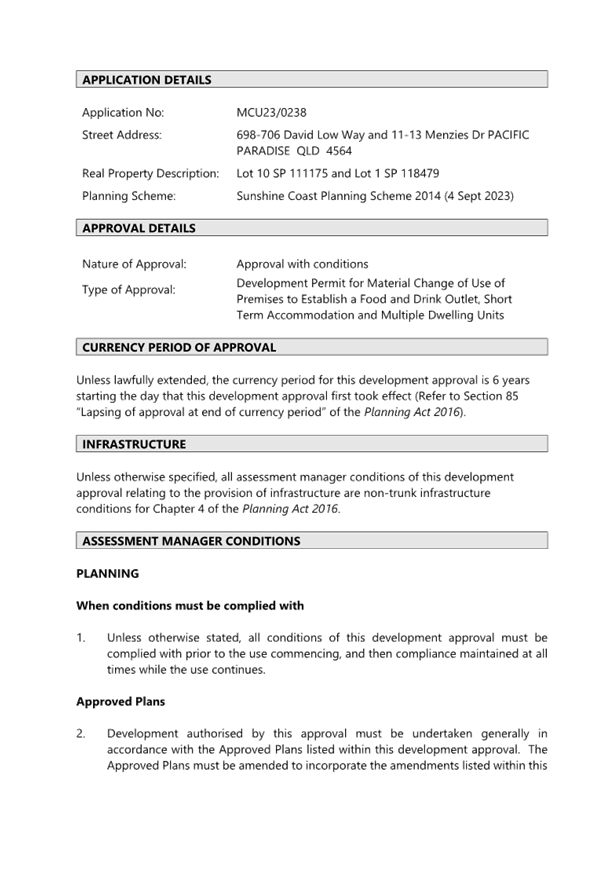
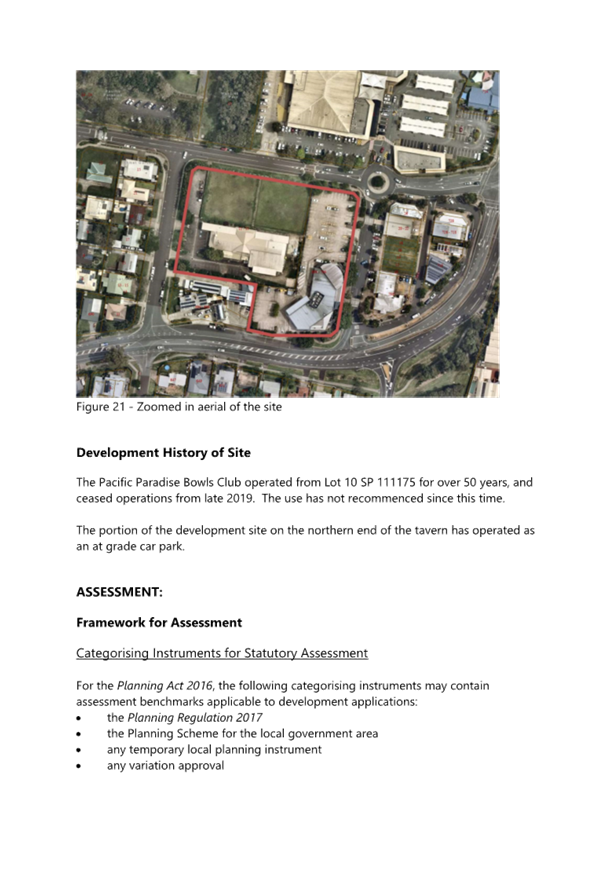
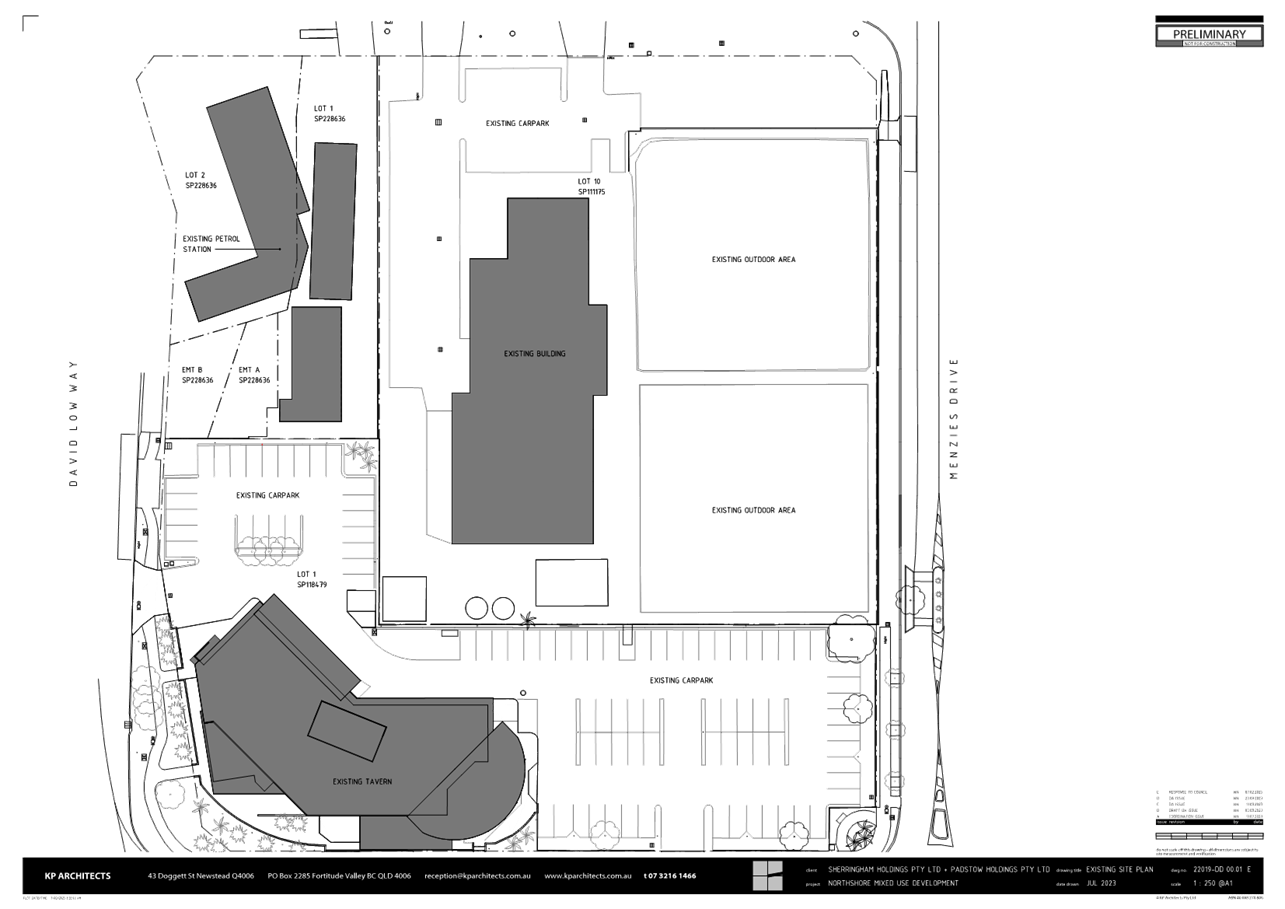
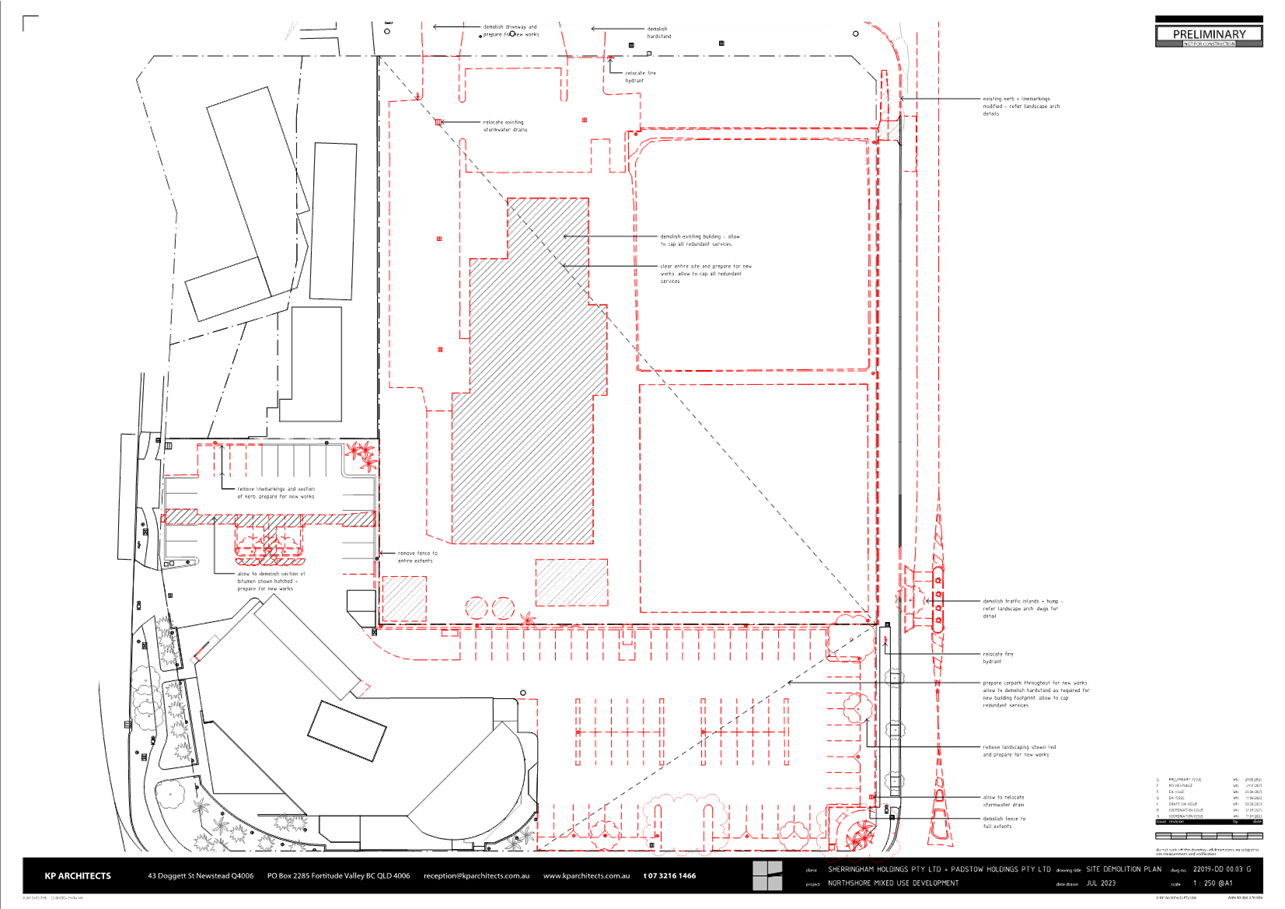
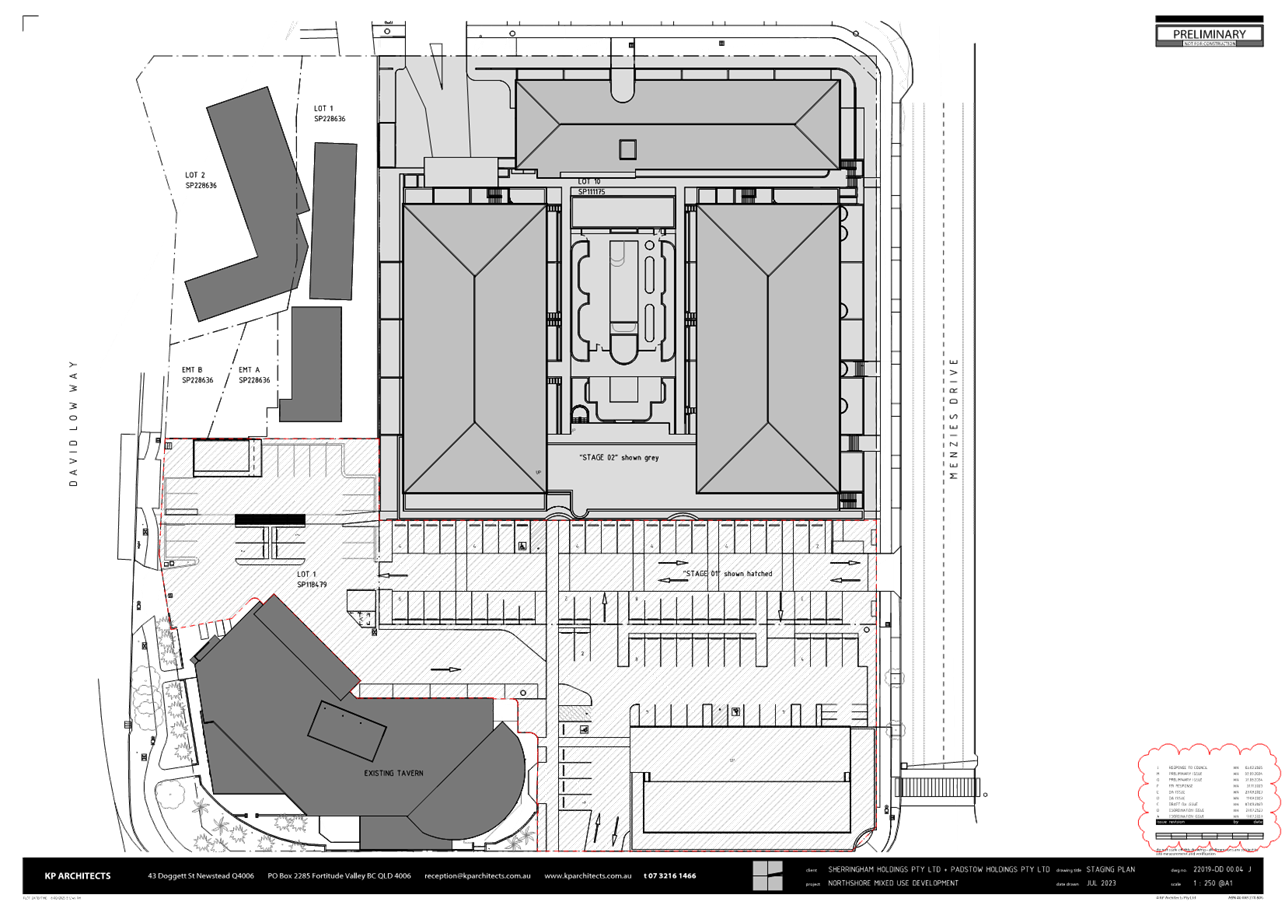
8.2 Development Permit for Material Change of Use of Premises to Establish a Food and Drink Outlet, Short Term Accommodation and Multiple Dwelling Units - 698-706 David Low Way and 11-13 Menzies Dr PACIFIC PARADISE QLD 4564
File No: MCU23/0238
Author: Principal Development Planner
Customer & Planning Services Group
Appendices: App
a - Recommended Conditions of
Approval.................... 25 ⇩
Attachments: Att
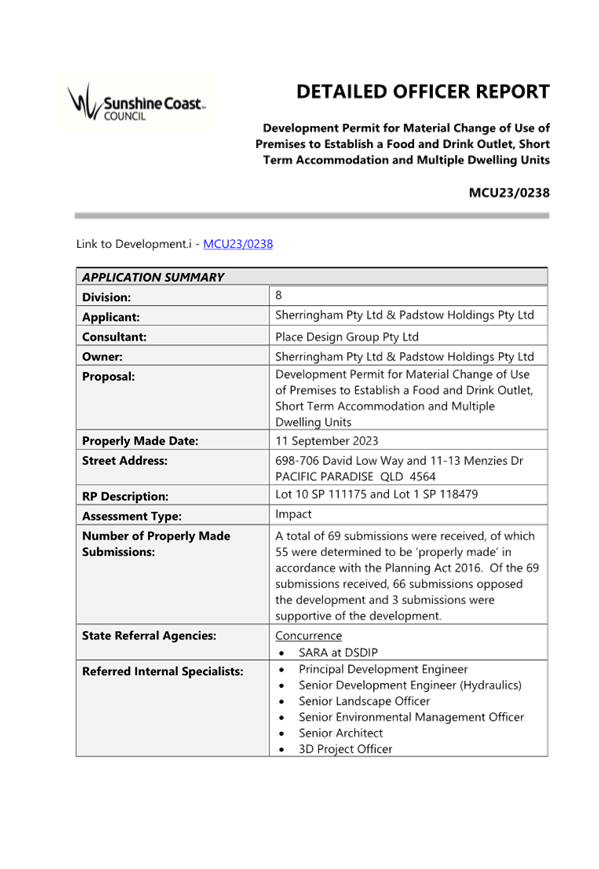
1 - Detailed Officer Report................................................. 63 ⇩
Att
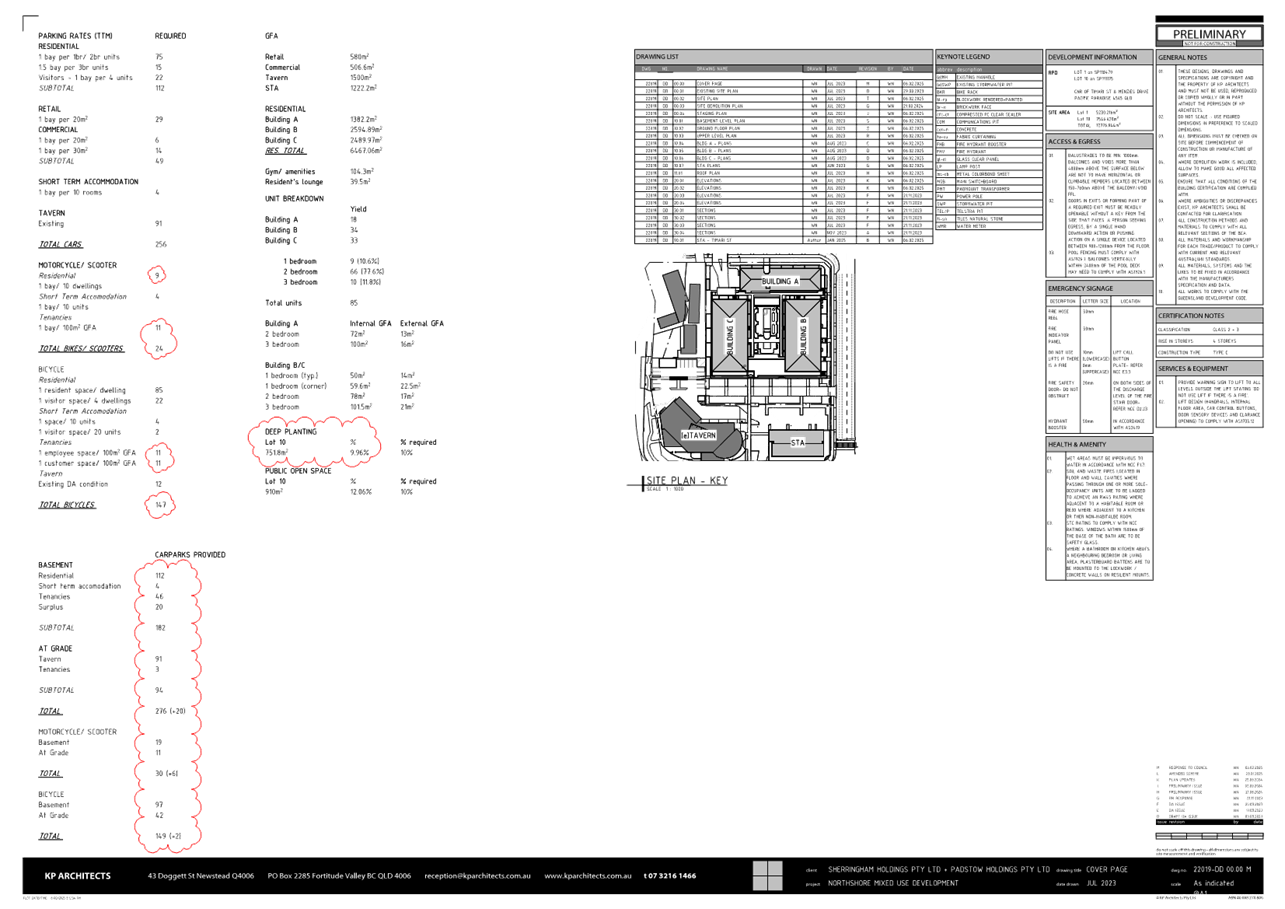
2 - Proposal Plans.............................................................. 115 ⇩
Att
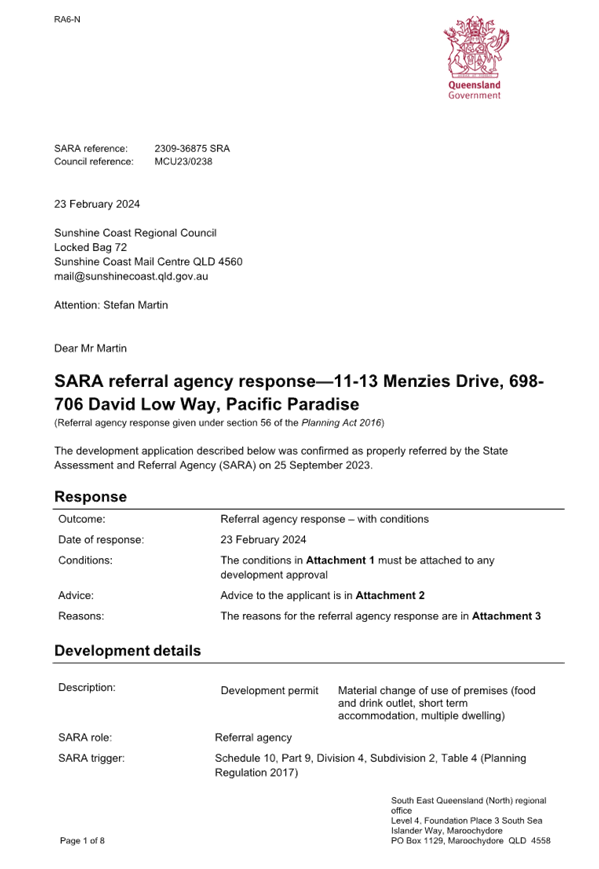
3 - Concurrence Agency Response
(with conditions).... 139 ⇩
Att
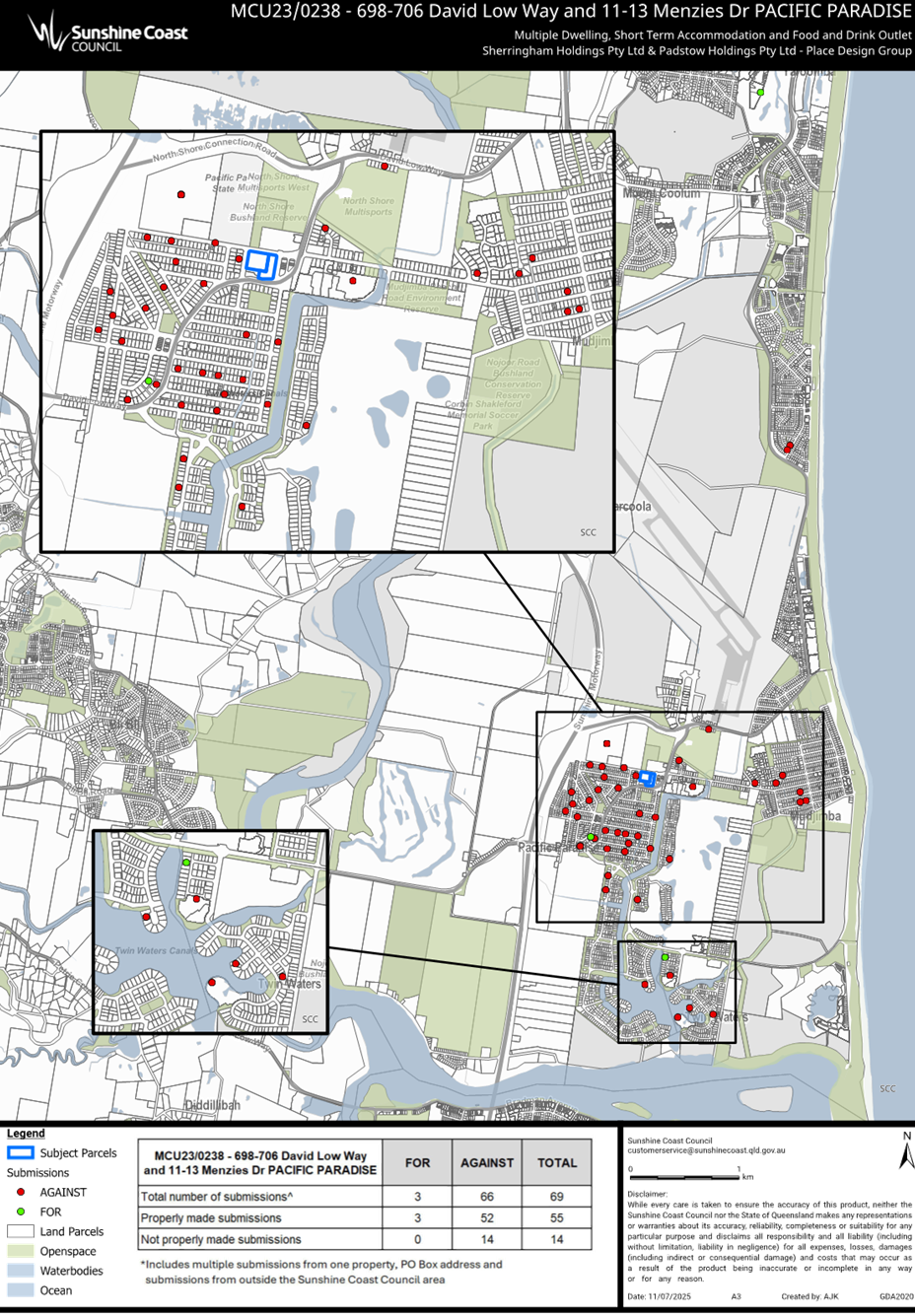
4 - Submissions Map......................................................... 161 ⇩
purpose
The purpose of this report is to seek Council’s determination of a Development Application for a Development Permit for Material Change of Use of Premises to Establish a Food and Drink Outlet, Short Term Accommodation, and Multiple Dwelling Units at 698-706 David Low Way and 11-13 Menzies Drive, Pacific Paradise (the application).
The application is before Council due to the construction cost of the development and consideration of Council’s strategic policy intent.
Executive Summary
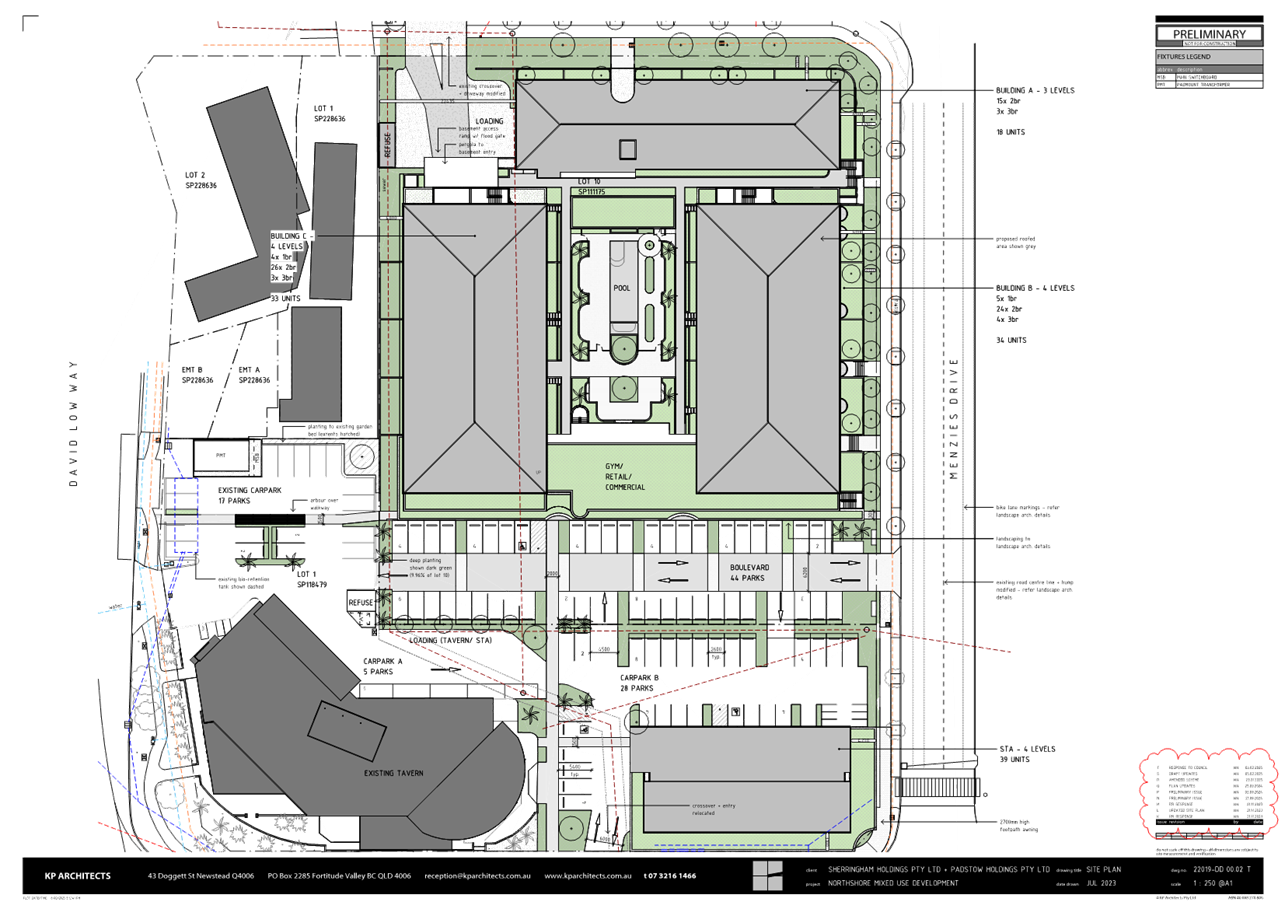
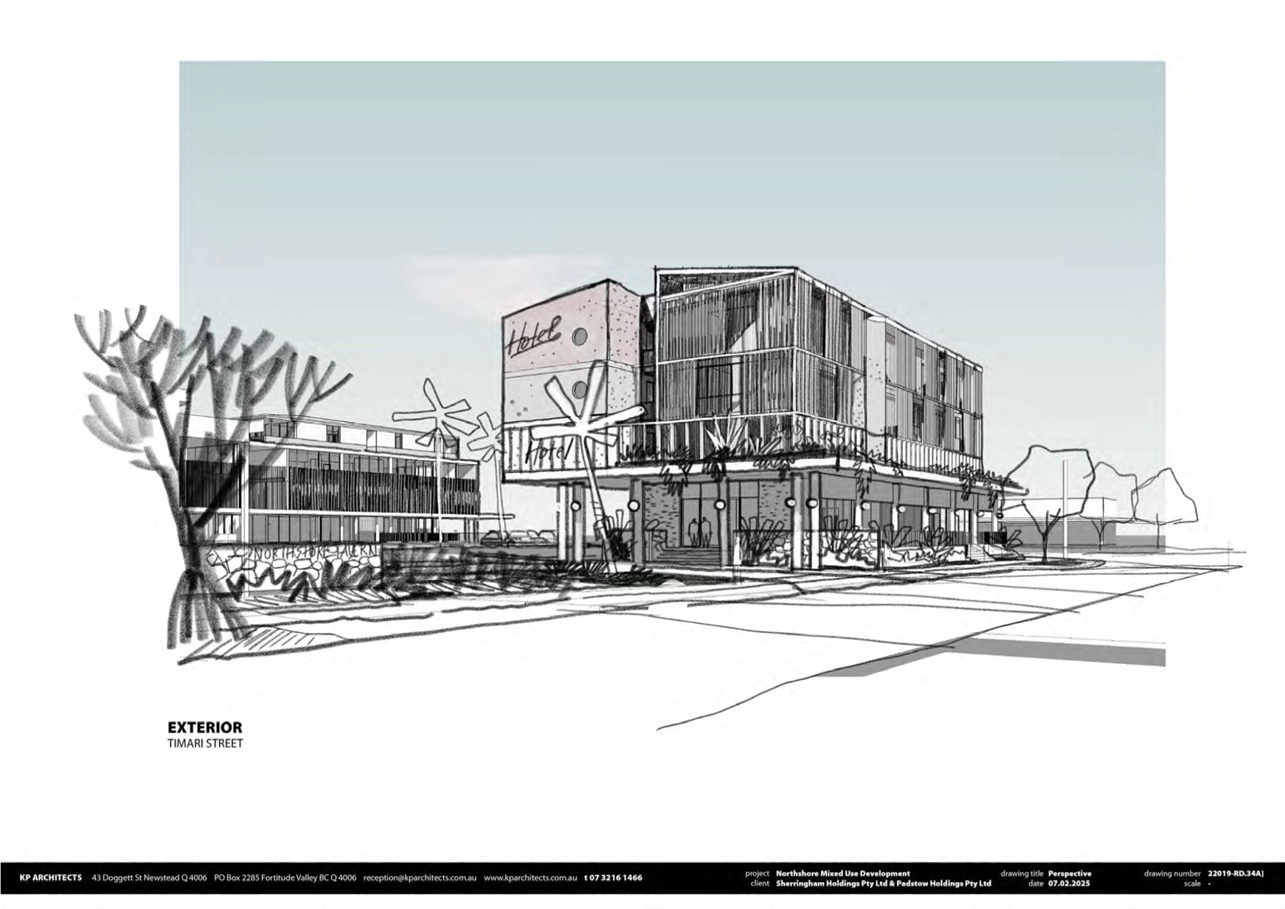
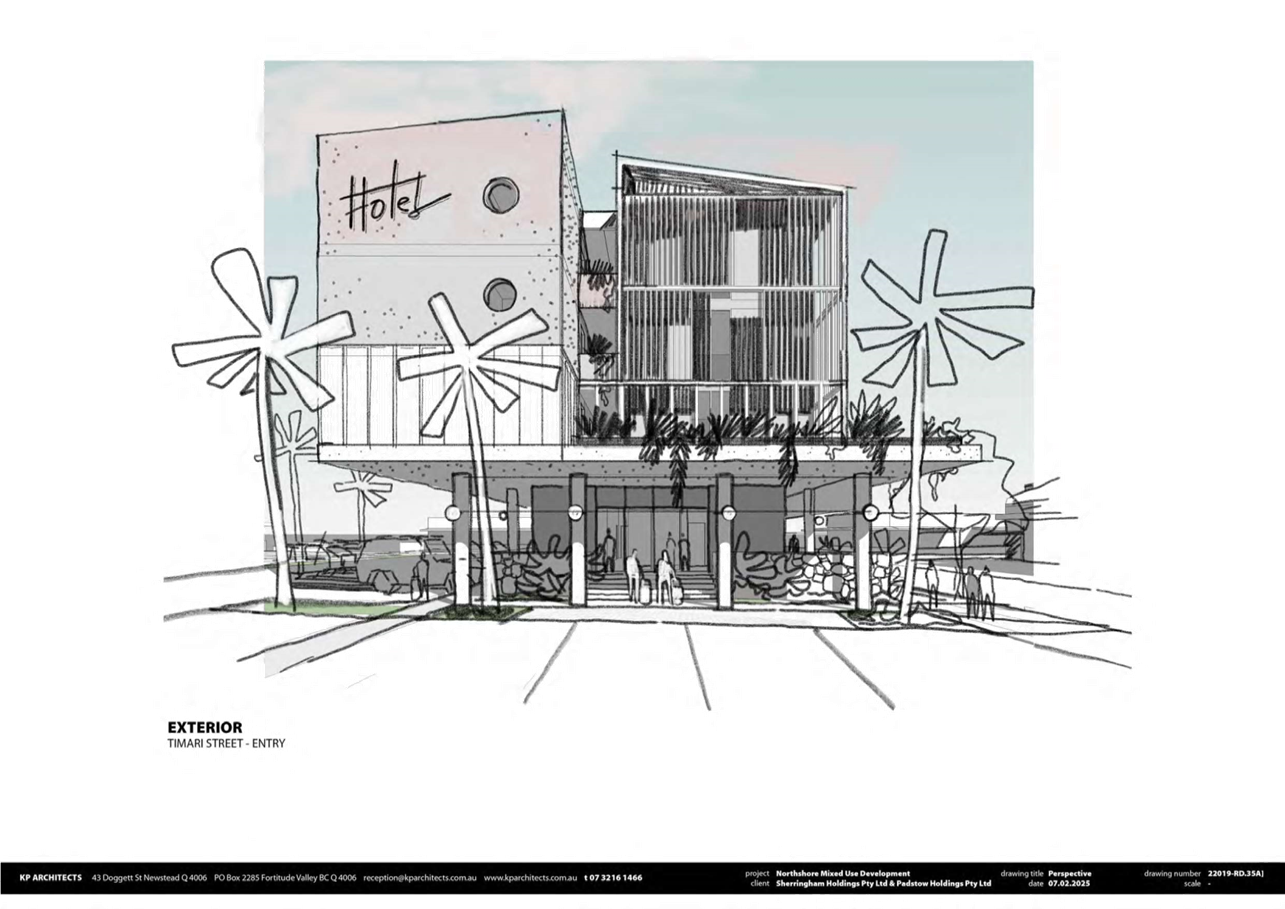
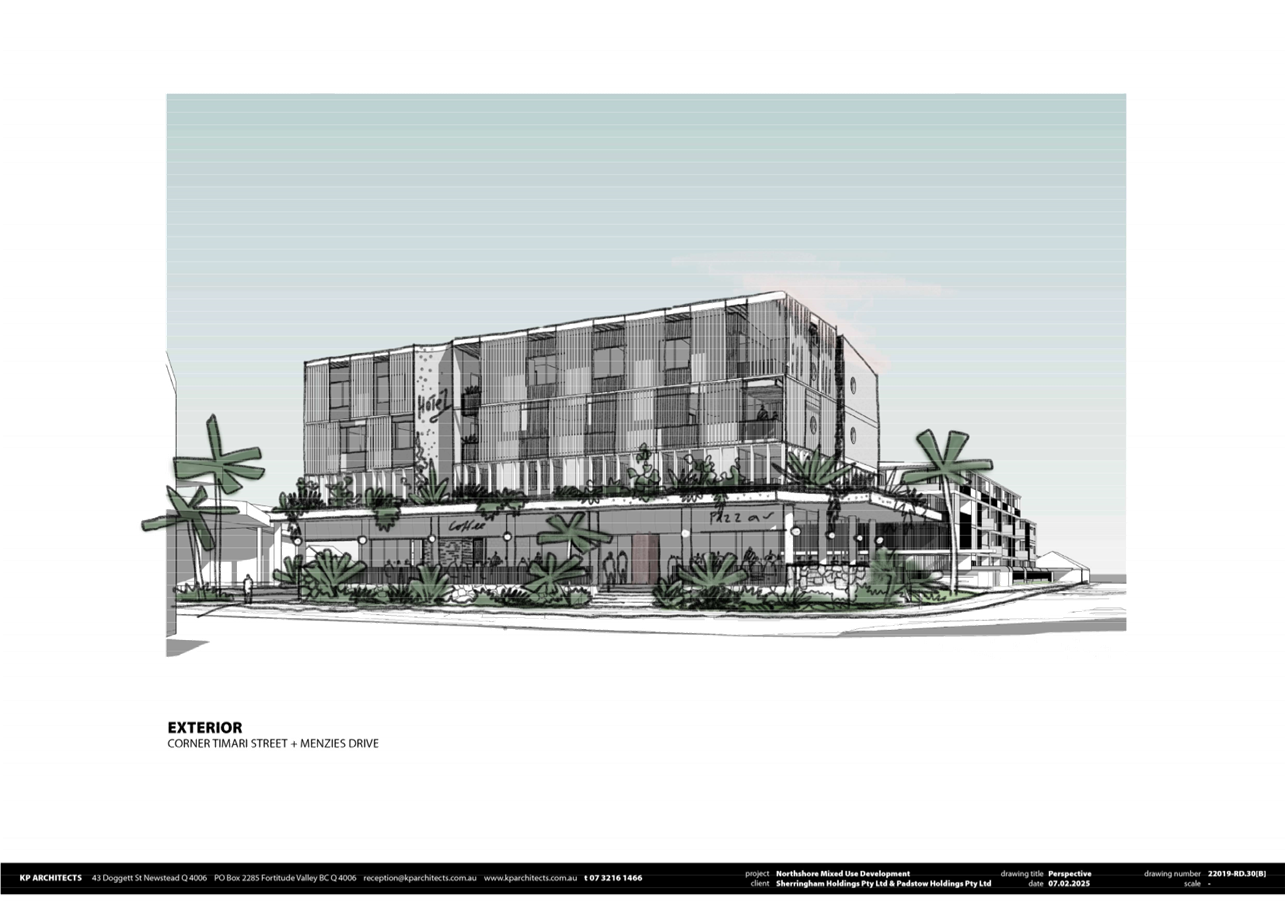
The application seeks approval for a Development Permit for Material Change of Use of Premises to Establish a Food and Drink Outlet, Short Term Accommodation, and Multiple Dwelling Units with four distinct buildings, which exceed the nominated building height under the Sunshine Coast Planning Scheme 2014.
The application has been assessed against the Sunshine Coast Planning Scheme 2014 and identifies that the development does not comply with the Height of buildings and structure overlay code and the multiple dwelling units are inconsistent in the Sport and recreation zone.
These matters could be considered to be a departure from the planning scheme, the Planning Act 2016 requires consideration of whether there are other relevant matters for consideration which warrant an approval or refusal of the application.
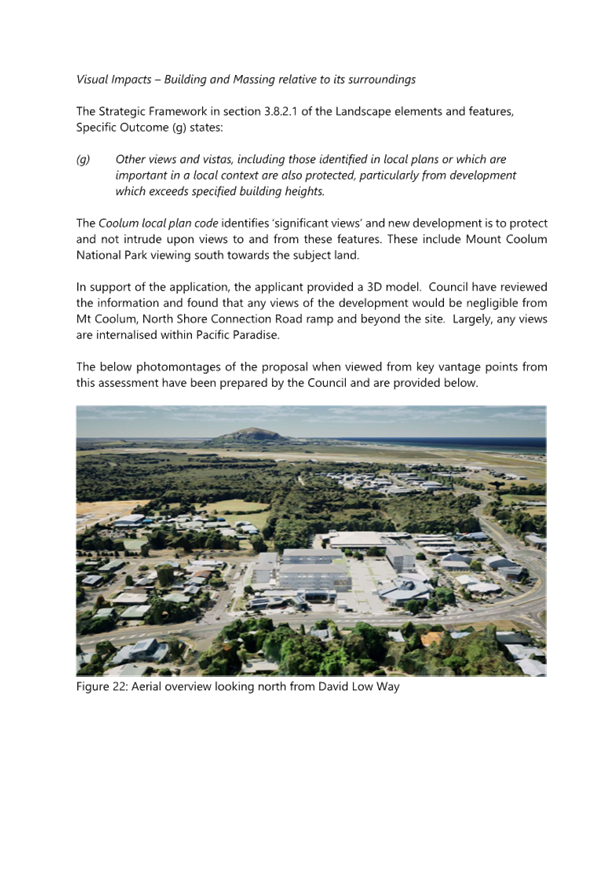
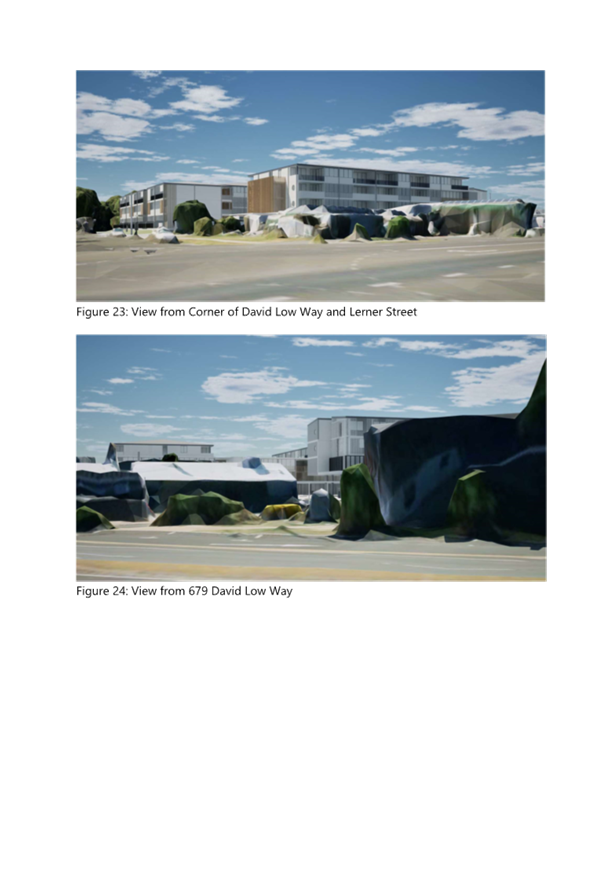
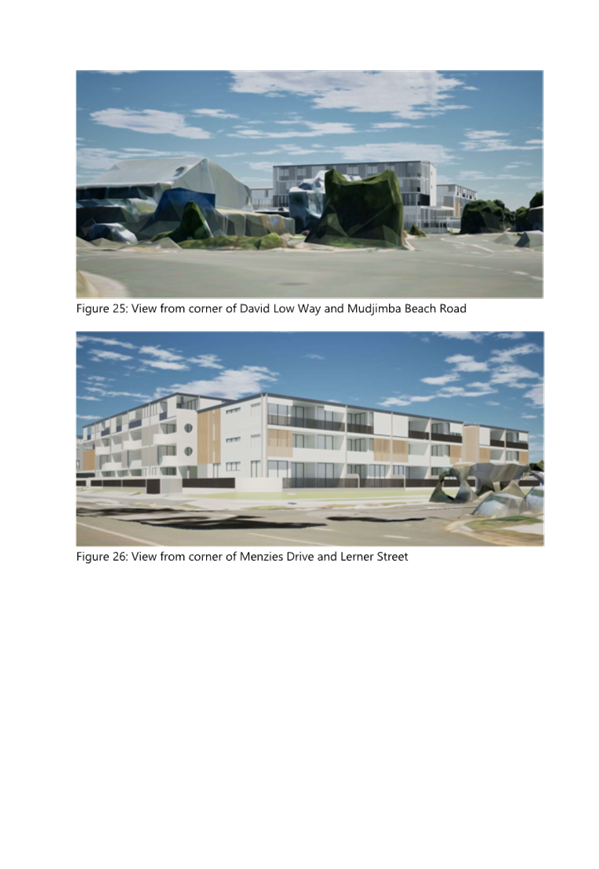
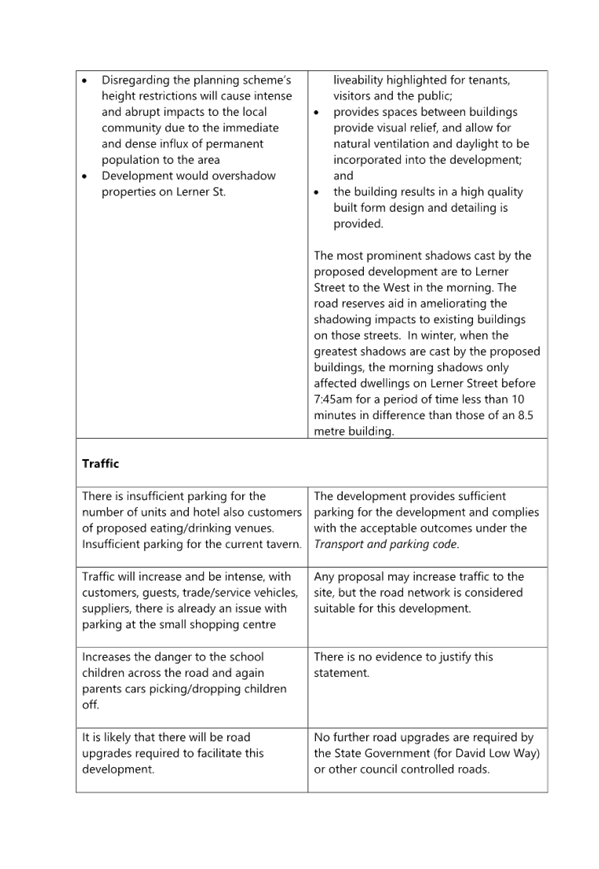
In this instance, the site is unique in the context, adjoining a Local centre zone and does not directly adjoin a residential zone. There are limited opportunities for this form of residential development in the current centre zone and, it also offers short term accommodation in close proximity to the Sunshine Coast Airport. Additionally, it offers a mix of housing product, and the design of the building is high quality and avoids impacts external to the site including overlooking or overshadowing, the development will not be visible from key vantage points outside the site particularly Mount Coolum.
In converse, the matters that may warrant refusal, include that the use may result in a reduction in Sport and recreation zoned land and that the building heights exceed that nominated in the Planning Scheme.
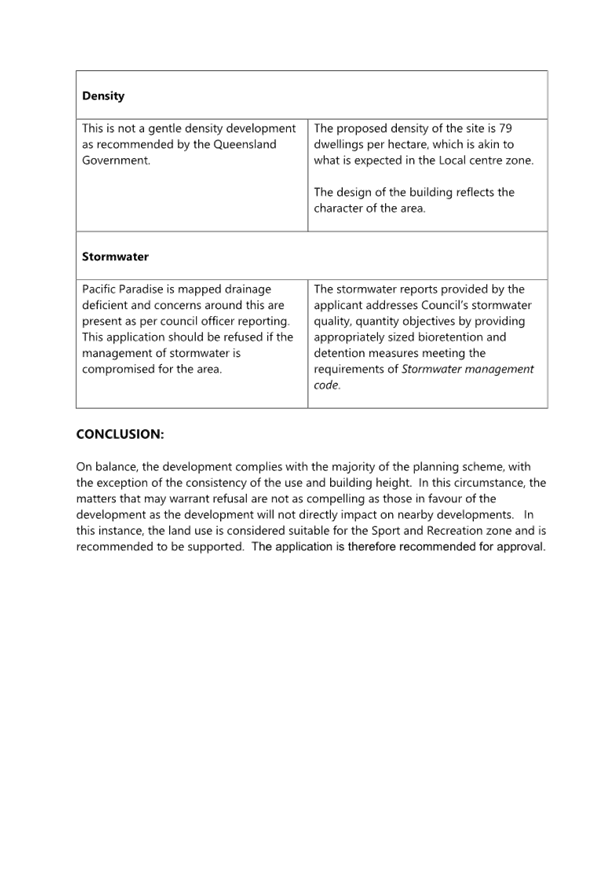
On balance, the development complies with the majority of the planning scheme, with the exception of the consistency of the use and building height. In this circumstance, the matters that may warrant refusal are not as compelling as those in favour of the development as the development will not have an adverse impact on nearby development. In this instance, the development application is recommended for approval.
That Council:
(a) receive and note the report titled “Development Permit for Material Change of Use of Premises to Establish a Food and Drink Outlet, Short Term Accommodation and Multiple Dwelling Units - 698-706 David Low Way and 11-13 Menzies Dr PACIFIC PARADISE QLD 4564” and
(b) APPROVE WITH CONDITIONS application no. MCU23/0238 for a Development Permit for Material Change of Use of Premises to Establish a Food and Drink Outlet, Short Term Accommodation and Multiple Dwelling Units situated at 698-706 David Low Way and 11-13 Menzies Dr PACIFIC PARADISE QLD 4564 as identified in Appendix A.
Finance and Resourcing
In the event of an approval, infrastructure charges would be applicable to the proposed development. Council’s Infrastructure Policy and Charges Team has estimated the infrastructure charge for this development to be approximately $1,030,668.
Corporate Plan
Corporate Plan Goal: Managing for Growth
Outcome: We serve our community by providing this great service
Operational Activity: S19 - Urban Planning and Development assessment - Providing strategic and statutory urban planning, infrastructure planning and charges, development assessment and compliance services.
Consultation
Councillor Consultation
Councillor T Bunnag as the Divisional Councillor has been briefed throughout the assessment of the application.
The Managing for Growth Portfolio Councillors, Councillor W Johnston and Councillor C Dickson have been consulted during the assessment process.
All Councillors were advised of the application at the time of lodgement.
Internal Consultation
The application was referred to and/or discussed with the following internal Council specialists and their assessment forms part of this report:
· Senior Development Engineer - Hydraulics, Specialist Services Team
· Principal Development Engineer - Specialist Services Team
· Senior Environmental Management Officer - Specialist Services Team
· Senior Landscape Officer - Specialist Services Team
· 3D Project Officer - Urban Design and Architecture Team
· Senior Architect - Urban Design and Architecture Team
· Interim Coordinator Planning Scheme Amendments - Strategic Planning Branch.
External Consultation
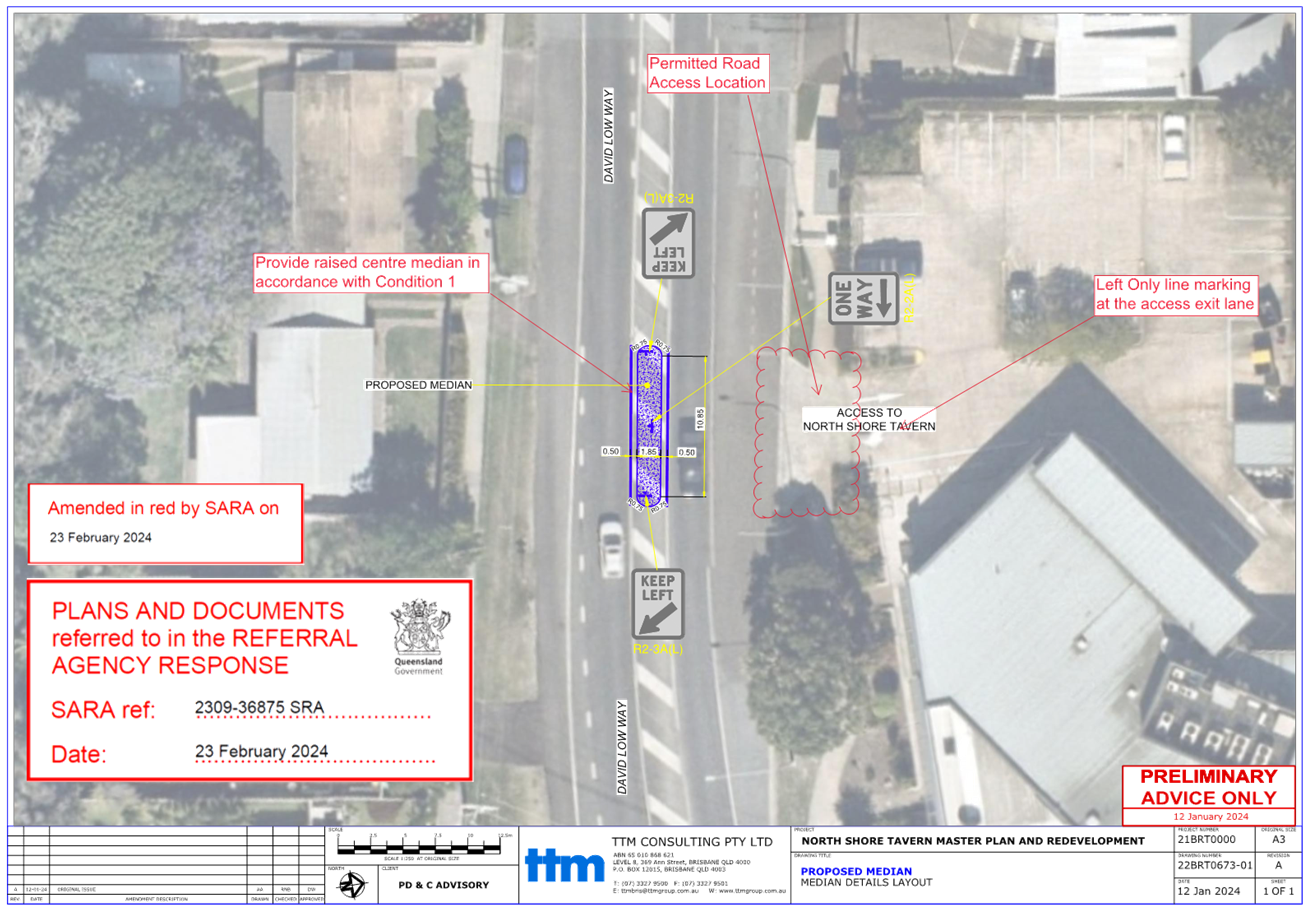
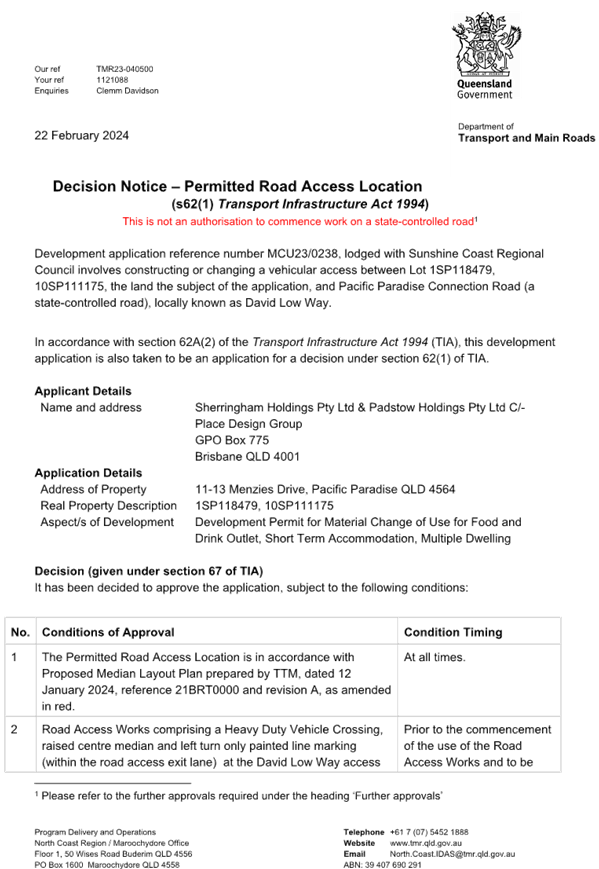
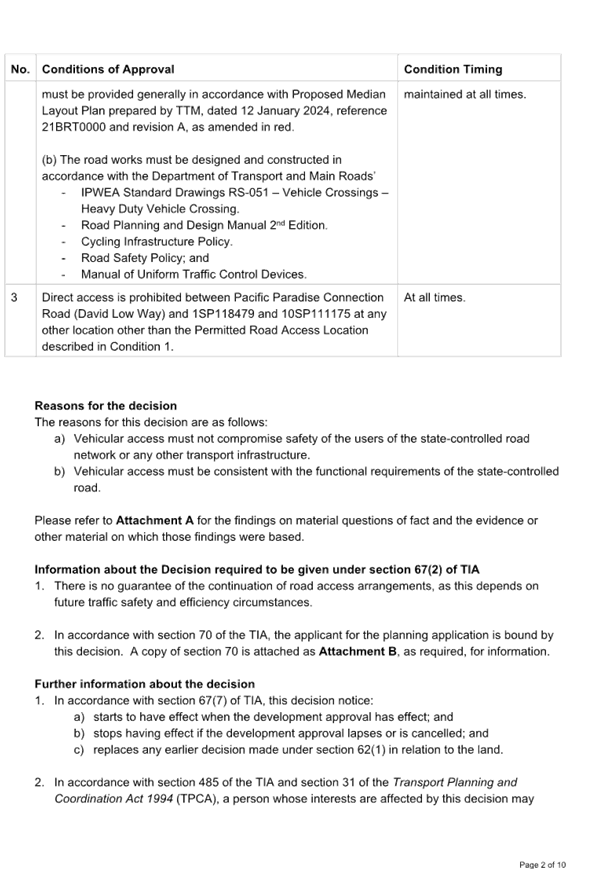
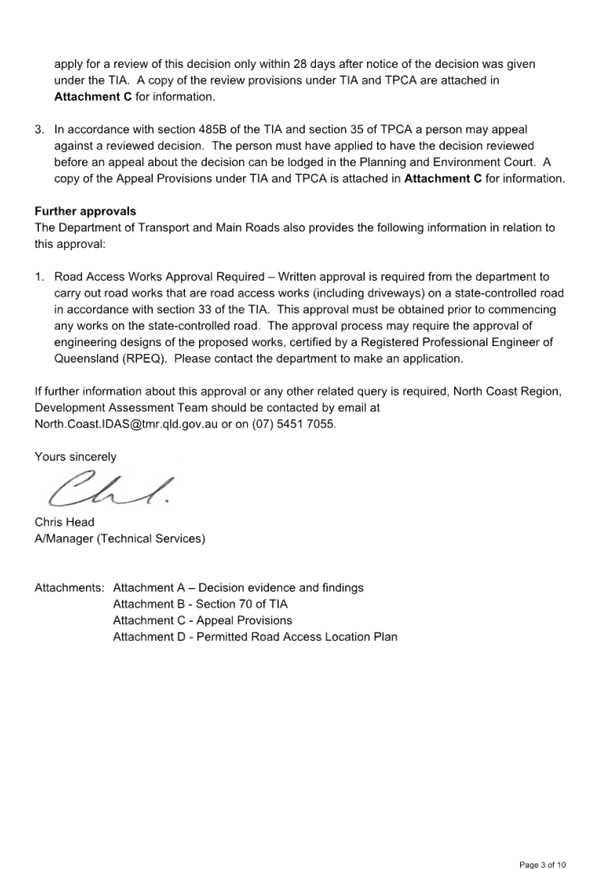
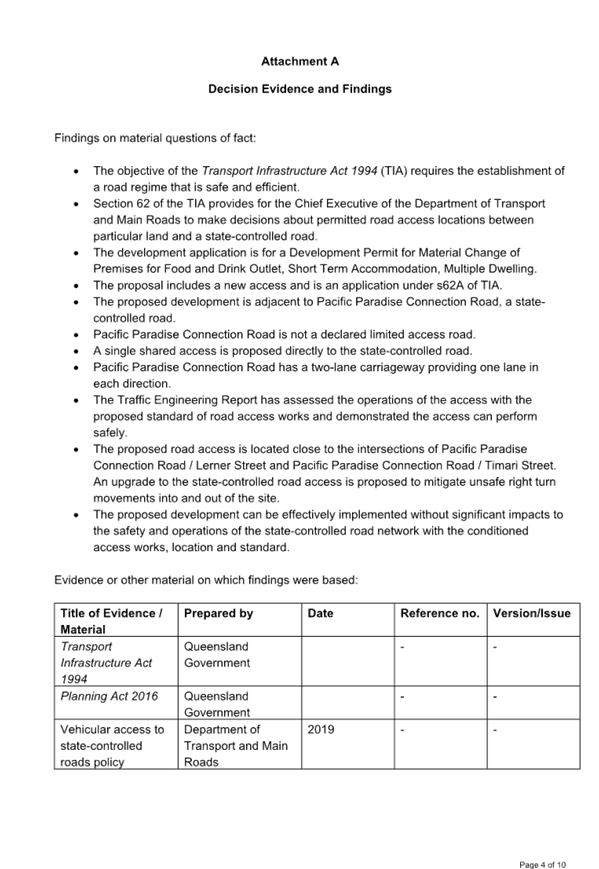
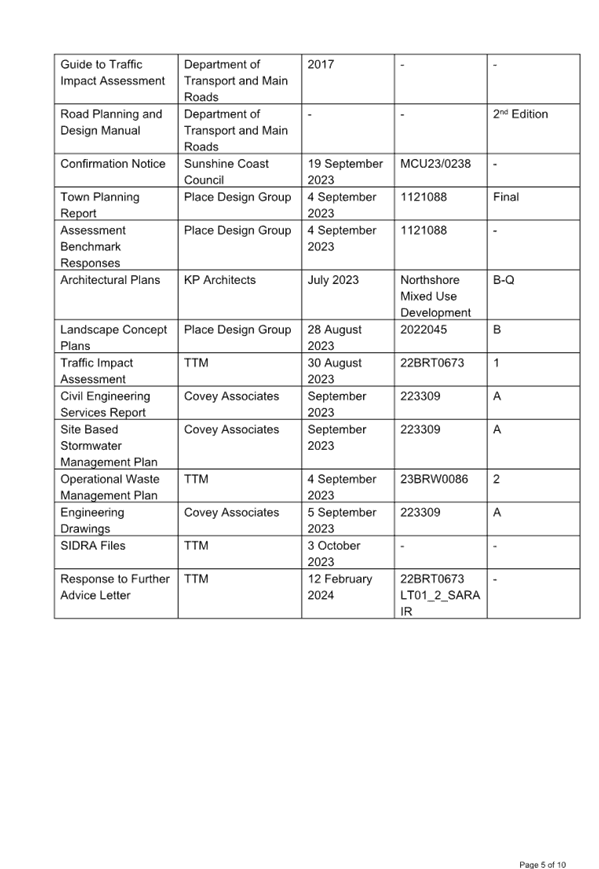
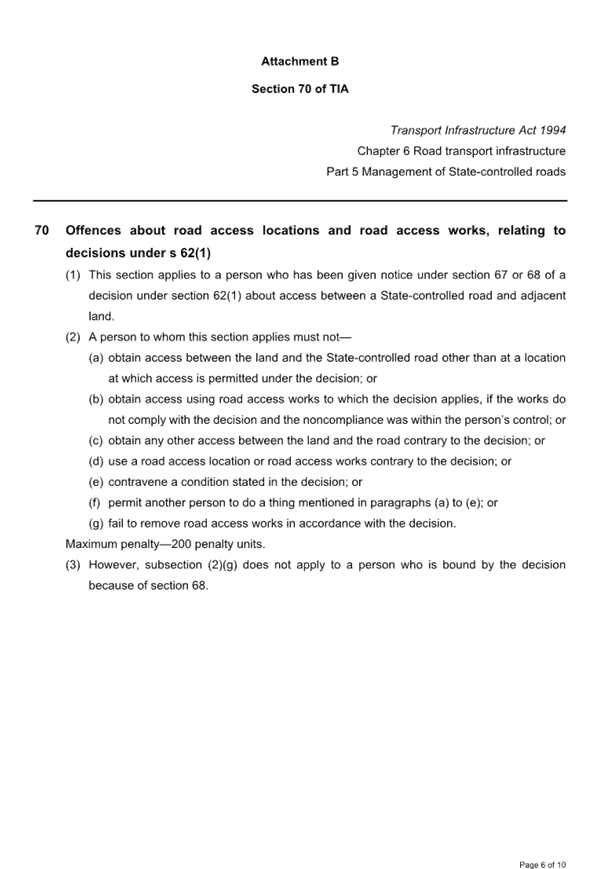
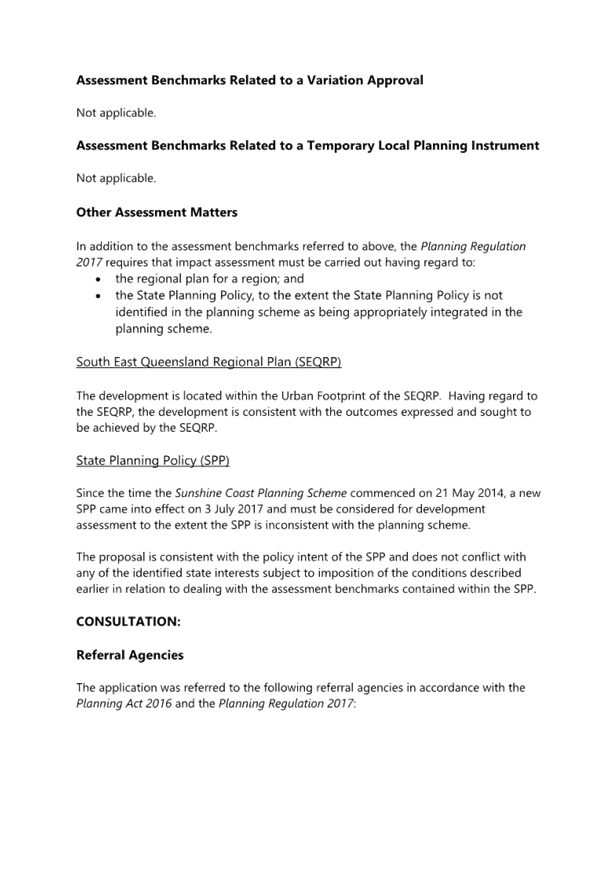
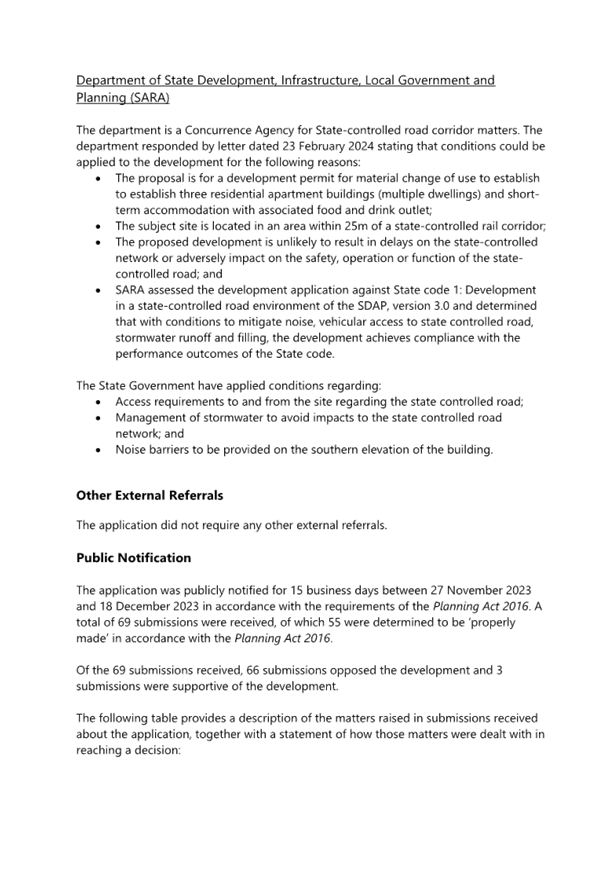
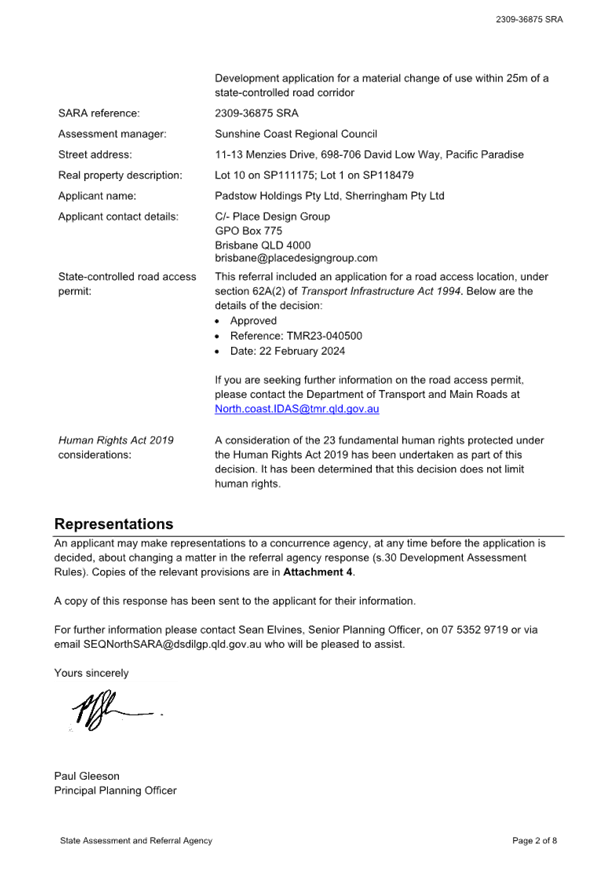
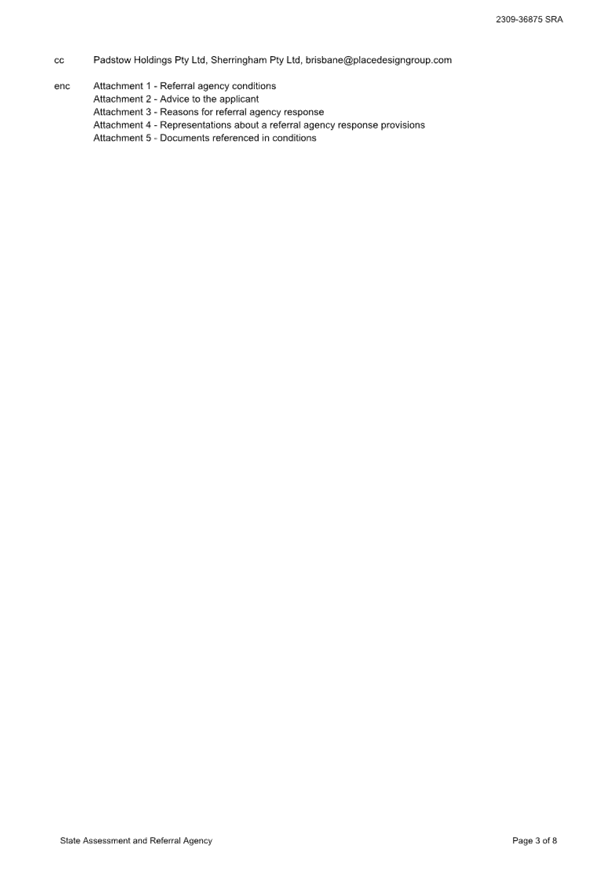
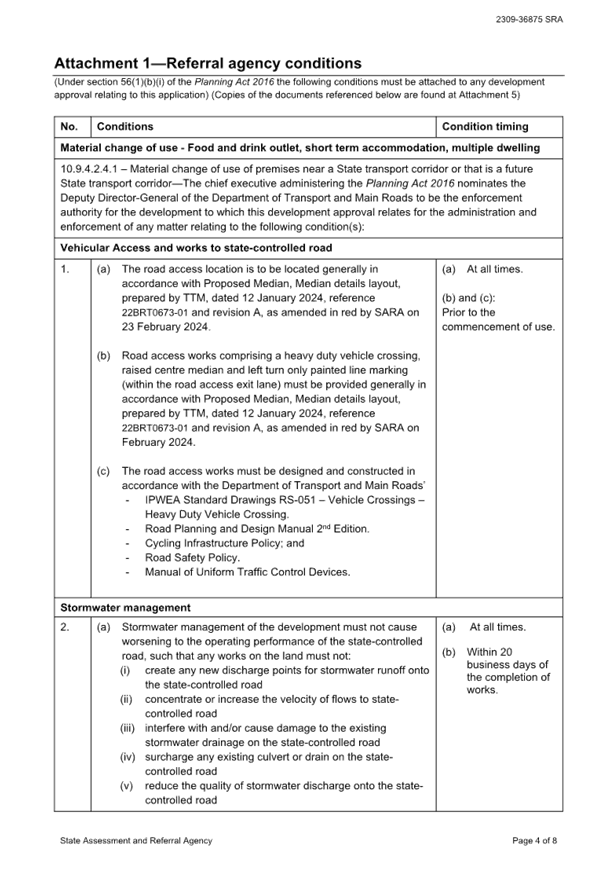
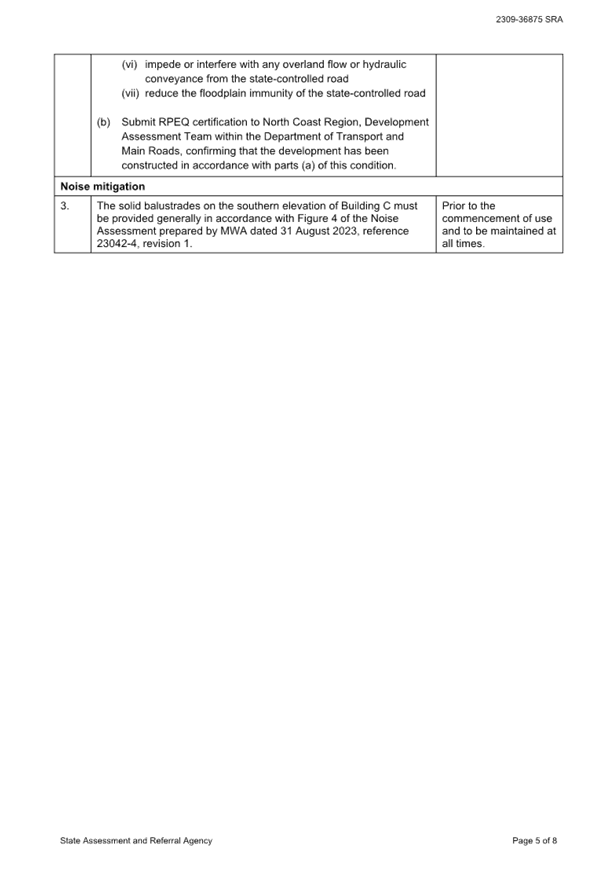
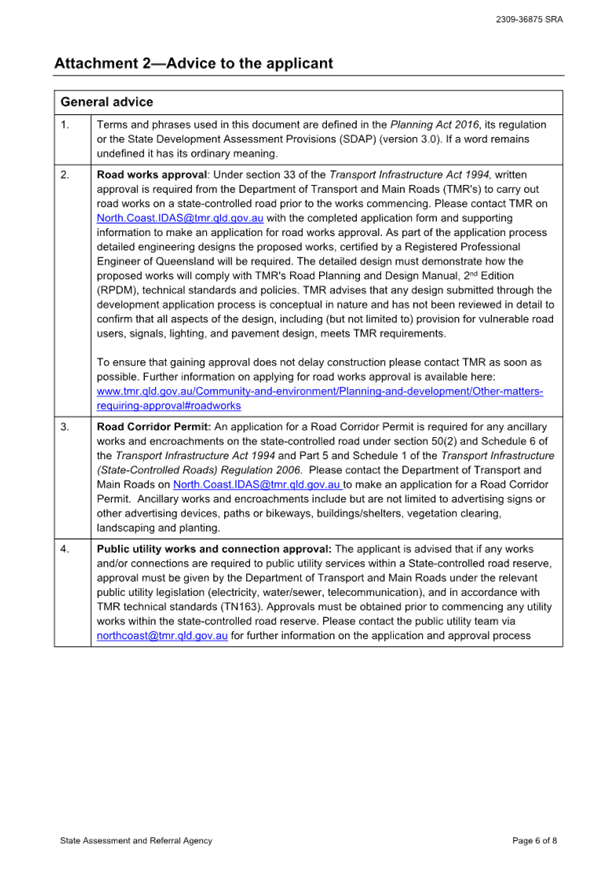
The application was referred to the Department of State Development, Infrastructure and Planning in accordance with the Planning Act 2016 and the Planning Regulation 2017 as a Concurrence Agency for State-controlled Road corridor matters given that David Low Way is a State-controlled Road. The department responded by letter dated 23 February 2024 stating that conditions could be applied to the development. Their response is included as Attachment 3.
Community Engagement
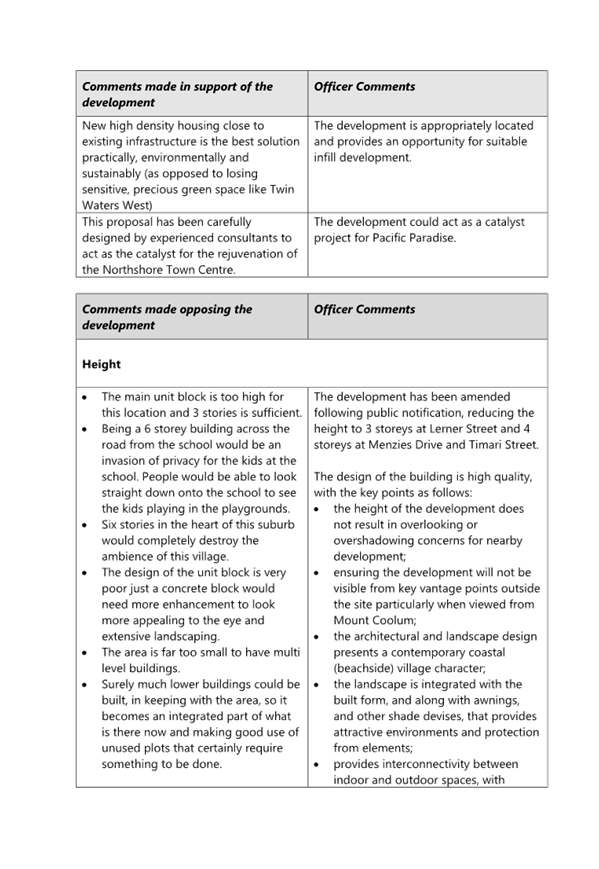
The application was publicly notified for 15 business days between 27 November 2023 and 18 December 2023 in accordance with the requirements of the Planning Act 2016. A total of 69 submissions were received, of which 55 were determined to be ‘properly made’ in accordance with the Planning Act 2016. Of the 69 submissions received, 66 submissions opposed the development, and 3 submissions were supportive of the development.
A summary of the issues raised by submitters together with a response is provided in the officer’s Detailed Assessment Report as Attachment 1 of this report.
A map identifying the locations of where the submissions were received from is provided in Attachment 4.
Proposal
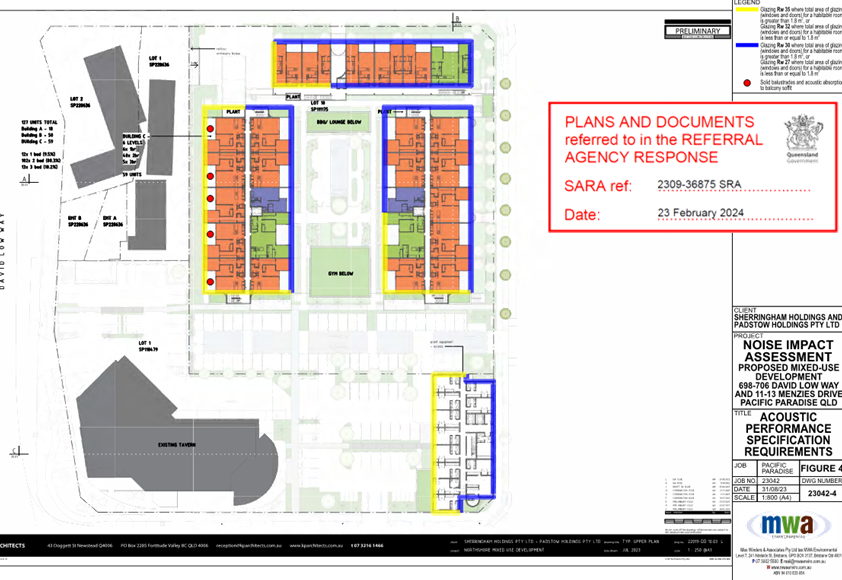
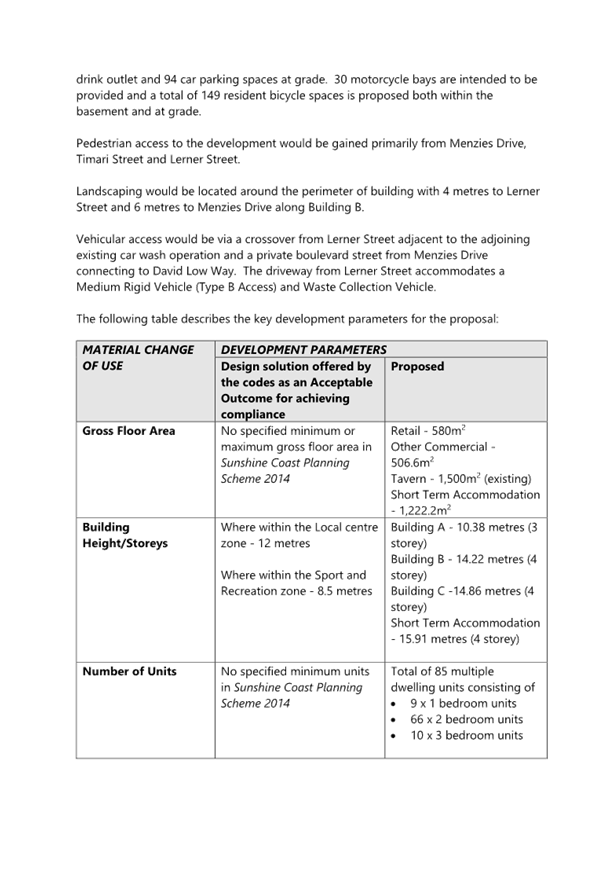
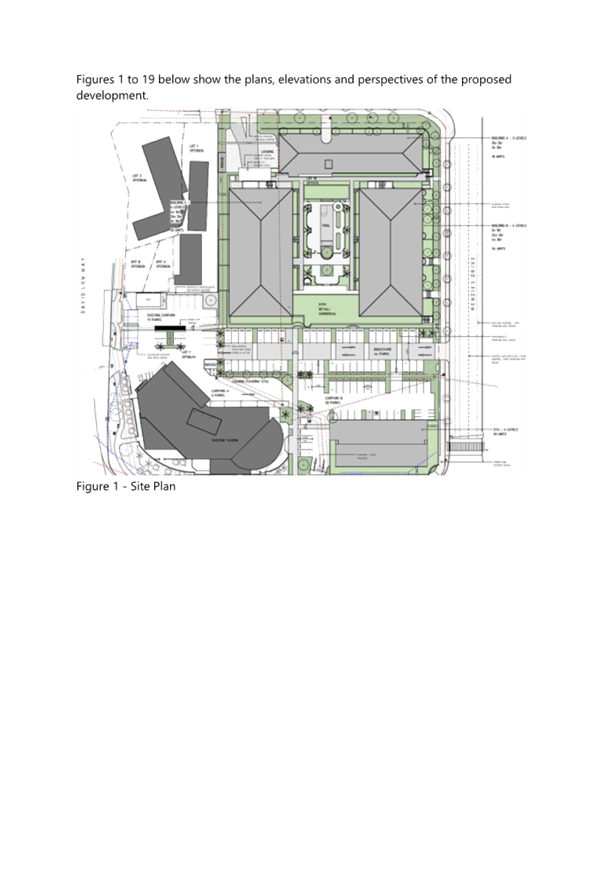
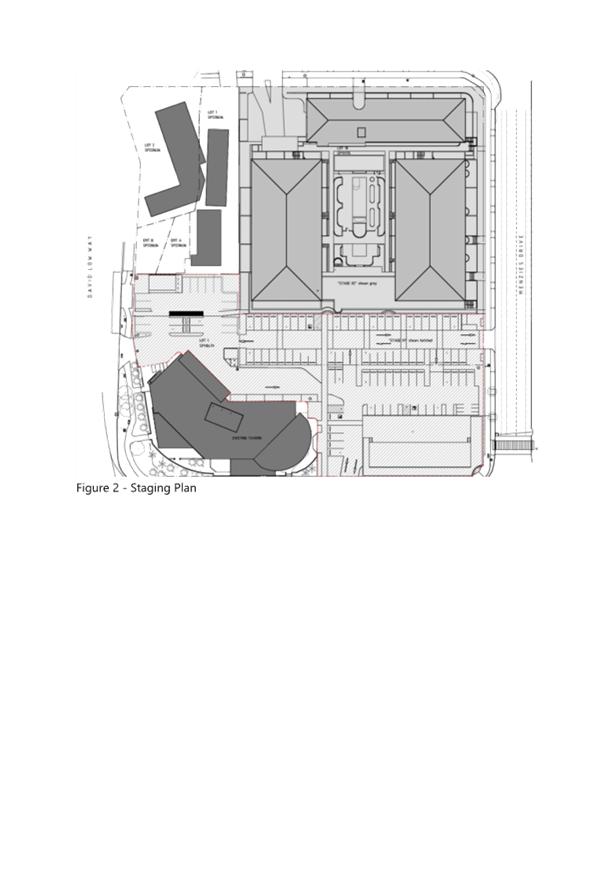
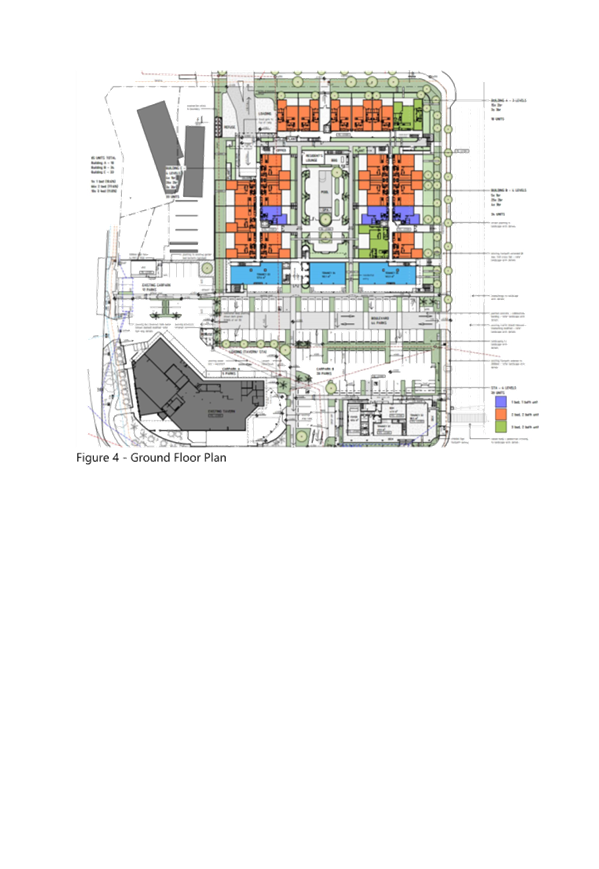
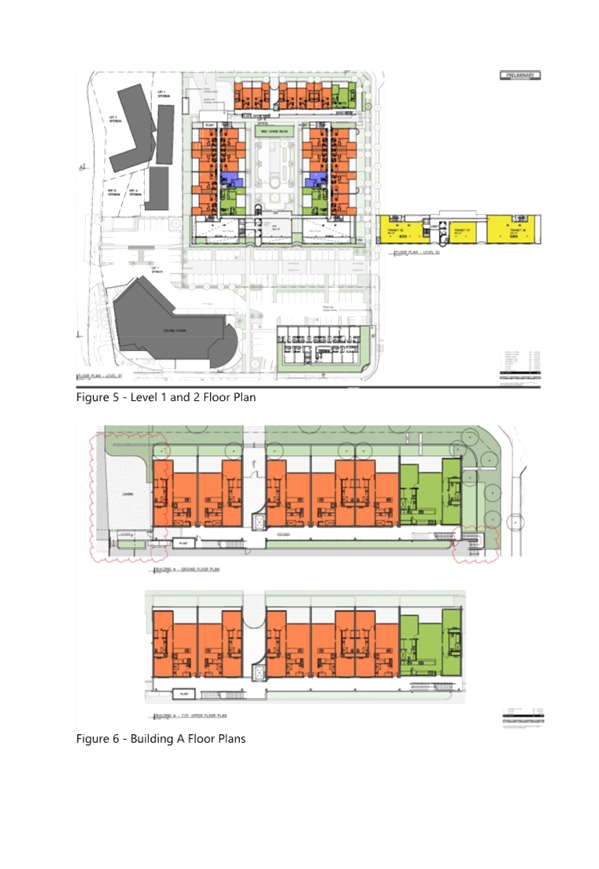
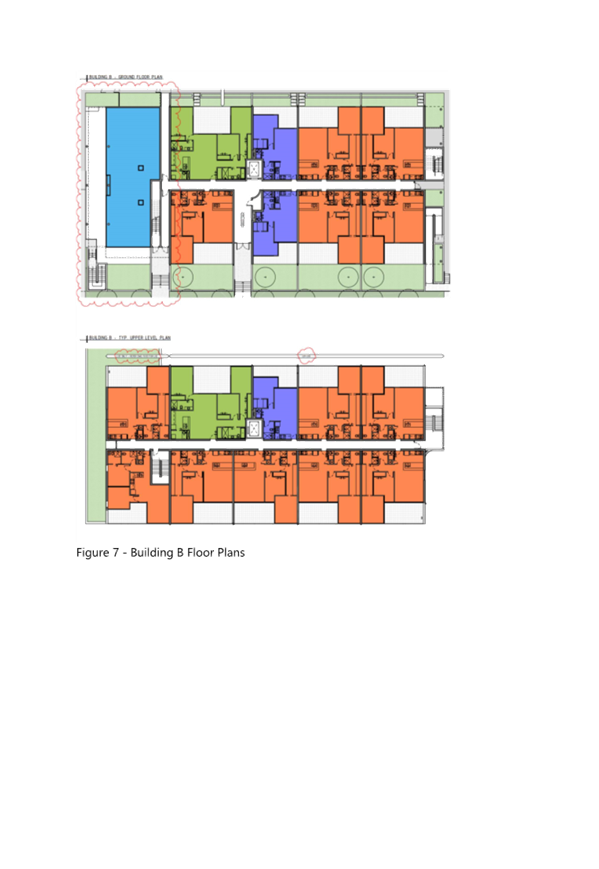
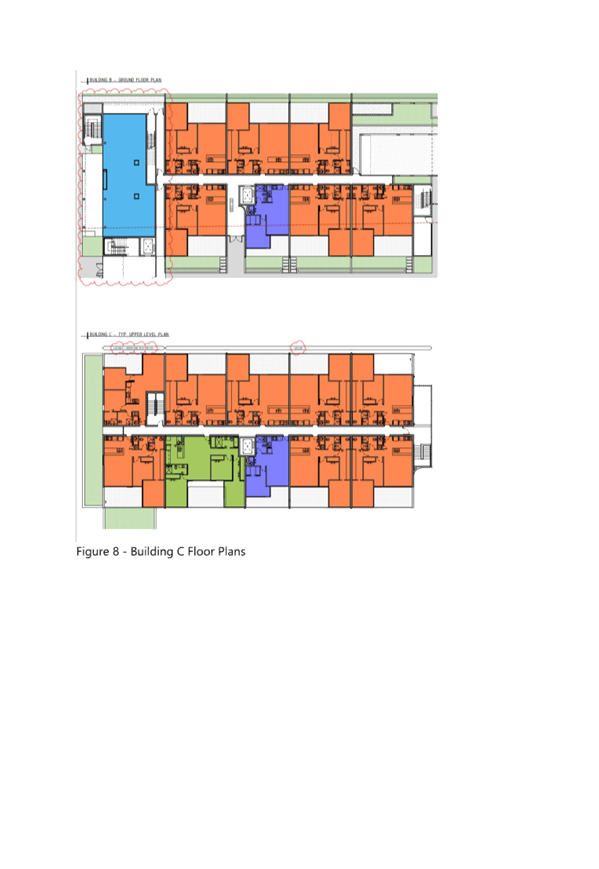
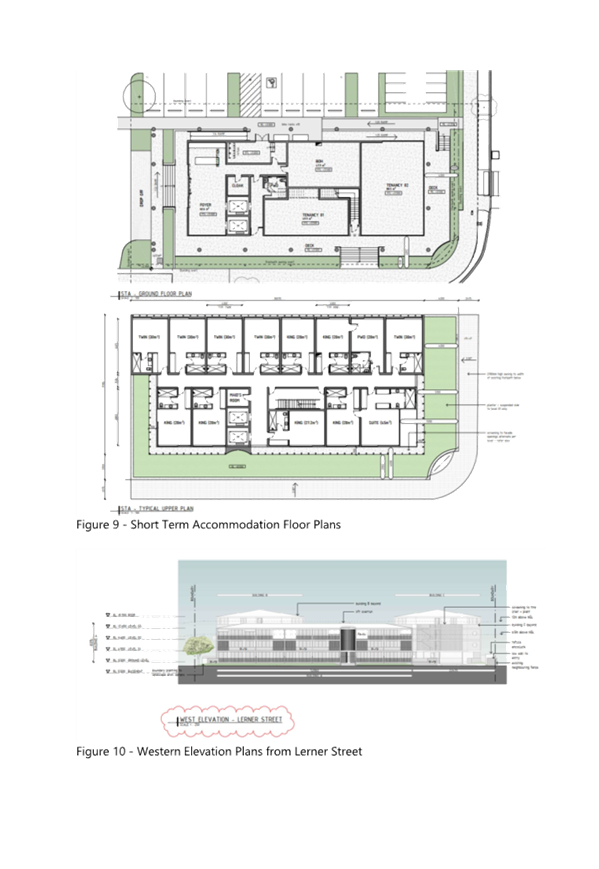
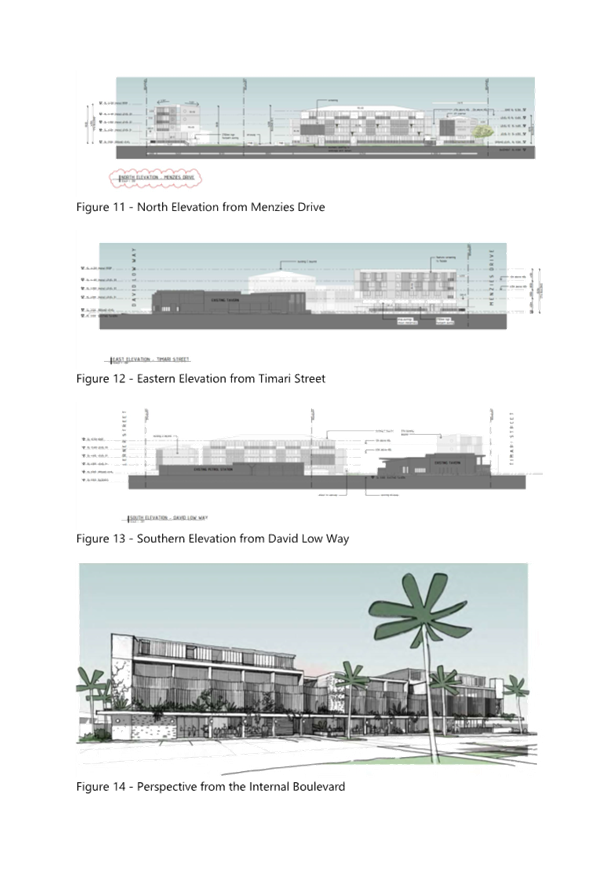
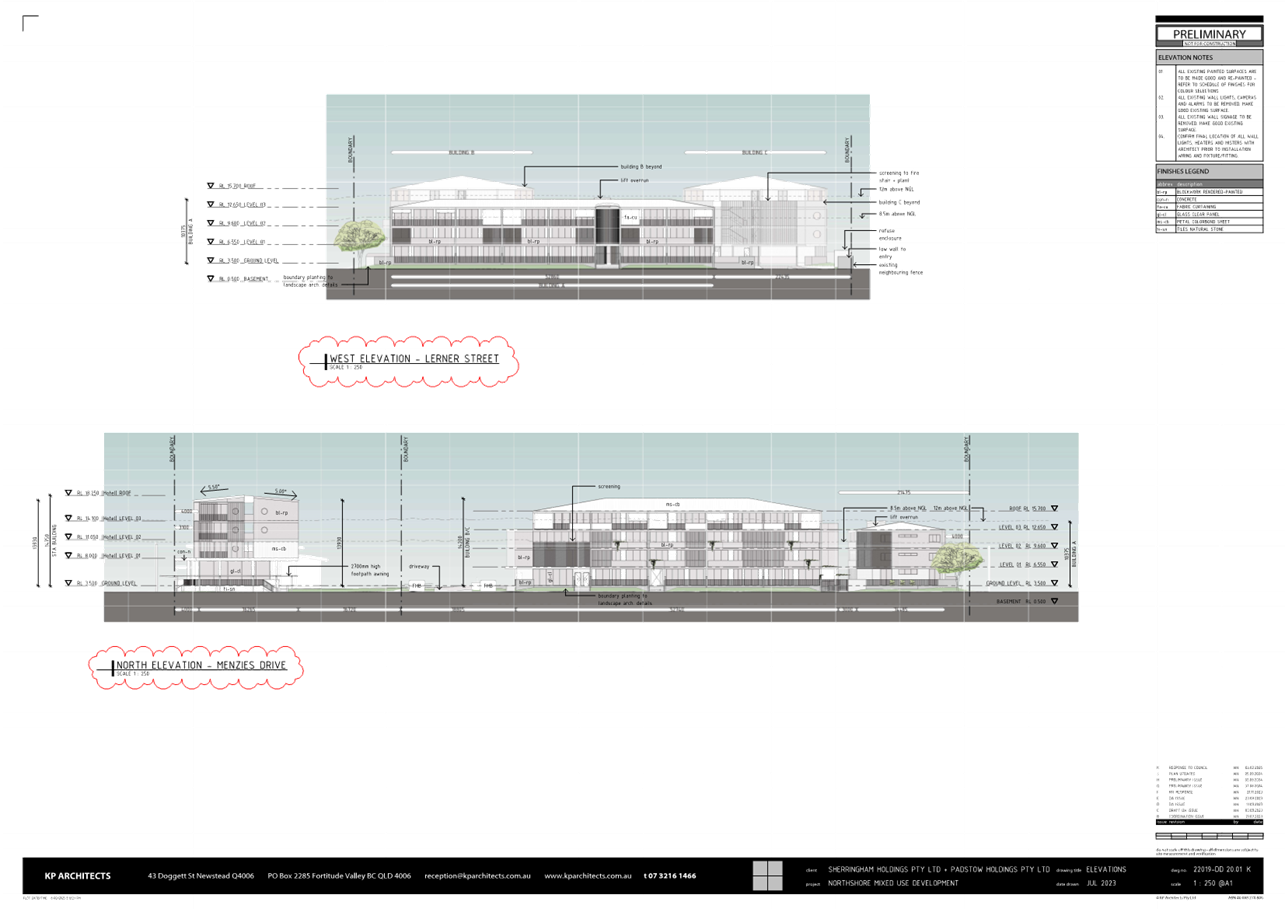
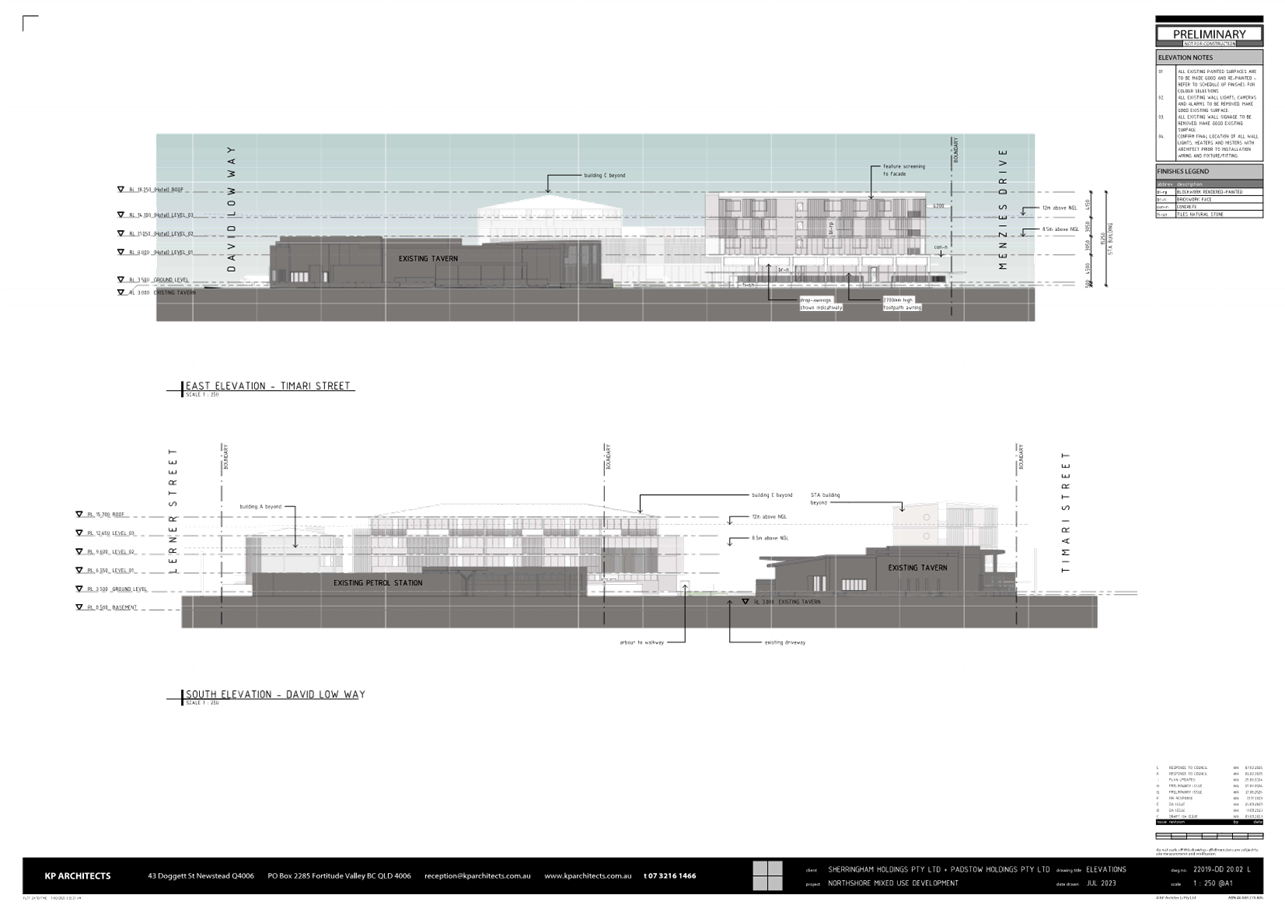
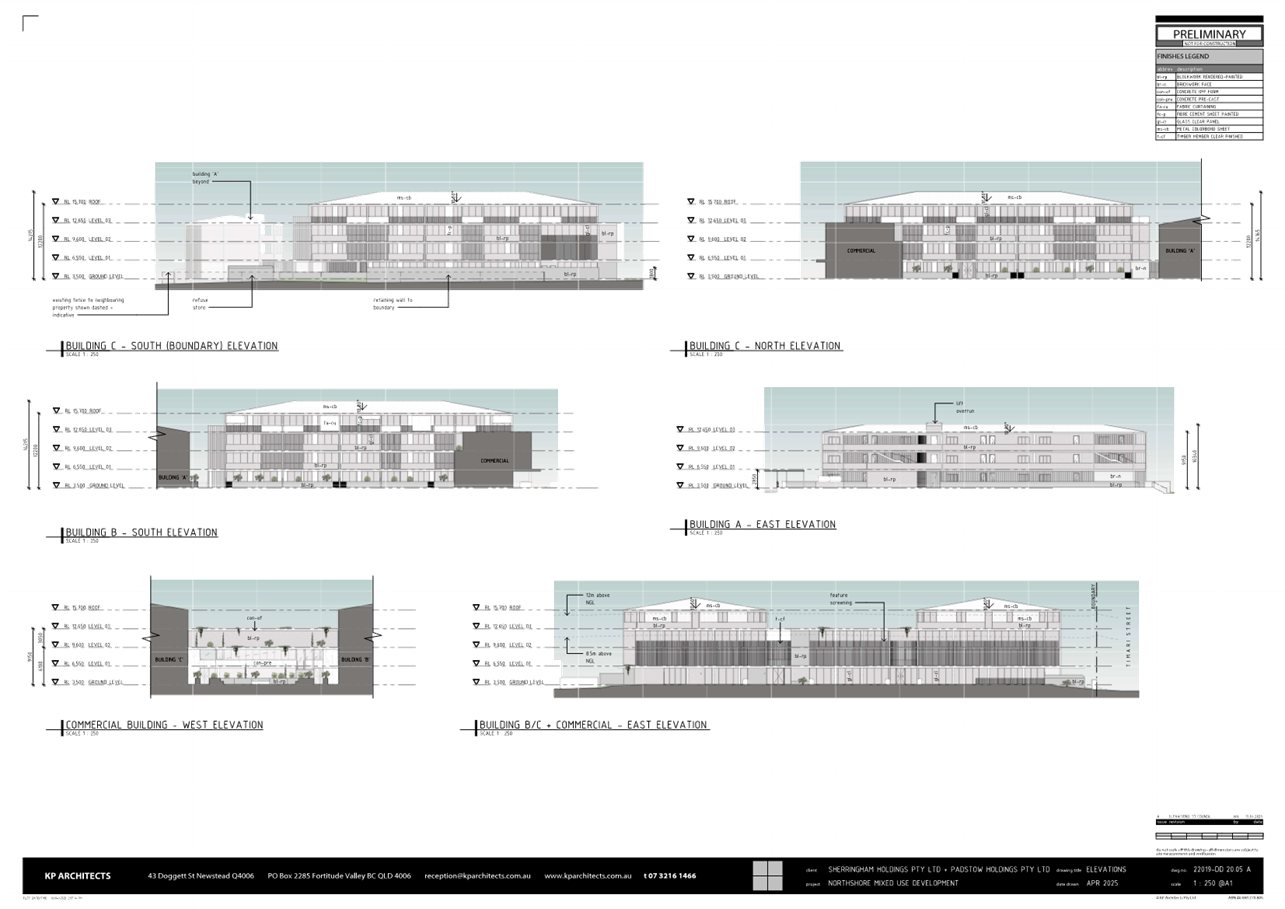
The development proposes four distinct buildings with their land uses and building heights proposed below.
· Building A with multiple dwelling units fronting Lerner Street - 10.38 metres (3 storey building)
· Building B with multiple dwelling units fronting Menzies Drive - 14.22 metres (4 storey building)
· Building C with multiple dwelling units located on the southern boundary fronting the car wash and service station -14.86 metres (4 storey building) and
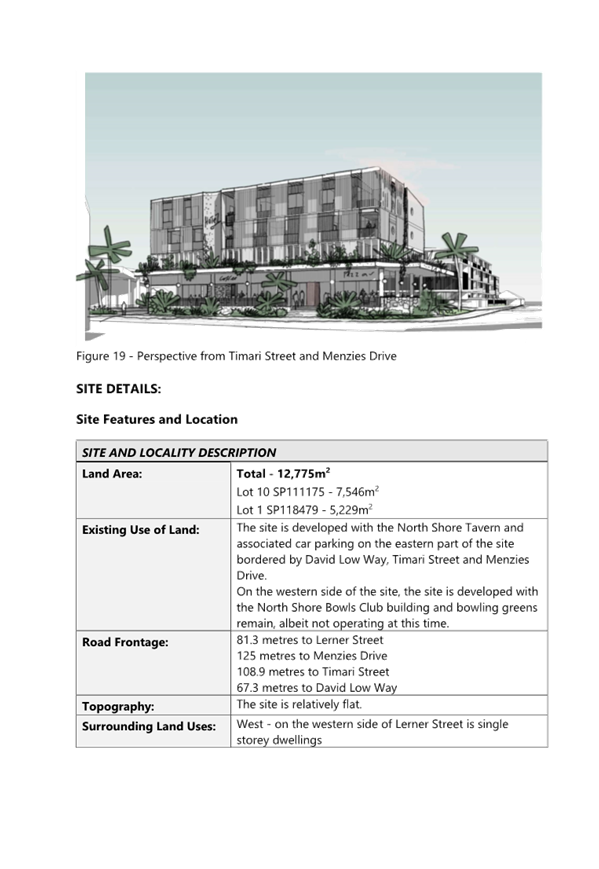
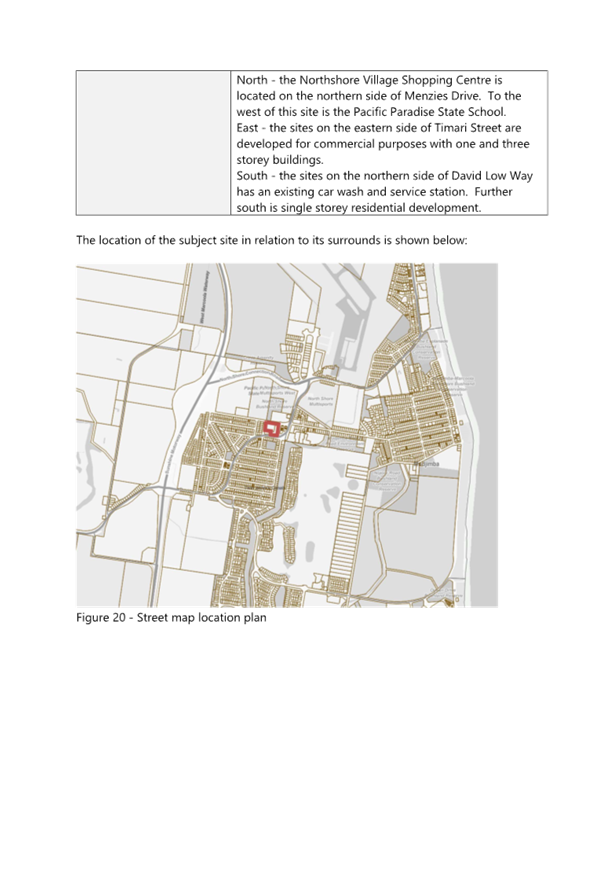
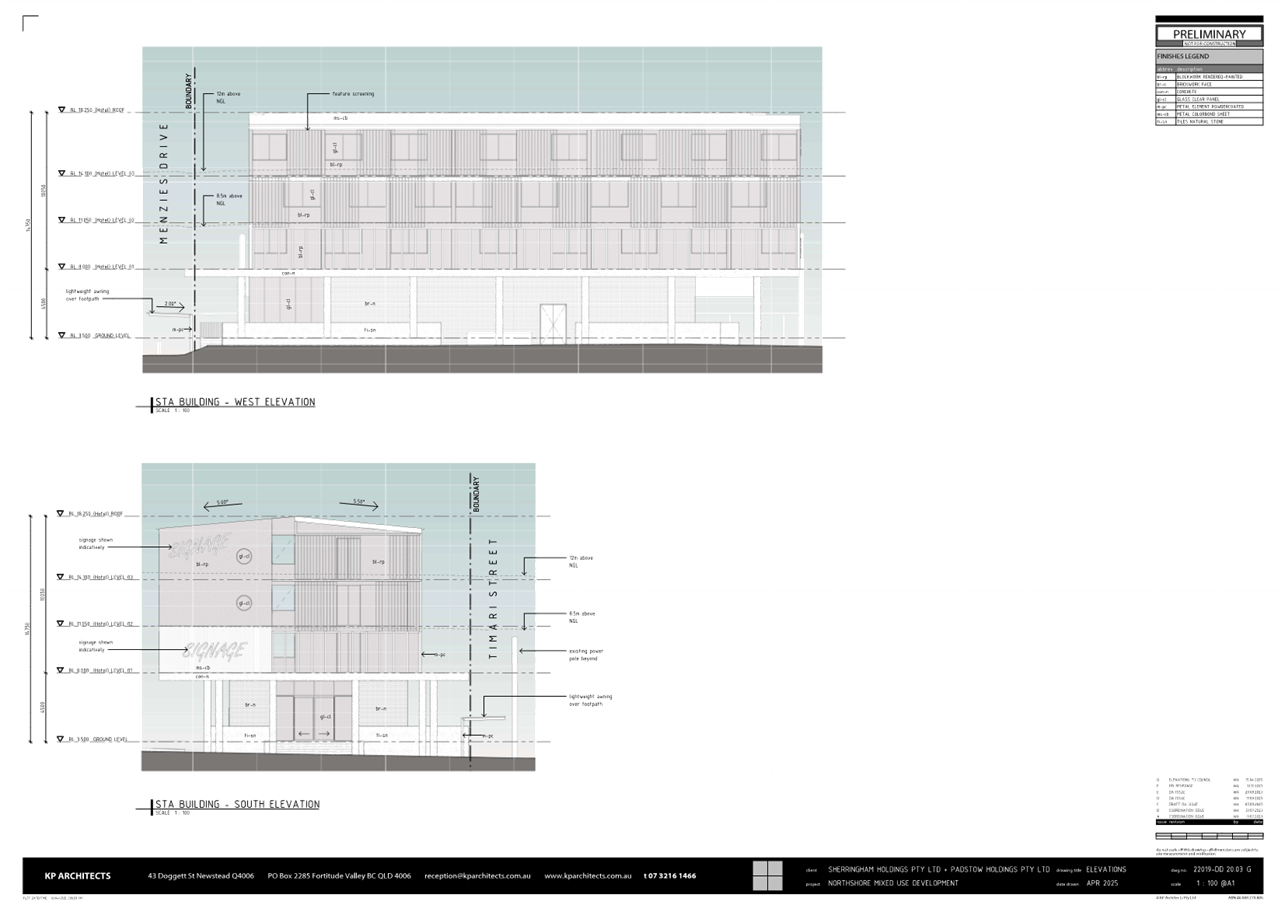
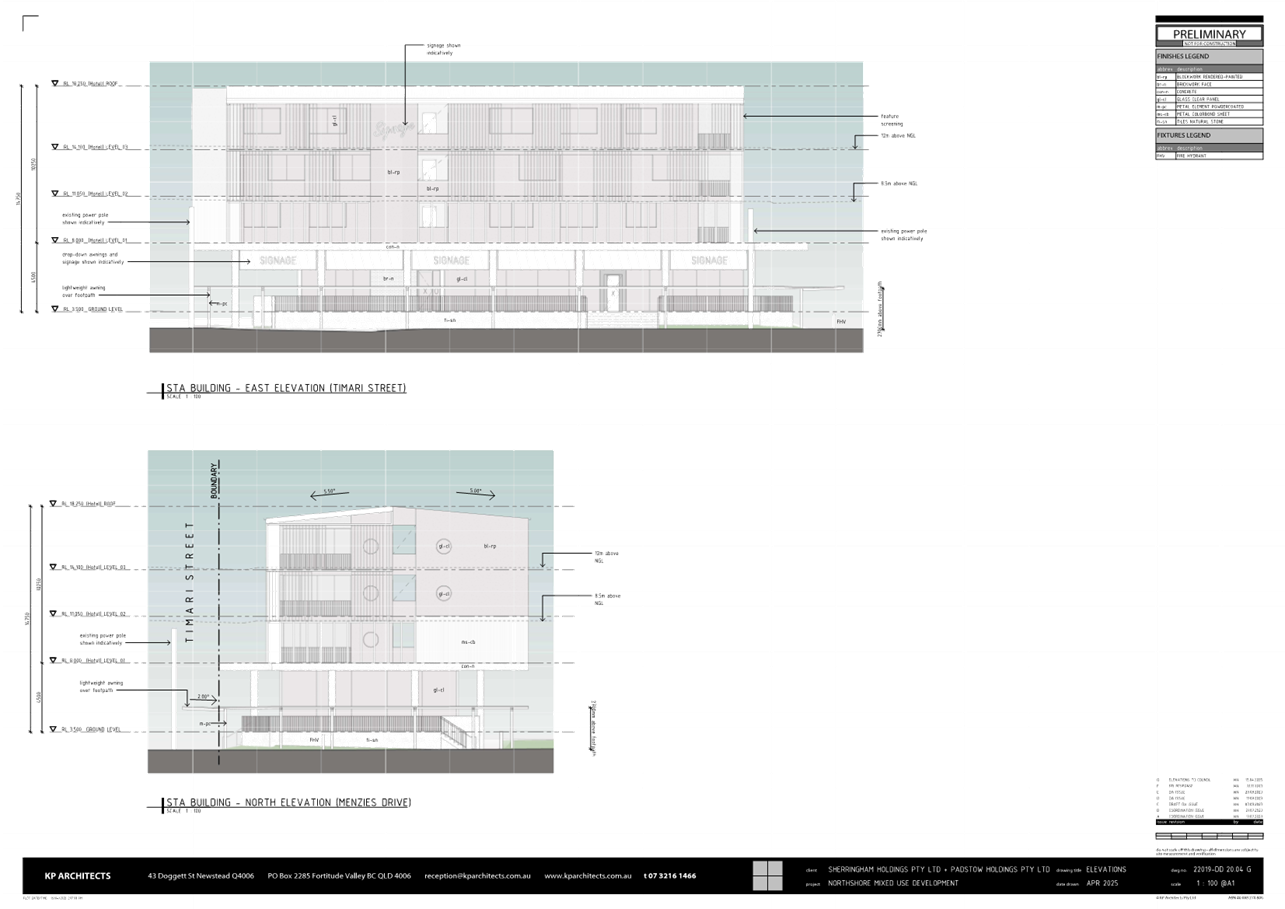
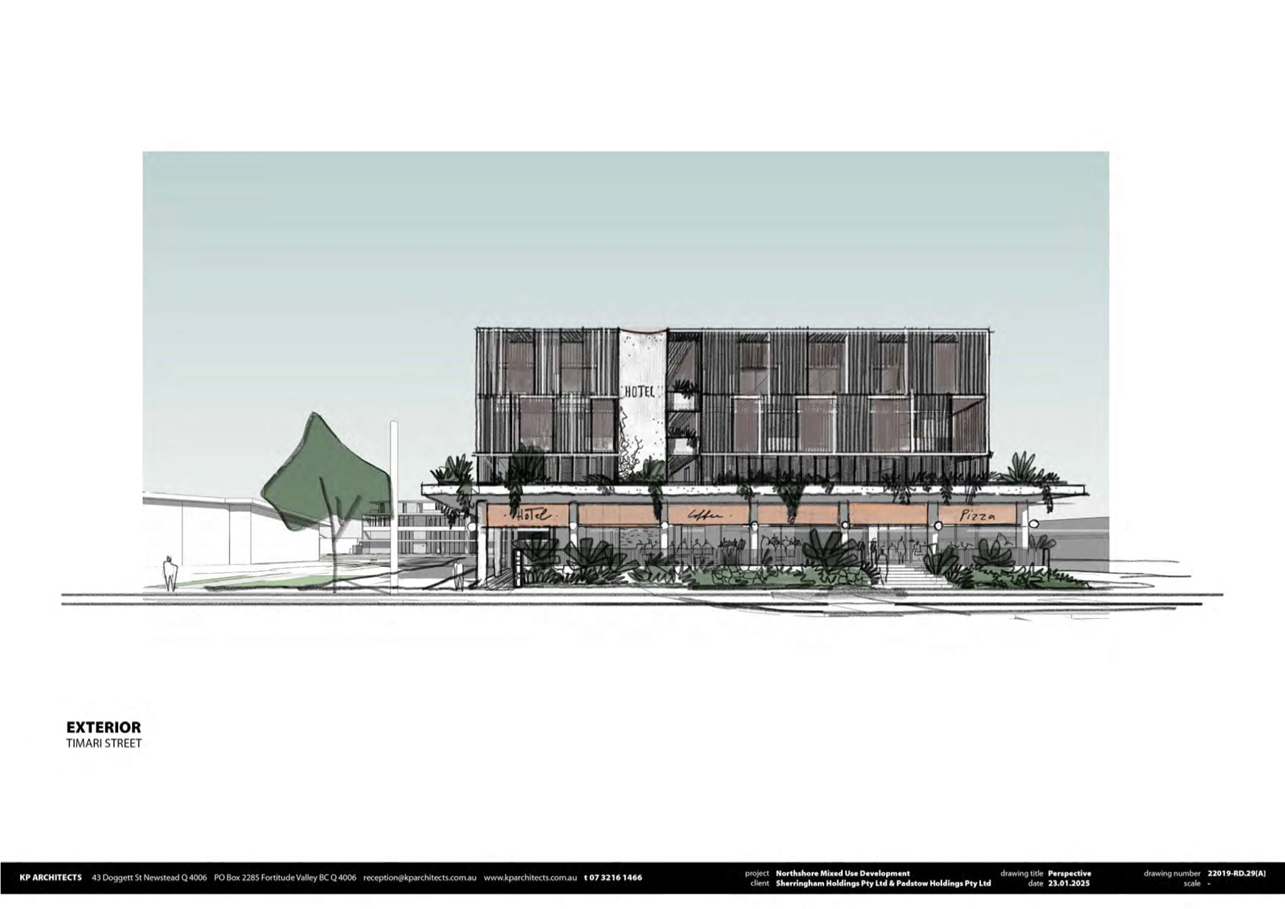
· Short Term Accommodation building with Food and drink outlet located fronting the corner of Menzies Drive and Timari Street - 15.91 metres (4 storey building).
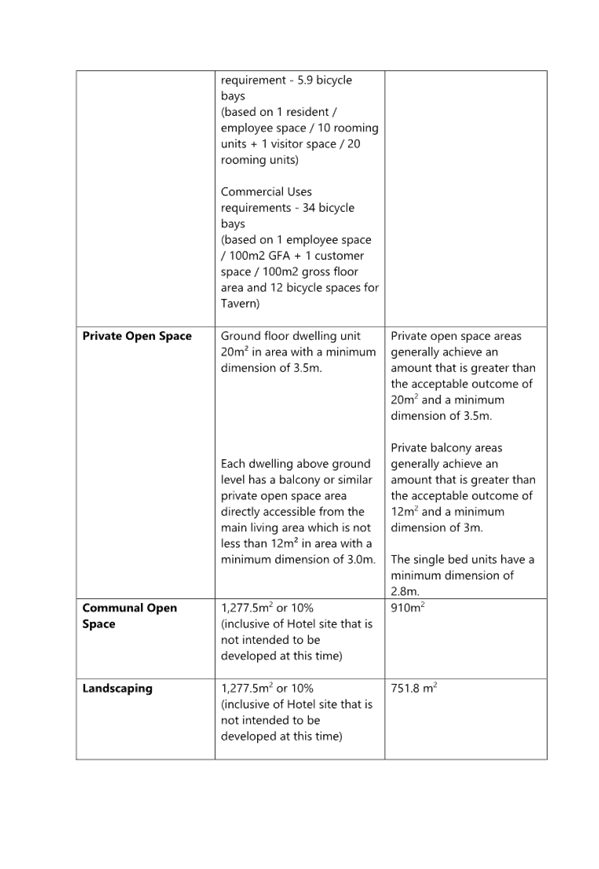
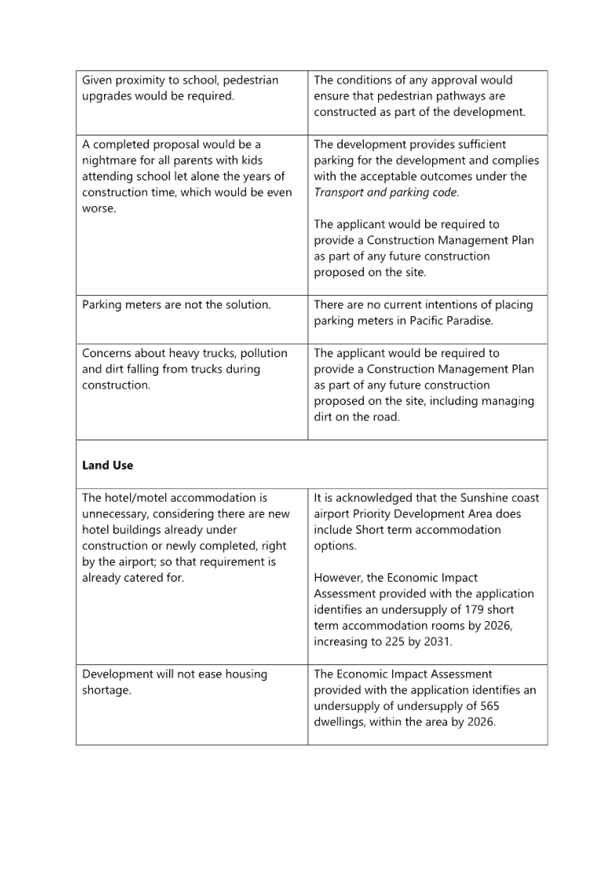
The development proposes a total of 1,086 m2 gross floor area of food and drink outlet, 39 short term accommodation units (all one-bedroom rooming units), 85 multiple dwelling units consisting of 9 x 1 bedroom units, 66 x 2 bedroom units and 10 x 3 bedroom units.
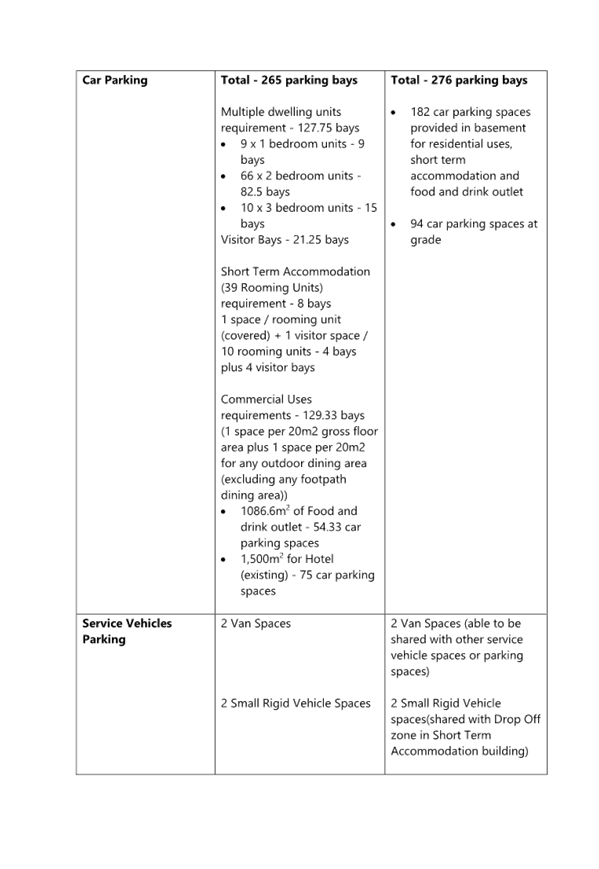
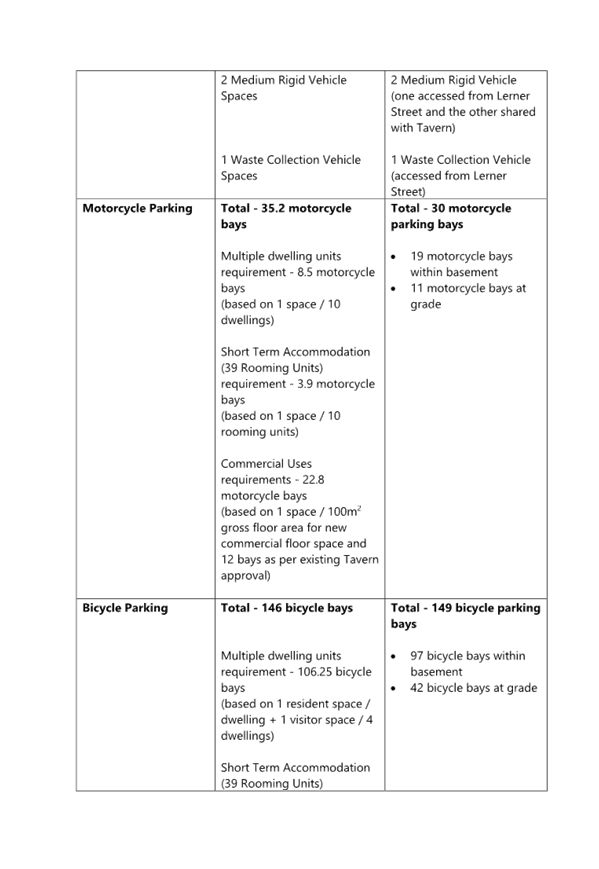
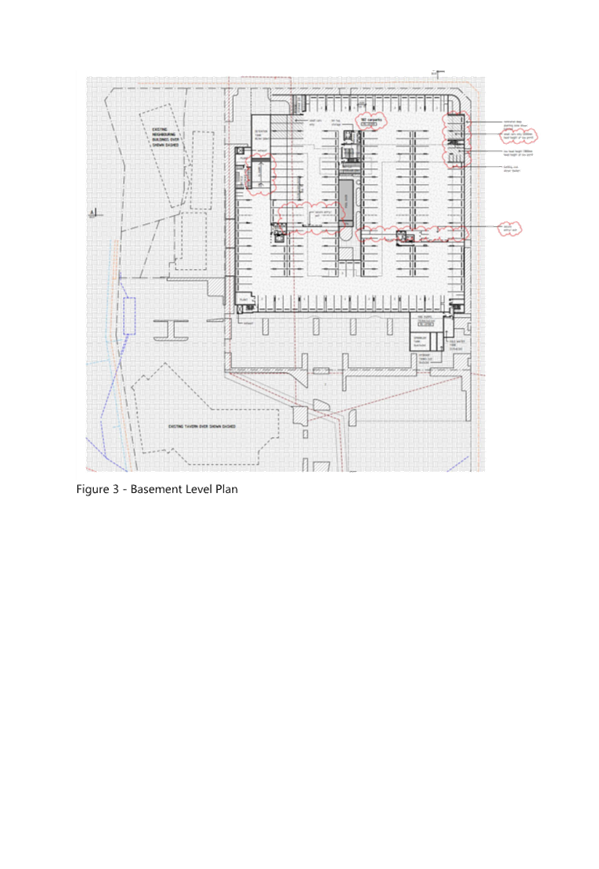
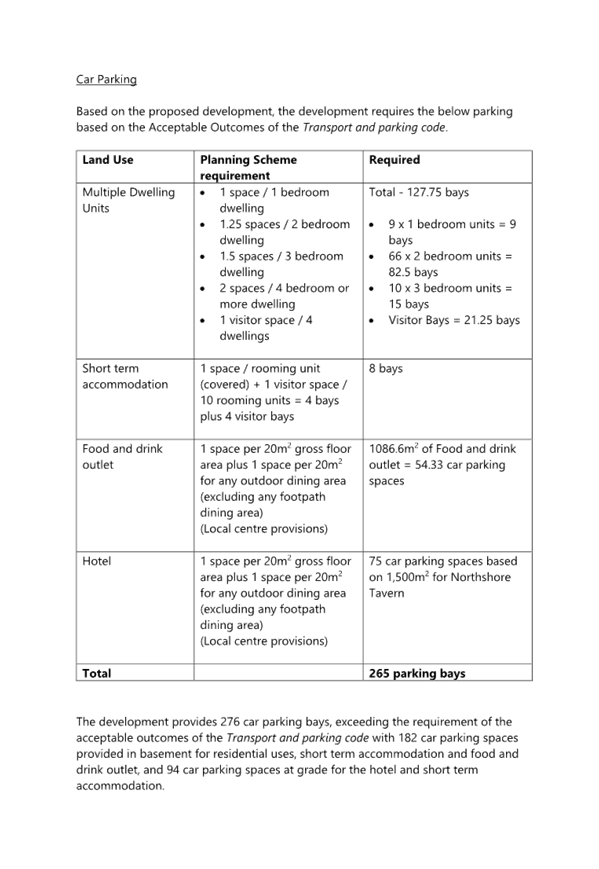
A total of 276 car parking spaces is proposed comprising of 182 car parking spaces provided in basement for residential uses, short term accommodation and food and drink outlet and 94 car parking spaces at grade. Furthermore, there are 30 motorcycle bays and 149 bicycle spaces proposed.
The application has been assessed against the Sunshine Coast Planning Scheme 2014 and the key assessment matters are discussed below.
Land Use
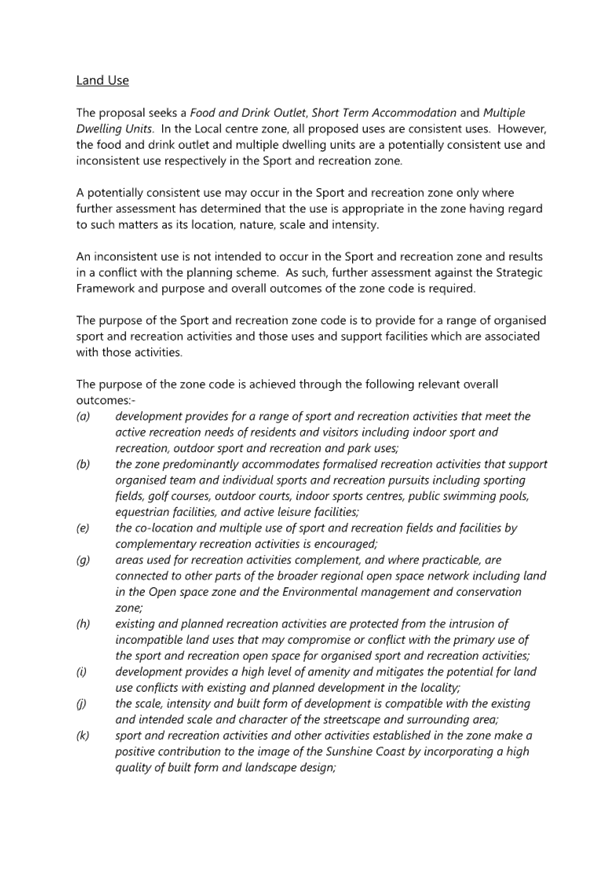
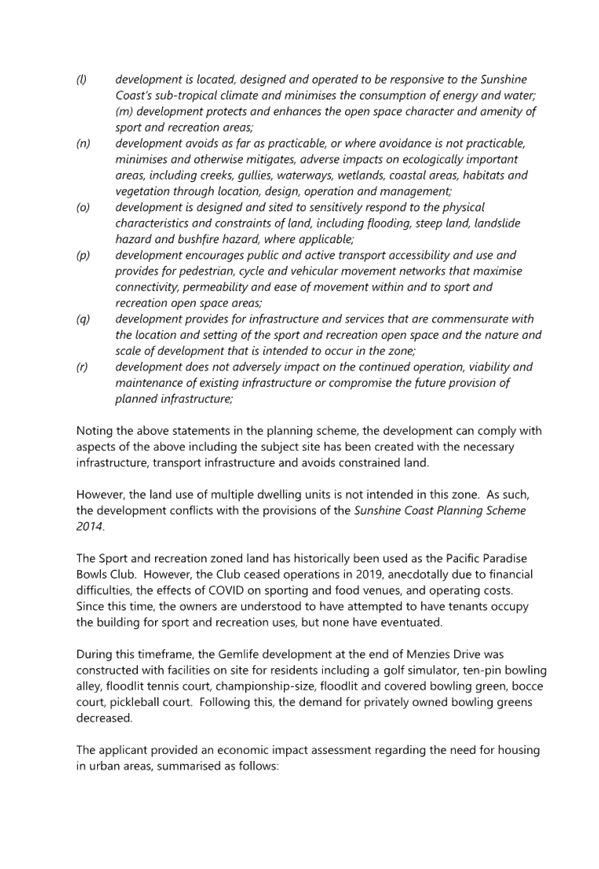
The proposal seeks a Food and Drink Outlet, Short Term Accommodation and Multiple Dwelling Units. In the Local centre zone, all proposed uses are consistent uses. However, the food and drink outlet and multiple dwelling units are a potentially consistent use and inconsistent use respectively in the Sport and recreation zone.
An inconsistent use is not intended to occur in the Sport and recreation zone and results in a conflict with the planning scheme. A potentially consistent use may occur in the Sport and recreation zone only where further assessment has determined that the use is appropriate in the zone having regard to such matters as its location, nature, scale and intensity.
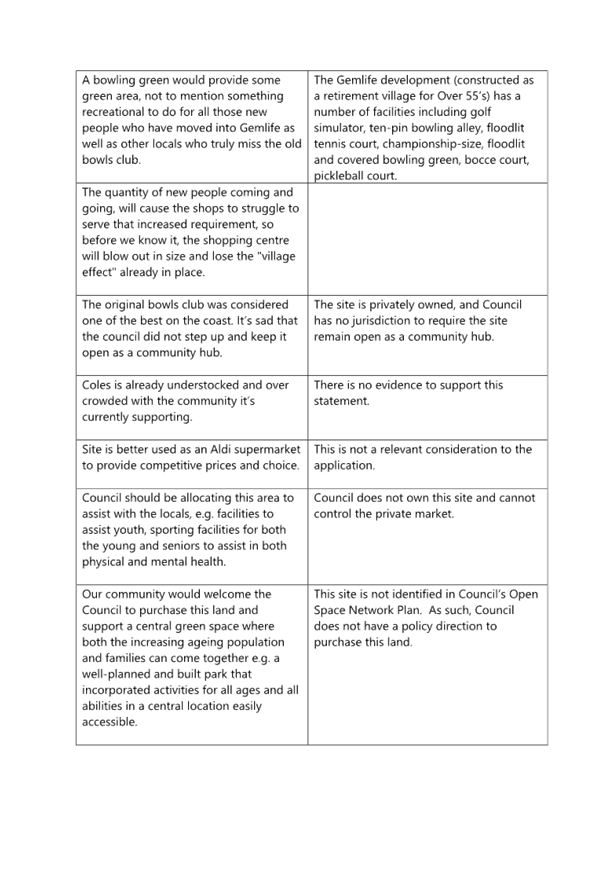
The applicant provided an economic impact assessment regarding the need for housing in urban areas where the report identifies an undersupply of 179 short term accommodation rooms by 2026, increasing to 225 by 2031, and an undersupply of 565 dwellings, within the defined catchment area (including Bli Bli, Twin Waters and Marcoola suburbs) by 2026. The site is ideally suited for increased housing supply with the proximity to local services, regional services, public transport and a state road network.
Building Heights
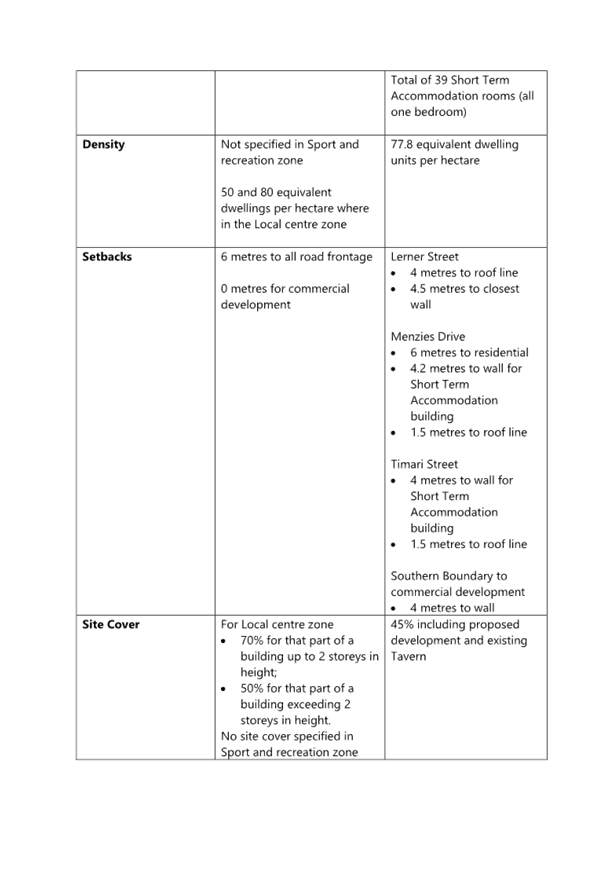
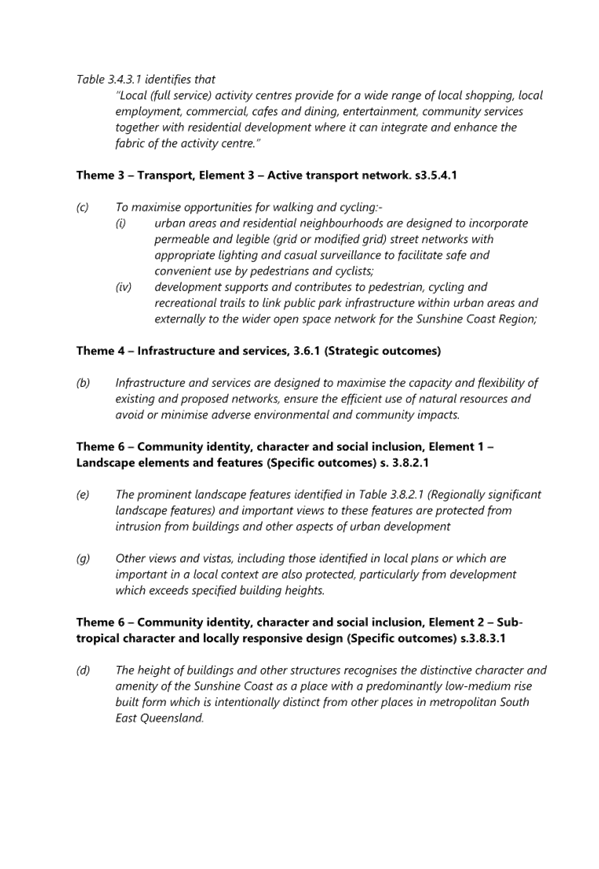
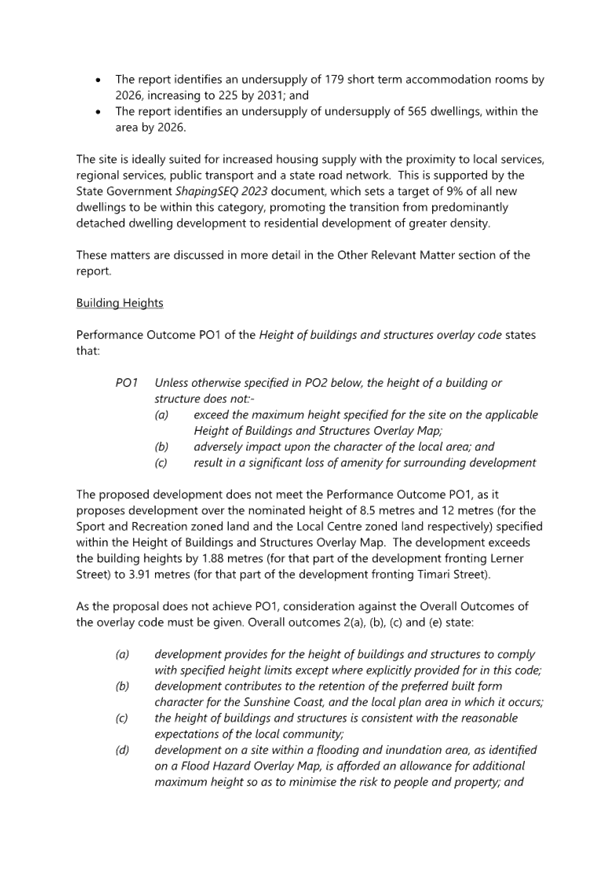
The proposed development does not meet Performance Outcome PO1 of the Height of buildings and structures overlay code, as it proposes development over the nominated height of 8.5 metres and 12 metres (for the Sport and recreation zoned land and the Local Centre zoned land respectively) specified within the Height of Buildings and Structures Overlay Map. The development exceeds the building heights by 1.88 metres (for that part of the development fronting Lerner Street) to 3.91 metres (for that part of the development fronting Timari Street).
As the proposal does not achieve PO1, consideration against the Overall Outcomes of the overlay code must be given considering building character and appearance of the Maroochy North Shore local plan code, reasonable expectations of the community, amenity impacts considering overshadowing and privacy impact, impacts upon views and building massing and scale relative to its surroundings.
Building Character and Appearance
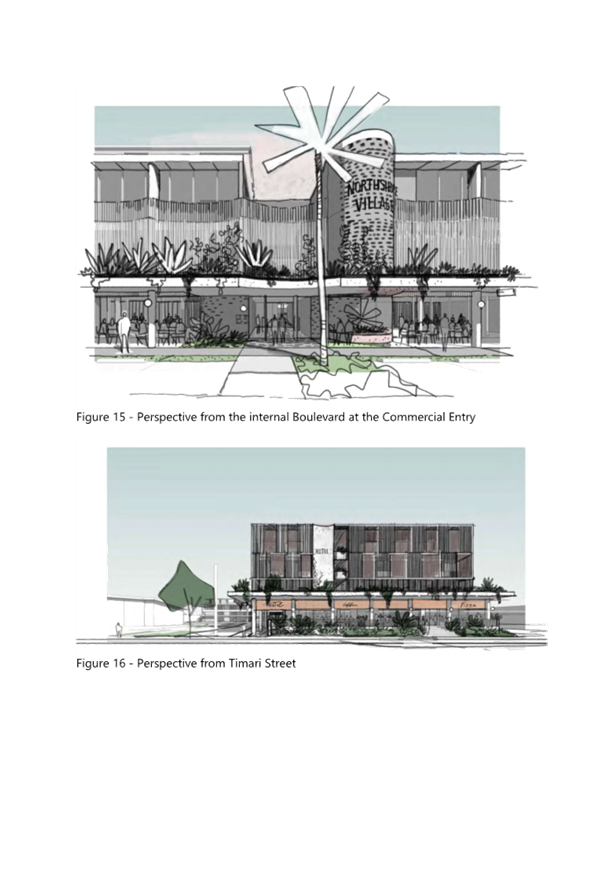
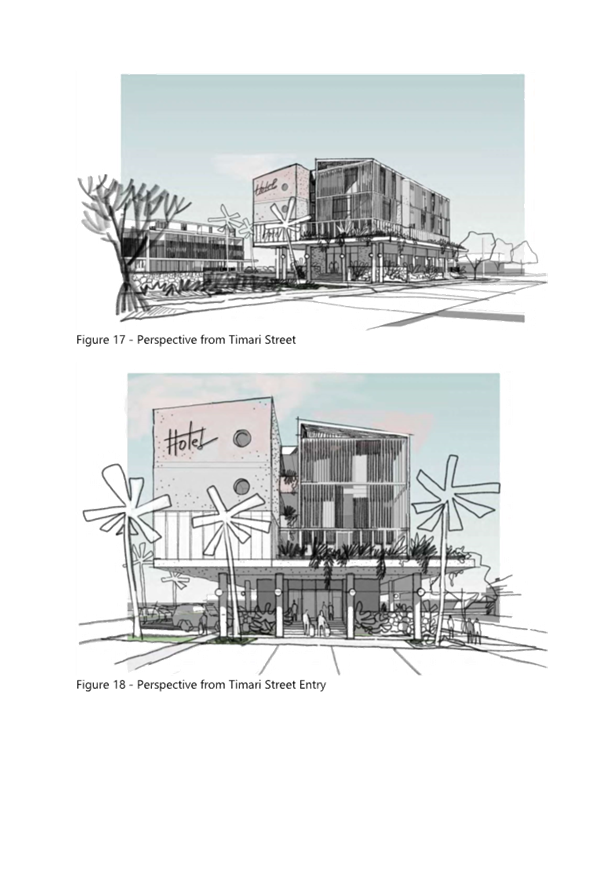
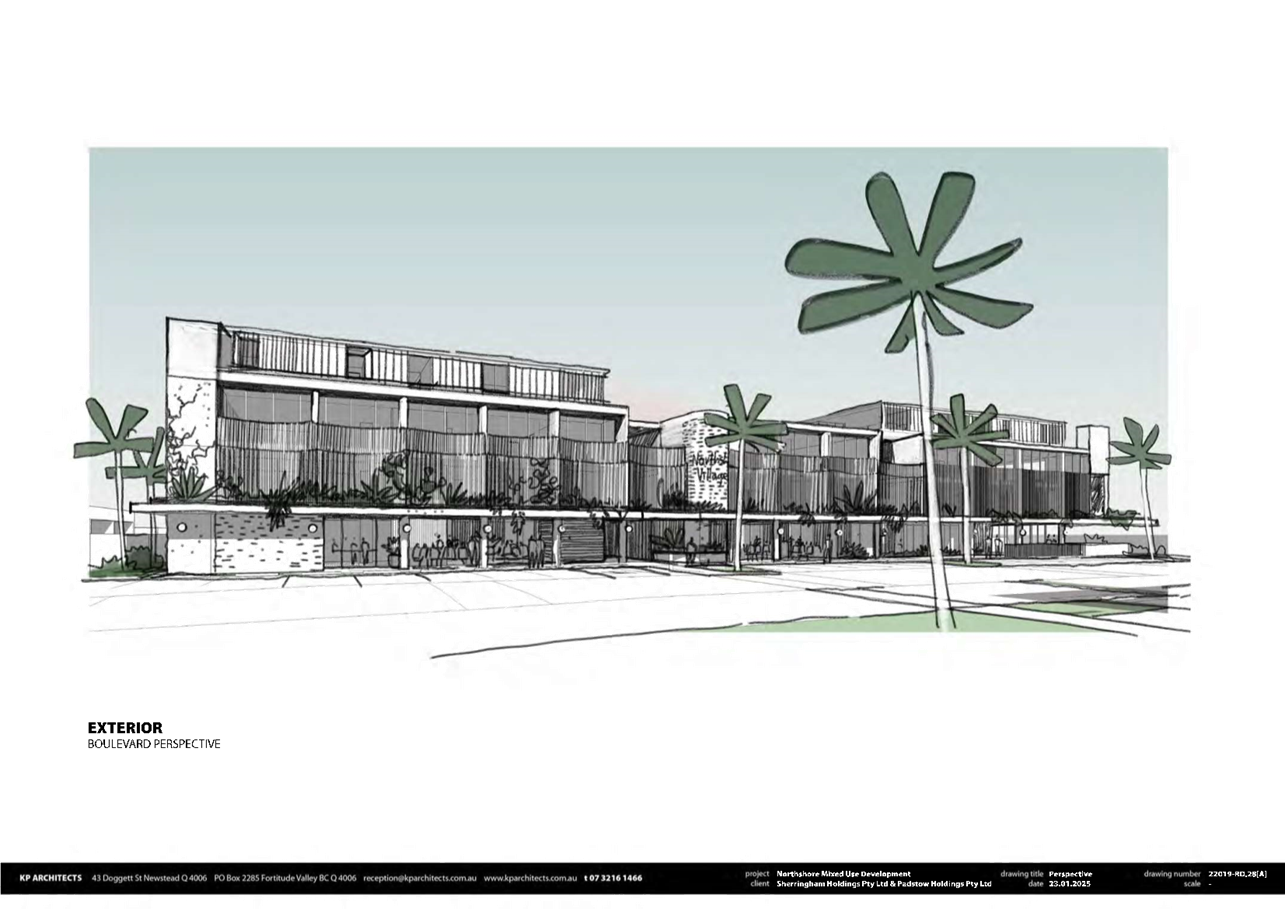
Considering the statements in the Strategic Framework and the Maroochy North Shore local plan code, the site overlooks a low-density residential area opposite Lerner Street to the west. The height of the built form here is 10.38m, rather than 8.5m and presents as three storeys rather than two storeys. However, the residential component presents as domestic in style, with pitched roof forms sloped away from Lerner Street and a predominance of attractive materials and detailing, transparent glazing and balconies that overlook the street. The design is high quality and well considered, with a lightness in built form due to predominance of openings and balconies to frontages. The legible pitched roof anchors the building and reads as a residential built form, such that it doesn’t read as an imposing tower. The presentation avoids parapet walls and a flat roof which would be less domestic in appearance and would increase the perception of mass and bulk. A generous landscape frontage and a 4m setback is achieved facing Lerner Street.
Building B and C are a level higher in height, however these buildings are centrally located on the site, away from the low-density area of Lerner St. These buildings are mixed use, with retail at the western end, and provide a connection between the Residential locality and the more commercial attributes of the Local centre zone. From the south, the built form does not have detrimental impact to the service station site. The transition from three to four storeys across the site achieves a gradation of height increase from toward the Local centre zone.
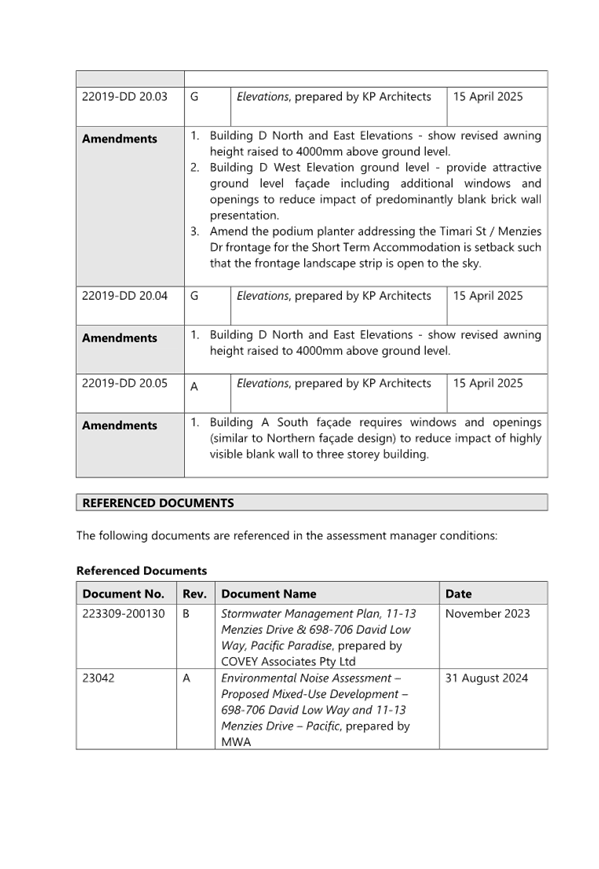
Improvements do need to be made to the blank wall presentation of Building A South façade. The North façade presents with additional windows, which break up the blank wall façade and soften the built form. The same, or similar, window and openings designs should be provided to the southern façade of this building, which is highly visible from Lerner Street and David Low Way. As a result, the proposed conditions require:
· improvements to the blank wall presentation of Building A South façade;
· awning height being raised to approximately 4 metres above ground, to improve appearance and outlook; and
· additional windows (akin to that provided on the Northern façade of the building) to the south façade of Building A to reduce the impact of the highly visible blank wall to the three storey building.
The short-term accommodation building provides connectivity, interest and activation to the site and the street frontage and presents as a well-designed building, except for the west façade which does not achieve this connectivity as the ground level presents as a blank wall. This must be addressed, with the addition of windows and openings, or other elements, to the western façade of the Short Term Accommodation Building to enhance the visual appearance of this wall.
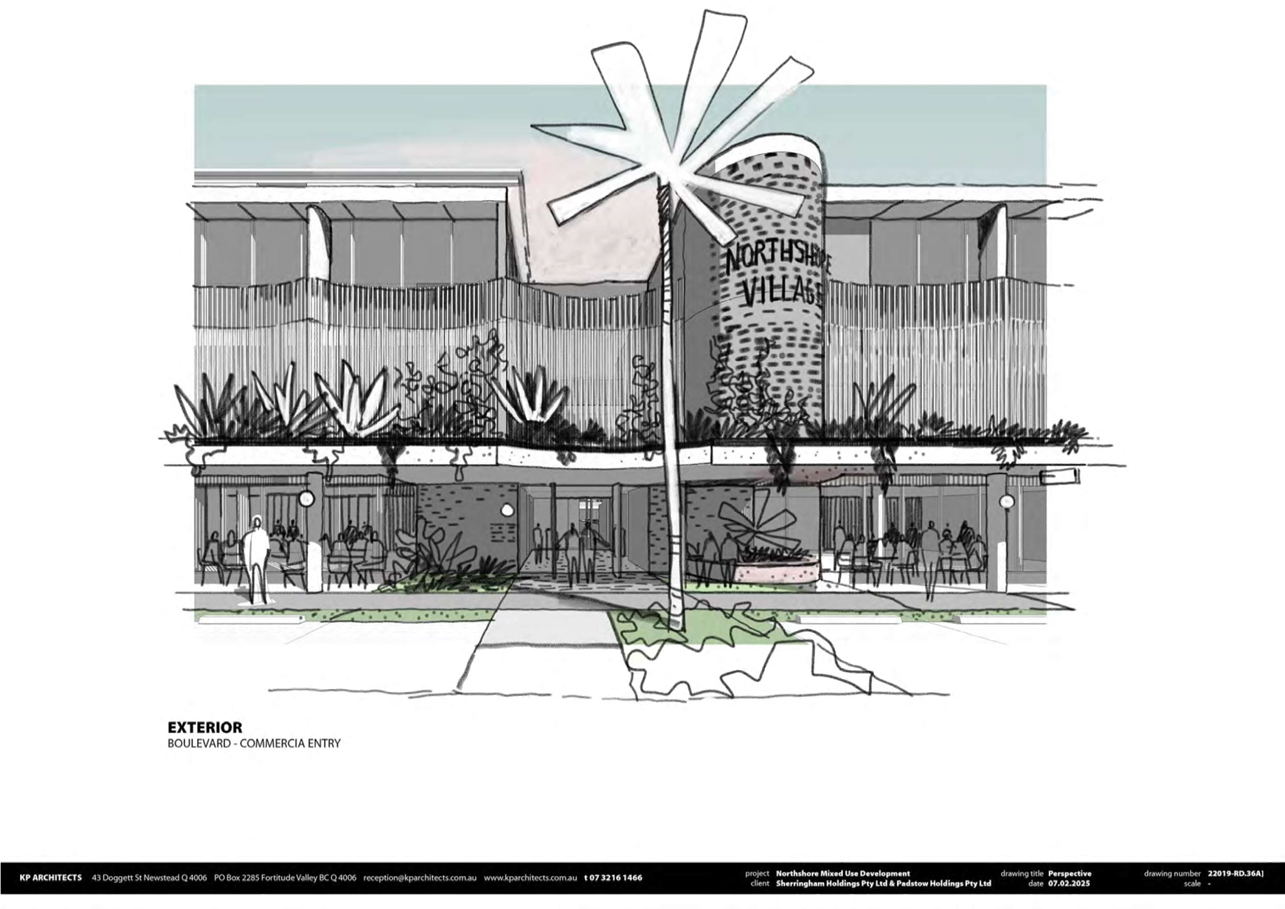
Overall, landscaping is integrated throughout the development and is integrated into the design on podium and roof areas as well as at ground level. The mixed-use development is well considered from an architectural and urban design perspective, enhancing the activation of the Local centre zone, whilst also responding to the adjacent residential areas.
Reasonable Expectations of the Community
The proposal exceeds the nominated building heights in the Height of buildings and structures overlay code. Further, Council is preparing a new planning scheme that will replace the current Sunshine Coast Planning Scheme 2014, where the ‘proposed planning directions’ for the North Shore Local Plan Area, that were released for public consultation in 2022, includes two key directions for the Pacific Paradise Area being no or minimal change in maximum allowable building heights and to extend the Local centre zone at Pacific Paradise to include the former bowls club site to provide opportunity for the centre to expand.
A total of 69 submissions were received with 44 (or 64%) objecting to the proposal including a concern regarding the proposed height of the development. In considering the reasonable expectations of the community in the context of the current Sunshine Coast Planning Scheme 2014, the public consultation ‘proposed planning directions’ for the proposed new Planning Scheme and the community submissions, it is considered that the proposed development may not be consistent with the reasonable expectations of the local community and is therefore in conflict with the overall outcomes of the Height of buildings and structures overlay code.
Amenity Impacts - Overshadowing and Privacy
Regarding overshadowing, the most prominent shadows cast by the proposed development are to Lerner Street to the West in the morning and to Timari Street to the East in the evening. In reviewing Council's 3D modelling, it shows that the surrounding properties are not affected by shadows cast by the proposed building during the period between 8.00am and 2:50pm and therefore it is considered that the impact of shadows is not unreasonable.
In regard to privacy and overlooking, the distance from the development to neighbouring properties minimises overlooking impacts. In addition, the site is bordered by public roads and has commercial development to both Timari Street and Menzies Drive, meaning that any privacy concerns are further reduced along these frontages. Facing west towards Lerner Street, there are some residential properties that are single storey and have low scale fencing. The road reserve is 25 metres wide, and this distance minimises the opportunity for direct overlooking.
Visual Impacts – Building and Massing relative to its surroundings
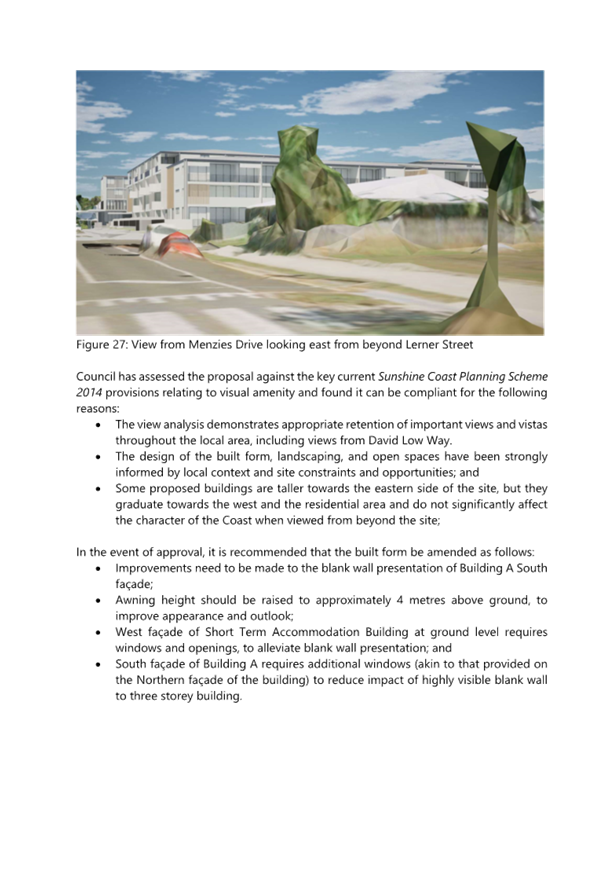
The Coolum local plan code identifies ‘significant views’ and new development is to protect and not intrude upon views to and from these features. These include Mount Coolum National Park viewing south towards the subject land. Council found that any views of the development would be negligible from Mt Coolum, North Shore Connection Road ramp and beyond the site. Largely, any views are internalised within Pacific Paradise.
Council has assessed the proposal against the key current Sunshine Coast Planning Scheme 2014 provisions relating to visual amenity and found it can be conditioned to be compliant. In the event of approval, it is recommended that the built form be amended to include more windows on certain elevations to improve the visual appearance of the building.
In summary, the development has been designed to be responsive to its local setting and in the event of approval, it is recommended that the built form be amended as summarised in this report and further details in the Attachment 1 Detailed Officers Report.
Other Relevant Matters
The development conflicts with the Sunshine Coast Planning Scheme 2014 given that the proposed development:
· does not comply with the Height of buildings and structure overlay code as the height of buildings exceeds the specified height limit for the sites and could be considered to not meet the reasonable expectations of the local community; and
· the multiple dwelling units are inconsistent in the Sport and recreation zone.
These matters could be considered to be a departure from the planning scheme, the Planning Act 2016 requires consideration of whether there are other relevant matters for consideration which warrant an approval or refusal of the application. While this “other relevant matters” test is still developing, the Planning and Environment Court have accepted the below matters with some frequency:
· planning, economic and community need;
· the absence of any unacceptable impacts, and
· whether conditions could be imposed to address areas of non-compliance.
The applicant has provided information regarding Housing Supply and Demand, Sunshine Coast Character and Built Form Design, Leverages Existing and Planned Infrastructure, Adopting Stakeholder and Community Feedback and Stakeholder Support.
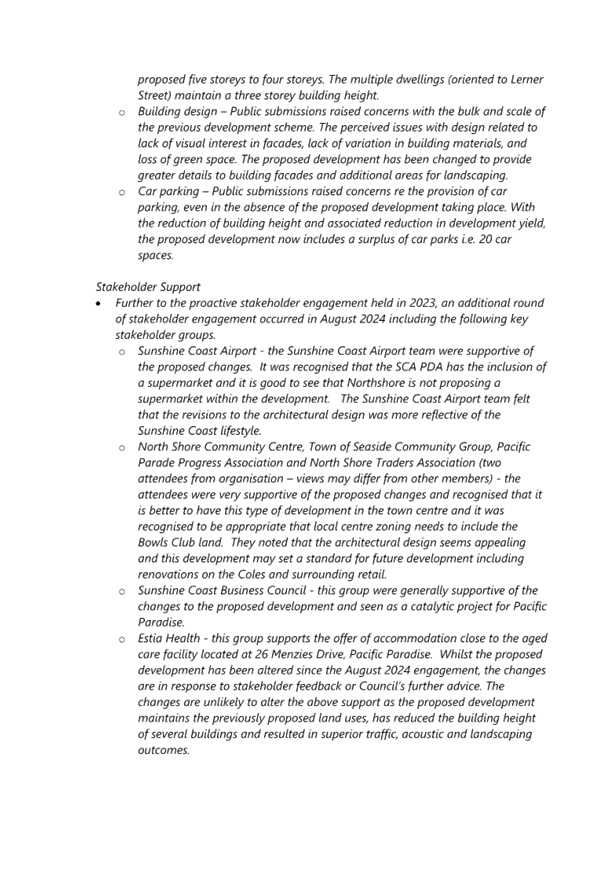
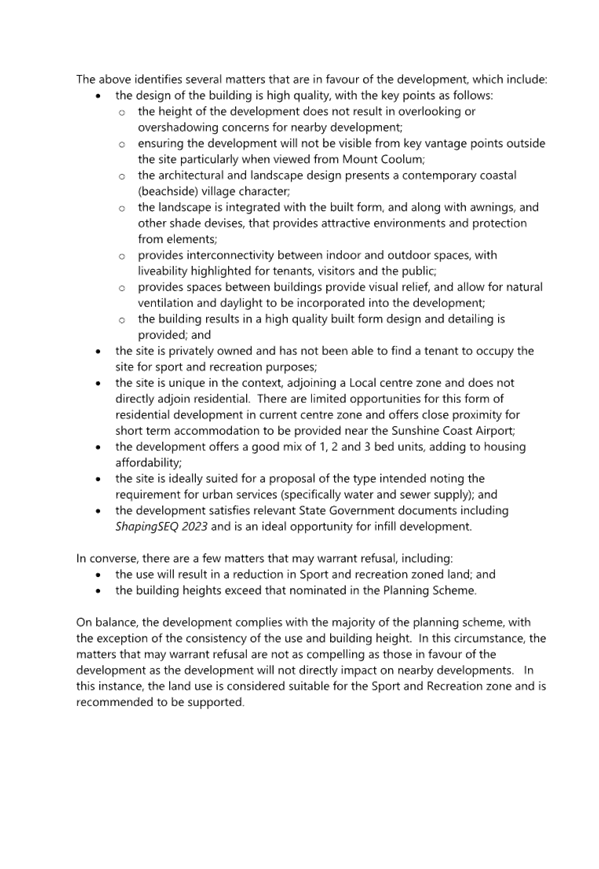
There are several matters that are in favour of the development, which include:
· The design of the building is high quality, with the key points as follows:
o the height of the development does not result in overlooking or overshadowing impacts for nearby development;
o ensuring the development will not be visible from key vantage points outside the site particularly when viewed from Mount Coolum;
o the architectural and landscape design presents a contemporary coastal (beachside) village character;
o the landscape is integrated with the built form, and along with awnings, and other shade devises, that provides attractive environments and protection from elements;
o provides interconnectivity between indoor and outdoor spaces, with liveability highlighted for tenants, visitors and the public;
o provides spaces between buildings provide visual relief, and allow for natural ventilation and daylight to be incorporated into the development;
o the building results in a high-quality built form design and detailing is provided;
· the site is privately owned and has not been able to find a tenant to occupy the site for sport and recreation purposes;
· the site is unique in the context, adjoining a Local centre zone and does not directly adjoin residential development. There are limited opportunities for this form of residential development in the current centre zone and the short term accommodation is located in close proximity to the Sunshine Coast Airport;
· the development offers a good mix of 1, 2 and 3 bed units, adding to housing affordability;
· the site is ideally suited for a proposal of the type intended noting the requirement for urban services (specifically water and sewer supply); and
· the development satisfies relevant State Government documents including ShapingSEQ 2023 and is an ideal opportunity for infill development.
In converse, the matters that may warrant refusal, include that:
· the use will result in a reduction in Sport and recreation zoned land, and
· the building heights exceed that nominated in the Planning Scheme.
On balance, the development complies with the majority of the planning scheme, with the exception of the consistency of the use and building height. In this circumstance, the matters that may warrant refusal are not as compelling as those in favour of the development as the development will not directly impact on nearby developments. In this instance, the land use is considered suitable for the Sport and recreation zone and is recommended to be supported.
Vehicle Queuing
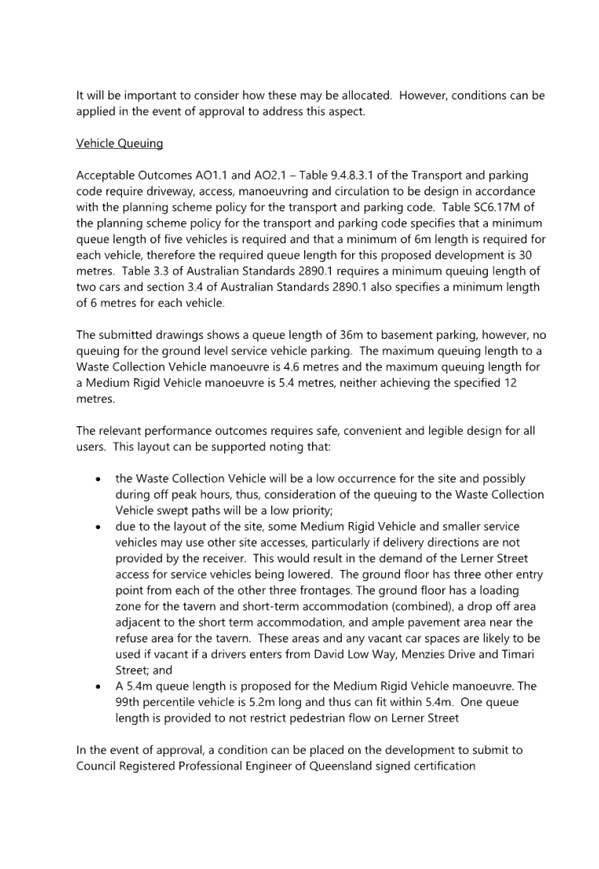
The submitted drawings shows no queuing for the ground level service vehicle parking. The maximum queuing length to a Waste Collection Vehicle manoeuvre is 4.6 metres and the maximum queuing length for a Medium Rigid Vehicle manoeuvre is 5.4 metres, neither achieving the specified 12 metres.
The relevant performance outcomes require safe, convenient and legible design for all users. This layout can be supported noting that the Waste Collection Vehicle will be a low occurrence for the site and possibly during off peak hours, some Medium Rigid Vehicle and smaller service vehicles may use other site accesses; and one queue length is provided to not restrict pedestrian flow on Lerner Street.
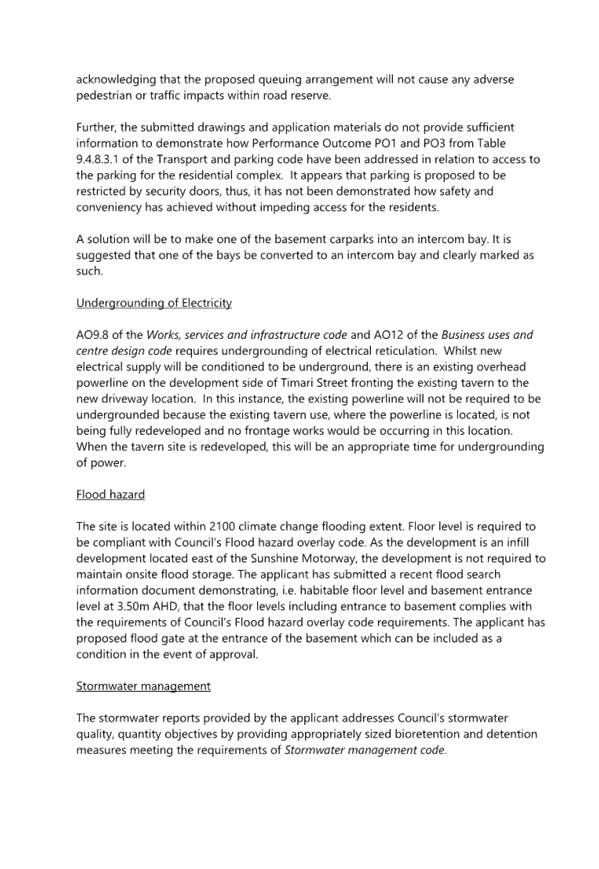
Further, the submitted drawings and application materials do not provide sufficient information to demonstrate how Performance Outcome PO1 and PO3 from Table 9.4.8.3.1 of the Transport and parking code have been addressed in relation to access to the parking for the residential complex. A solution will be to make one of the basement carparks into an intercom bay. If this proposal is to be supported a condition would be included to require that one of the bays be converted to an intercom bay and clearly marked as such.
Flood hazard
The site is located within 2100 climate change flooding extent. Floor level is required to be compliant with Council’s Flood hazard overlay code. The applicant has proposed a flood gate at the entrance of the basement which can be included as a condition in the event of approval.
Legal
There are currently no legal implications relevant to this report, however Council’s decision can be appealed to the Planning and Environment Court by the applicant and any properly made submitter to the application. Council will proceed with any required actions resulting from any legal action.
Policy
The application has been assessed against the Sunshine Coast Planning Scheme 2014 and regard has been given to all relevant Council policies.
Risk
This matter can be appealed to the Planning and Environment Court by the applicant or any properly made submitters to the application. Council will proceed with any required actions resulting from any legal action.
Previous Council Resolution
There is no previous Council resolution relevant to this report.
Related Documentation
A copy of the officer’s detailed assessment report is included as Attachment 1 to this report.
A copy of the proposal plans, elevations, sections, and perspective drawings is included as Attachment 2 to this report.
A copy of the State Government Concurrence Agency Response is provided as Attachment 3 to this report.
A Map identifying the locations of where the submissions were received from is provided in Attachment 4 to this report.
Critical Dates
The decision due date was 4 October 2024 in accordance with the provisions of the Planning Act 2016. However, it should be noted that there is minimal risk associated with this ‘impact assessment’ development application not being decided within the statutory timeframes.
Implementation
Should the recommendation be accepted by Council, Council officers will communicate the outcome of Council’s resolutions to the applicant and submitters as appropriate.
|
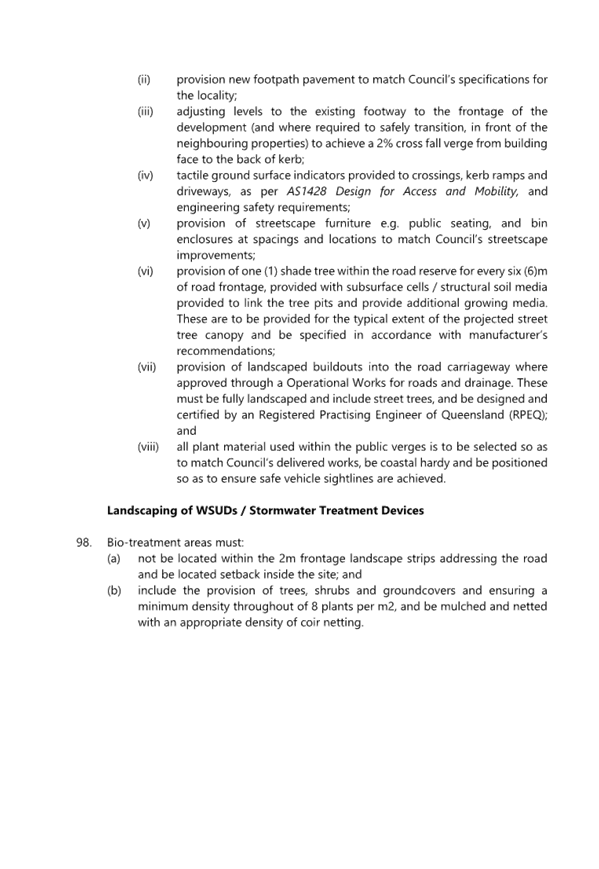
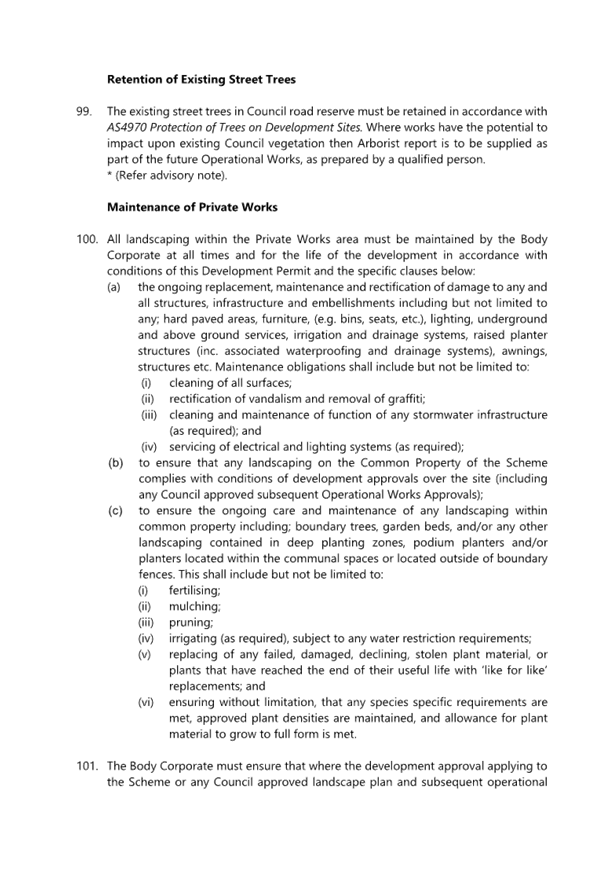
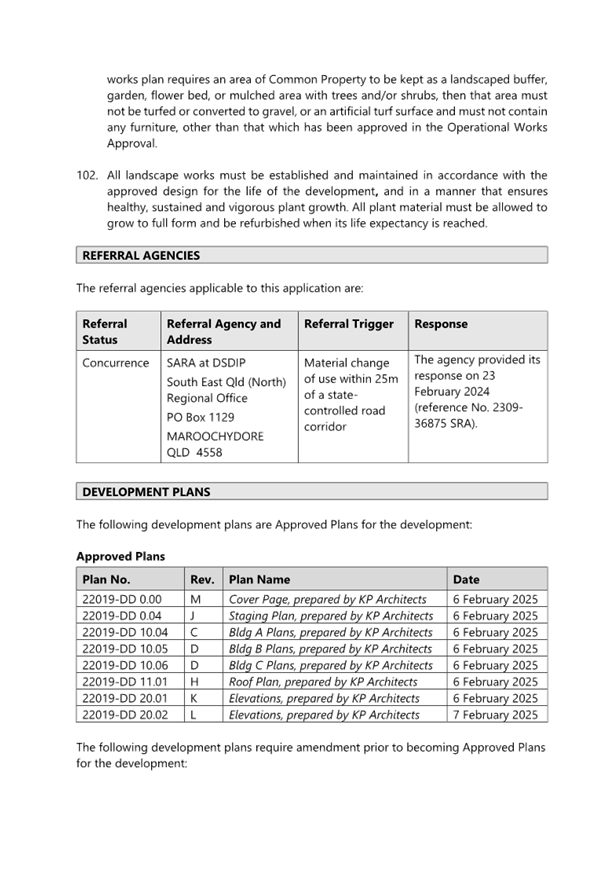
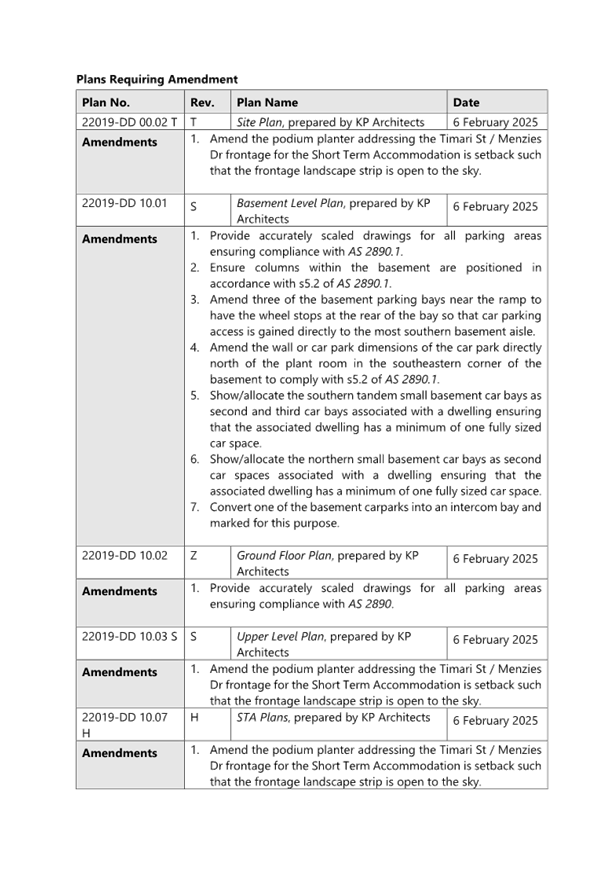
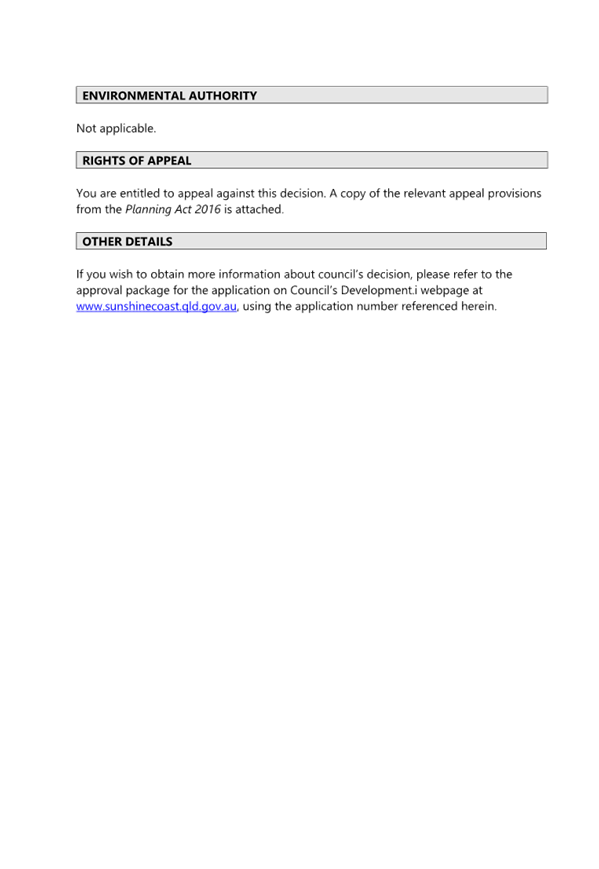
Ordinary Meeting Agenda Item 8.2 Development Permit for Material Change of Use of Premises to Establish a Food and Drink Outlet, Short Term Accommodation and Multiple Dwelling Units - 698-706 David Low Way and 11-13 Menzies Dr PACIFIC PARADISE QLD 4564 Appendix A Recommended Conditions of Approval |
24 July 2025 |
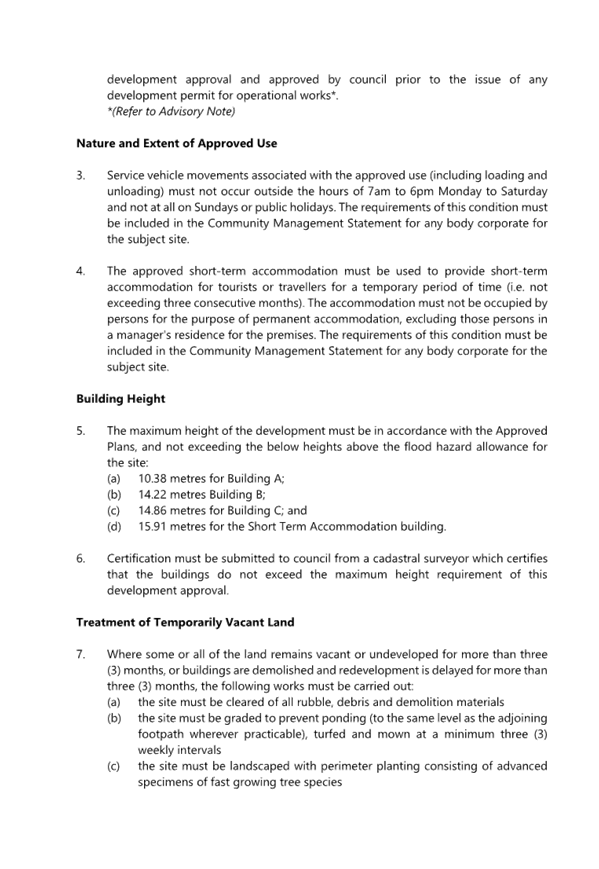
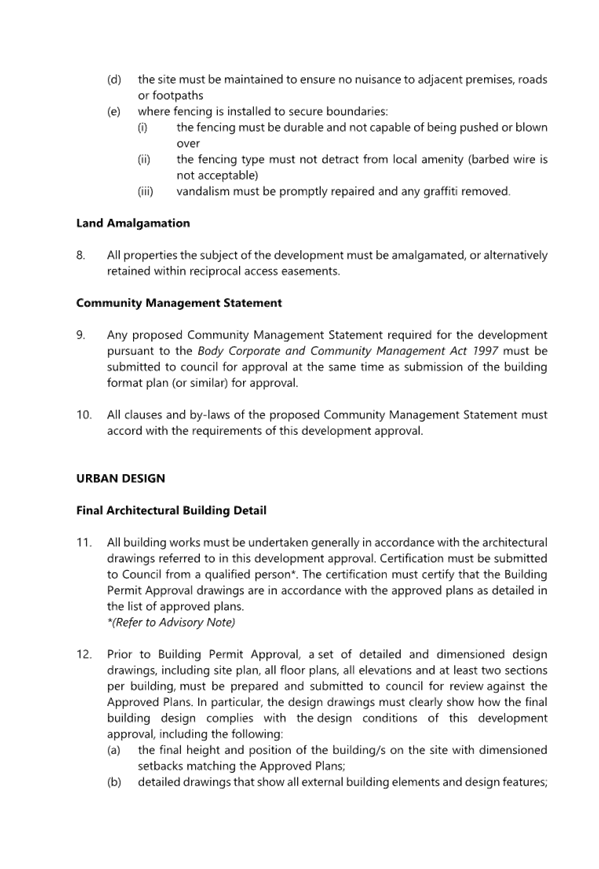
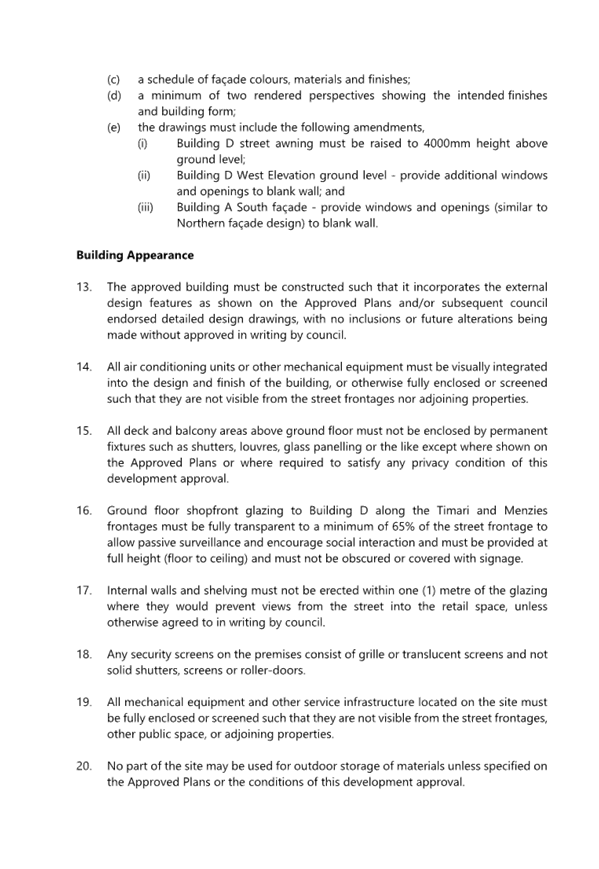
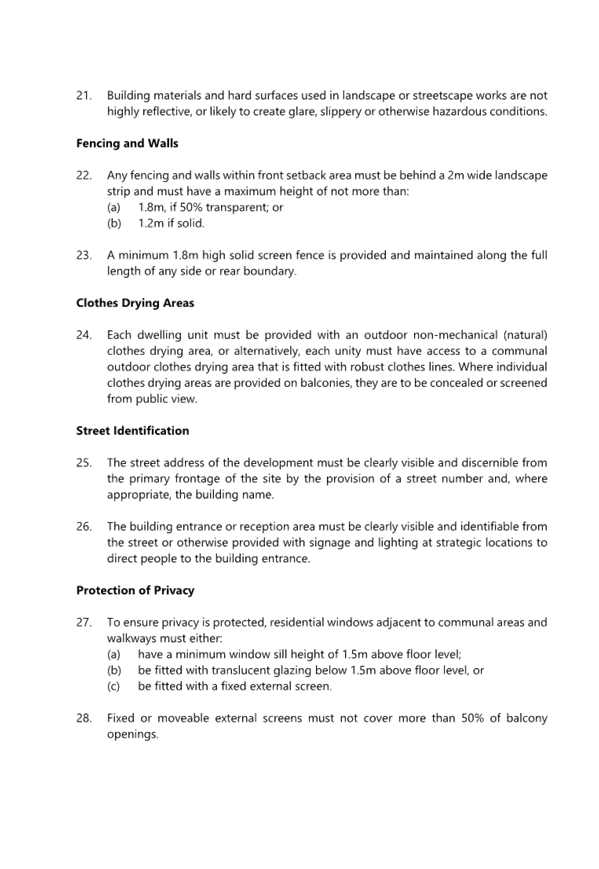
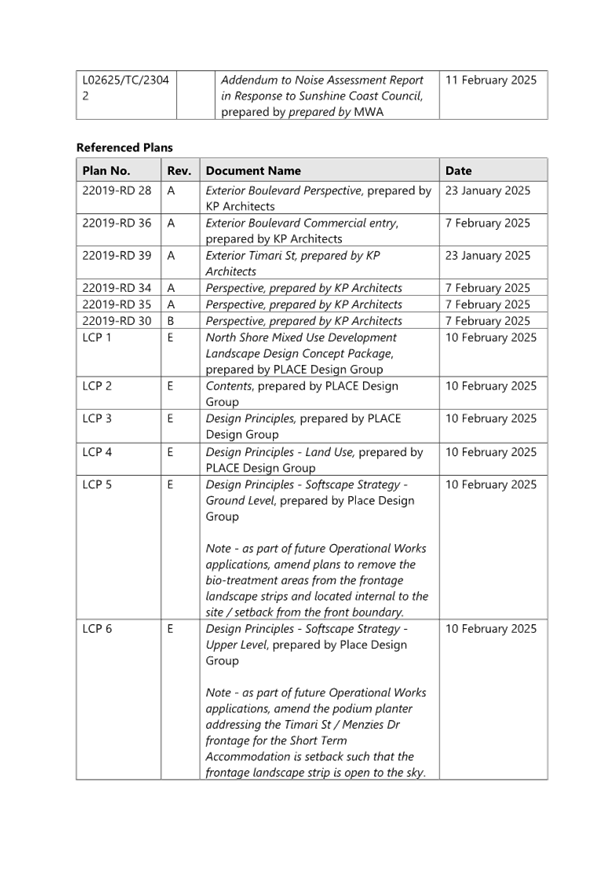
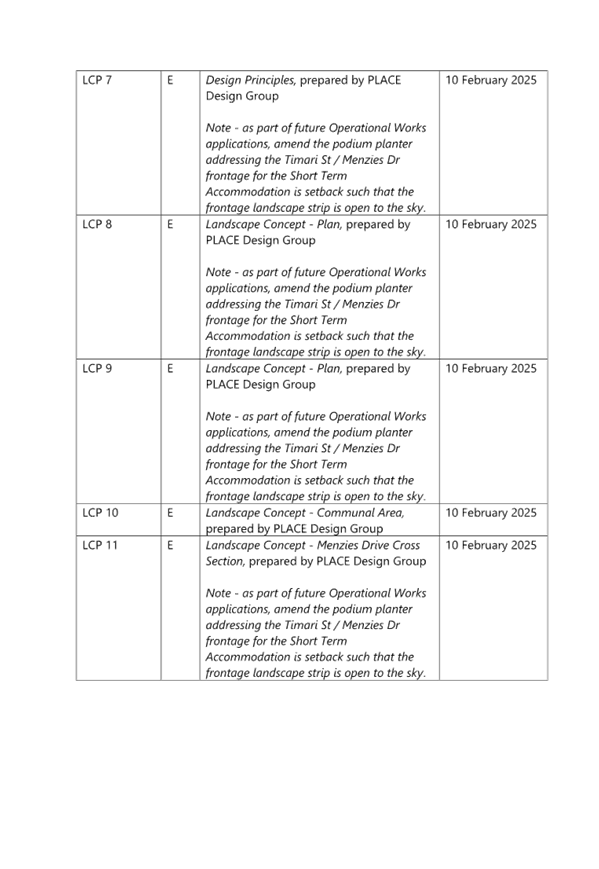
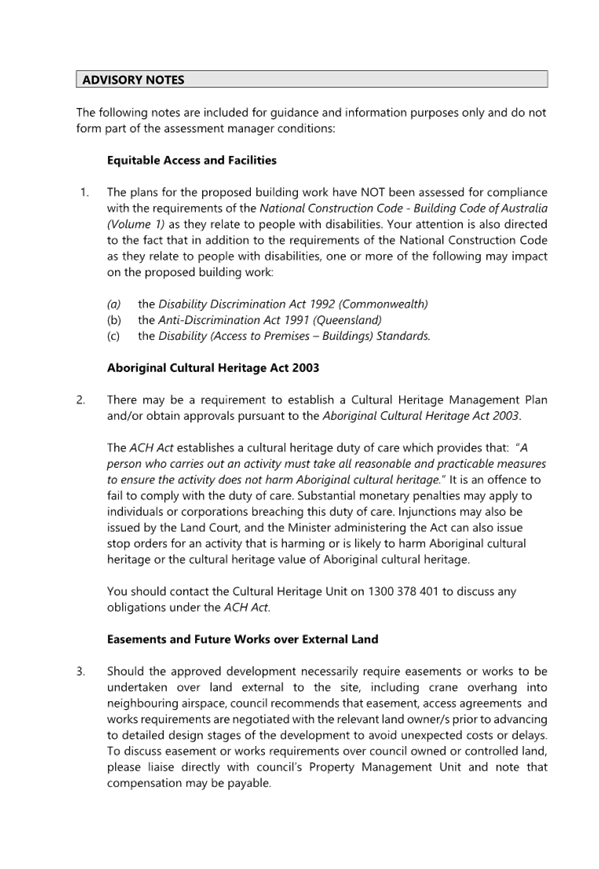
|
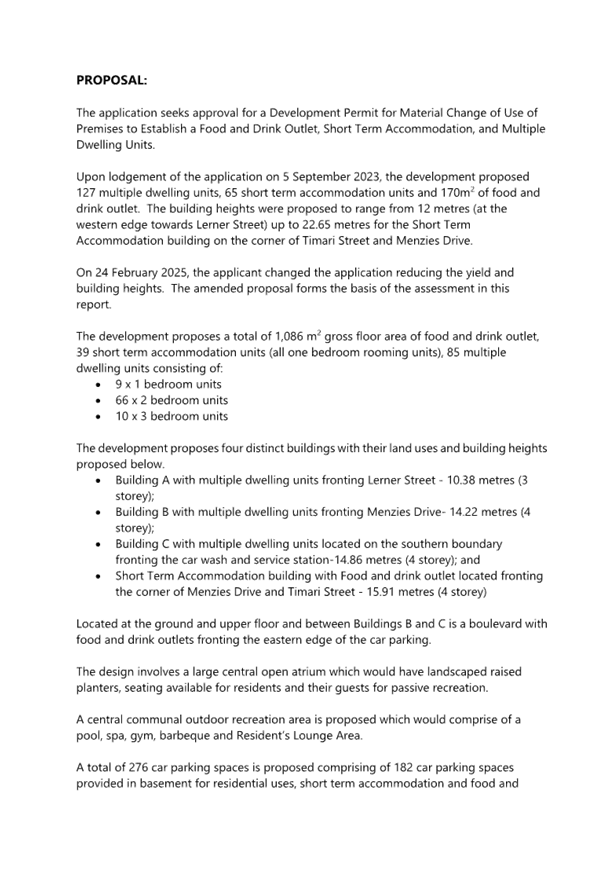
Ordinary Meeting Agenda Item 8.2 Development Permit for Material Change of Use of Premises to Establish a Food and Drink Outlet, Short Term Accommodation and Multiple Dwelling Units - 698-706 David Low Way and 11-13 Menzies Dr PACIFIC PARADISE QLD 4564 Attachment 1 Detailed Officer Report |
24 July 2025 |
|
Ordinary Meeting Agenda Item 8.2 Development Permit for Material Change of Use of Premises to Establish a Food and Drink Outlet, Short Term Accommodation and Multiple Dwelling Units - 698-706 David Low Way and 11-13 Menzies Dr PACIFIC PARADISE QLD 4564 Attachment 2 Proposal Plans |
24 July 2025 |
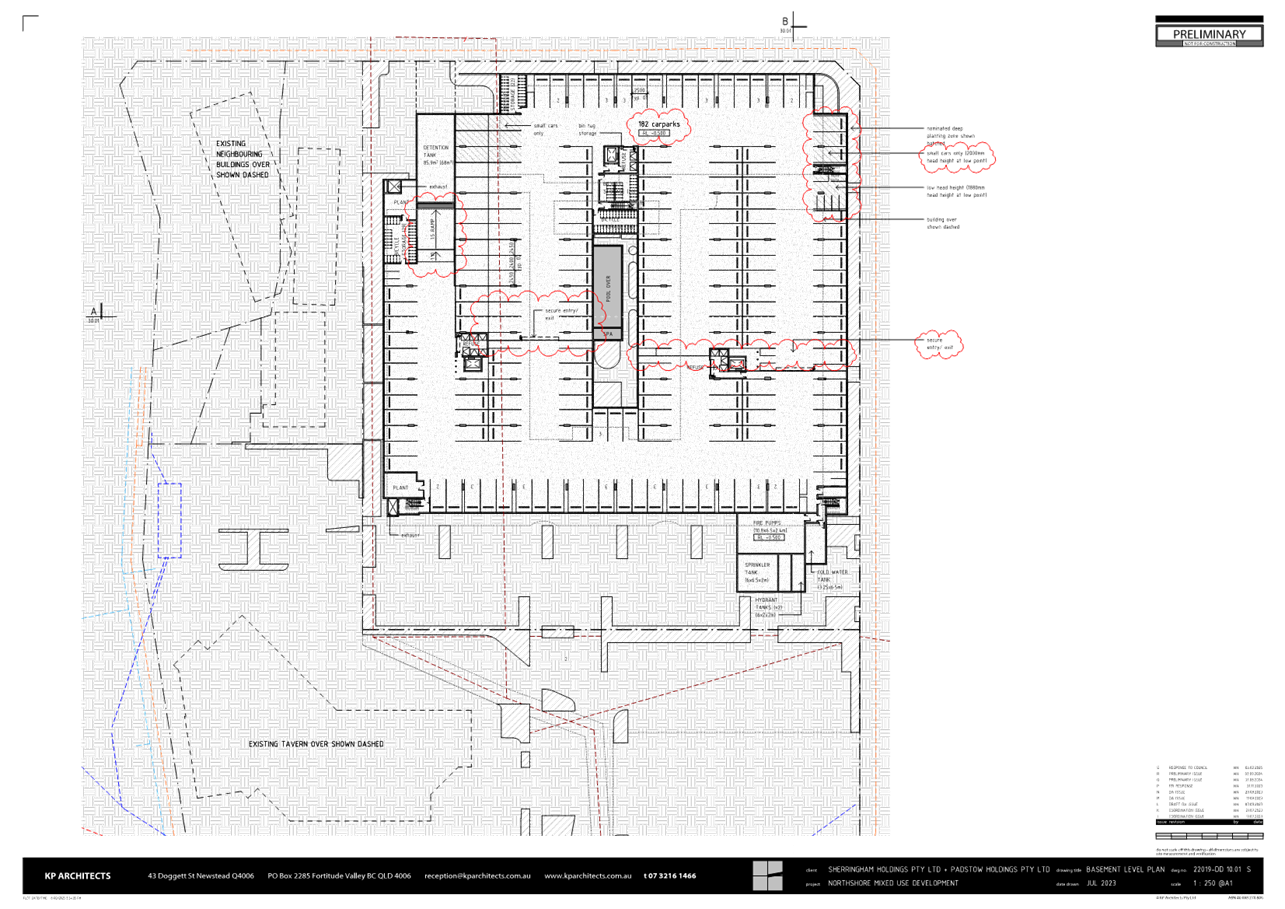
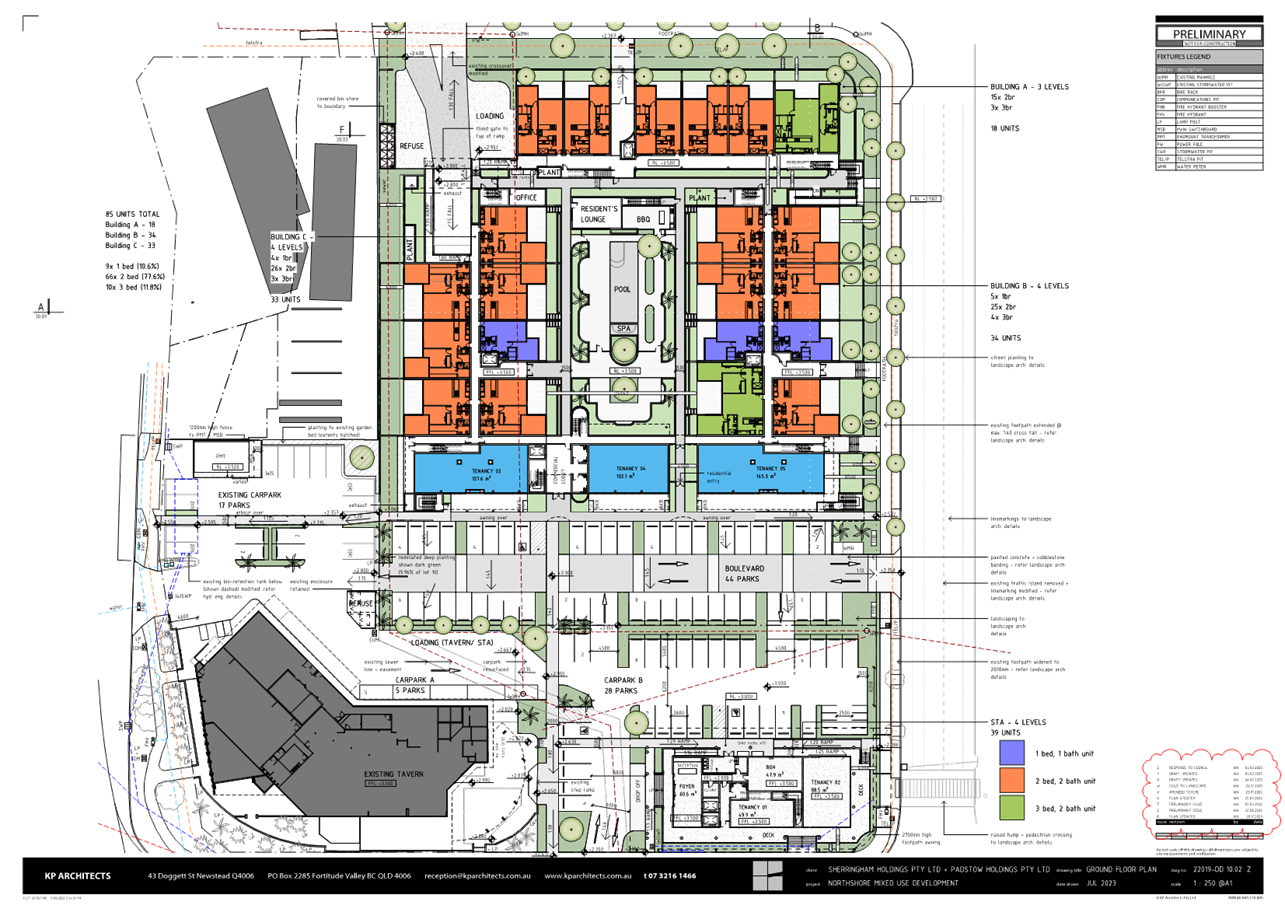
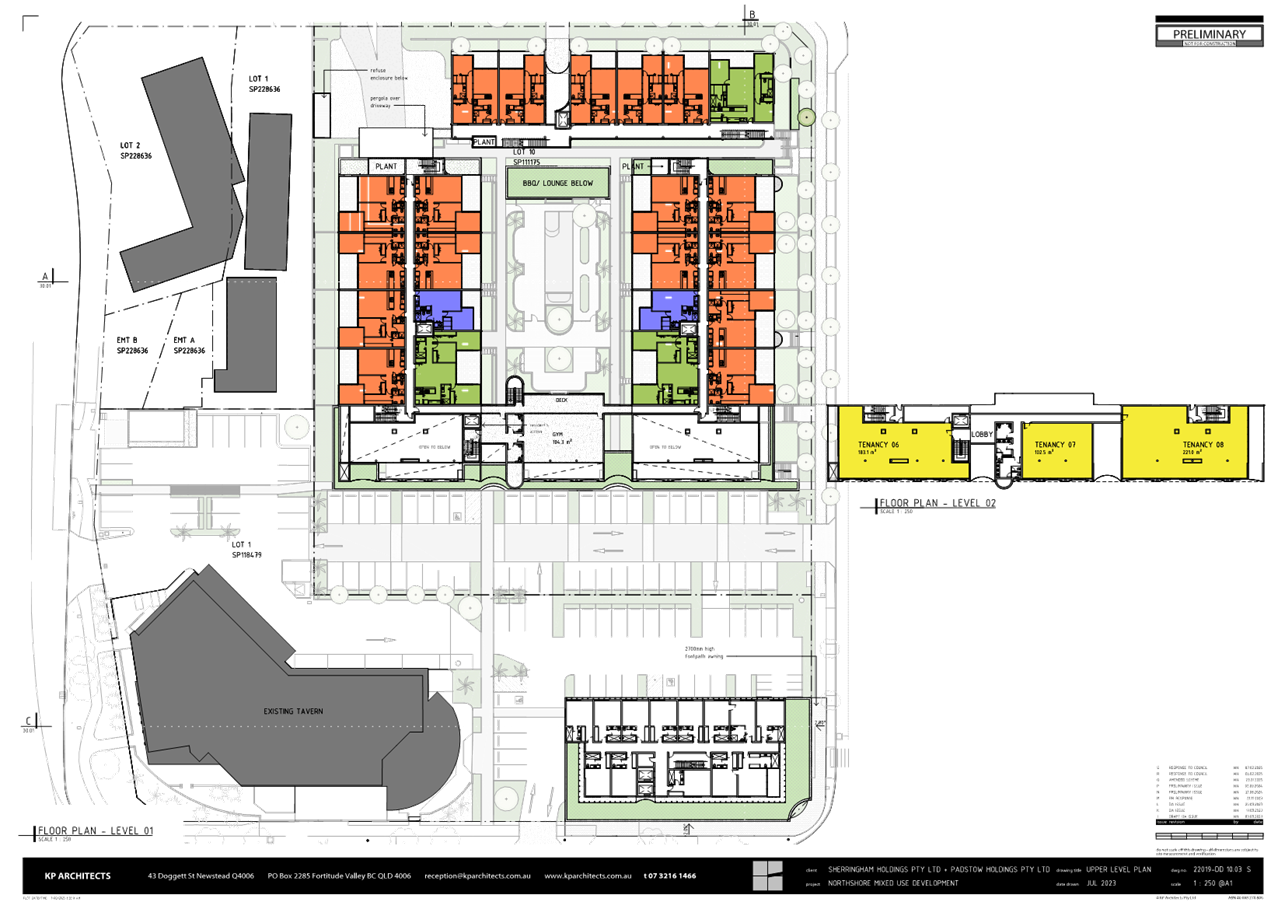
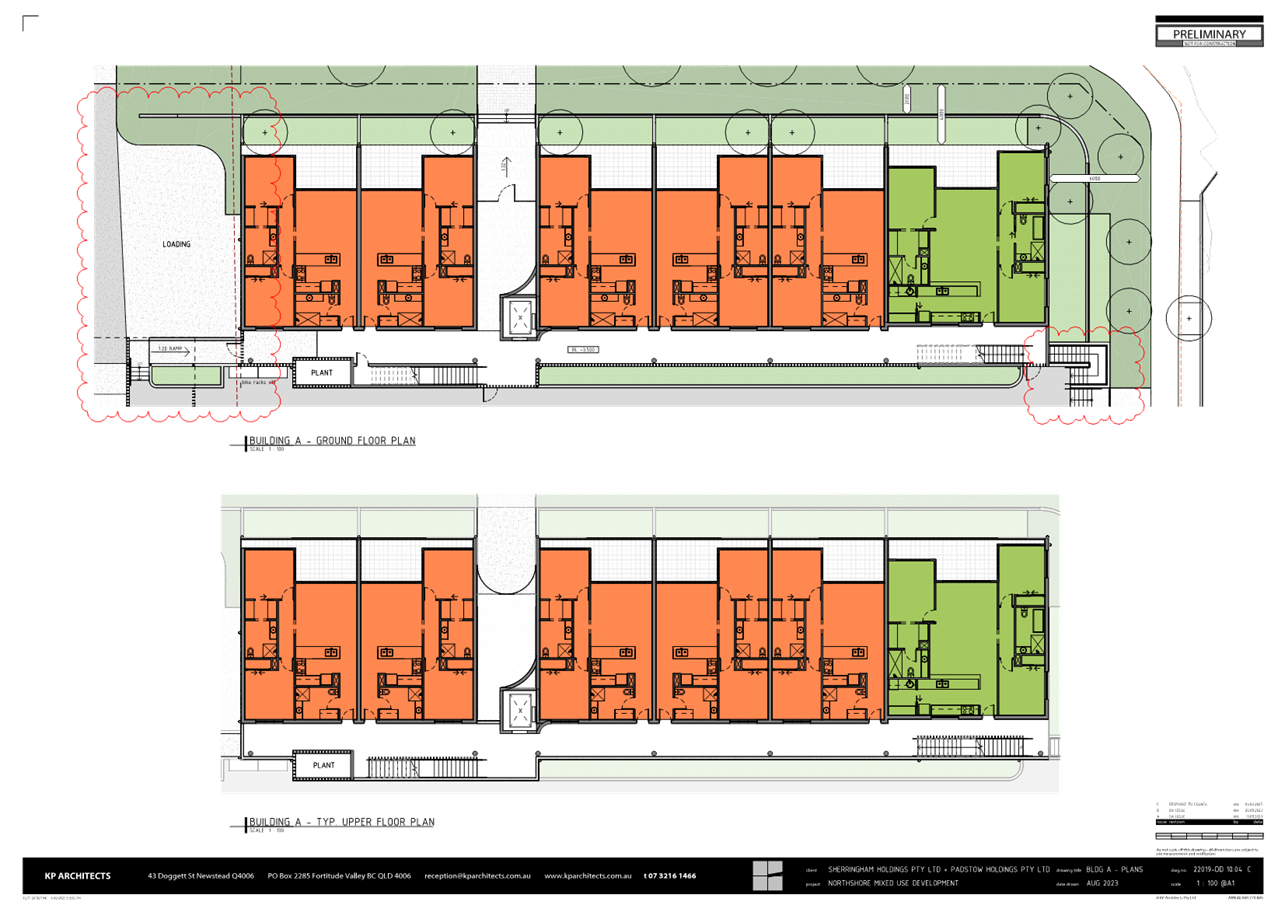
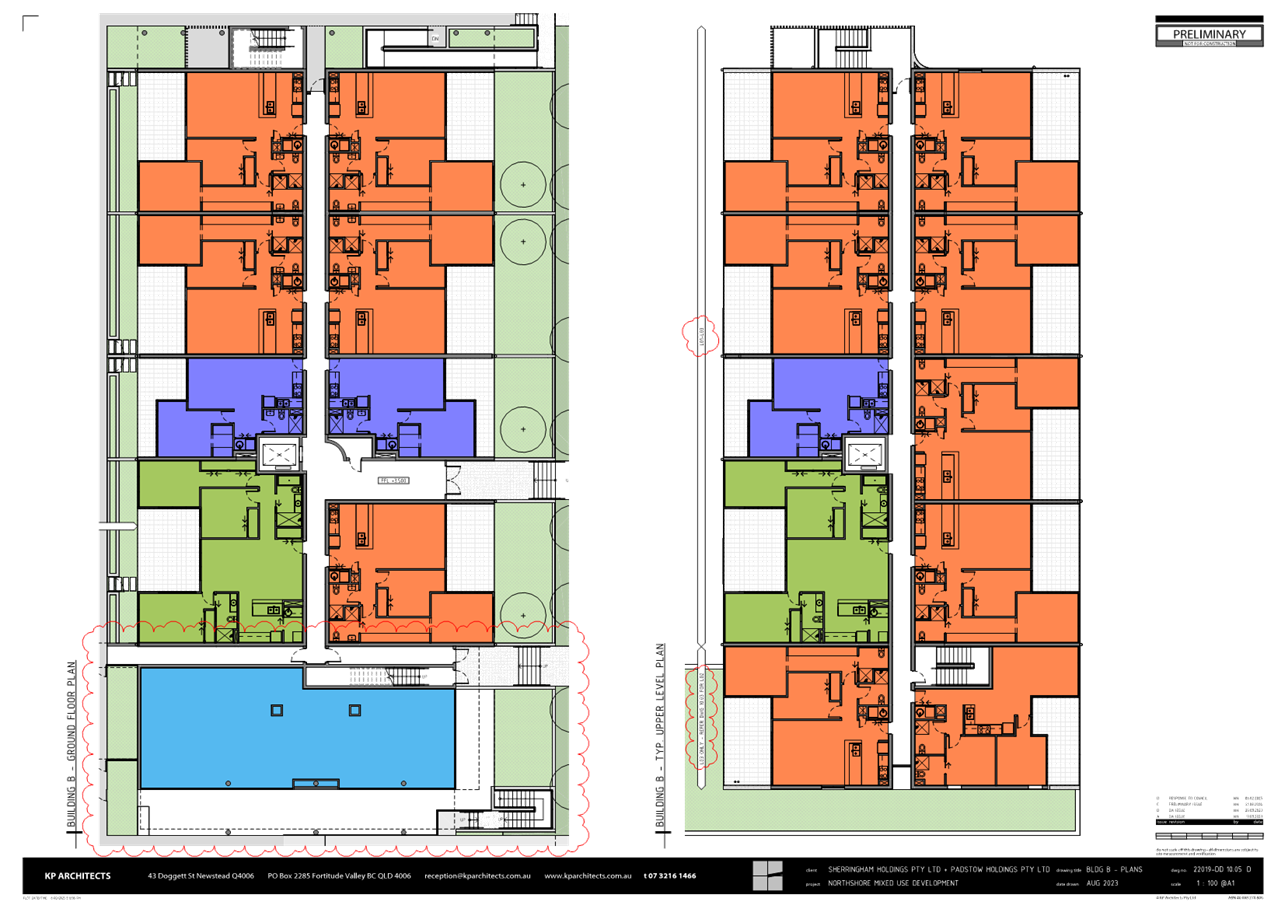
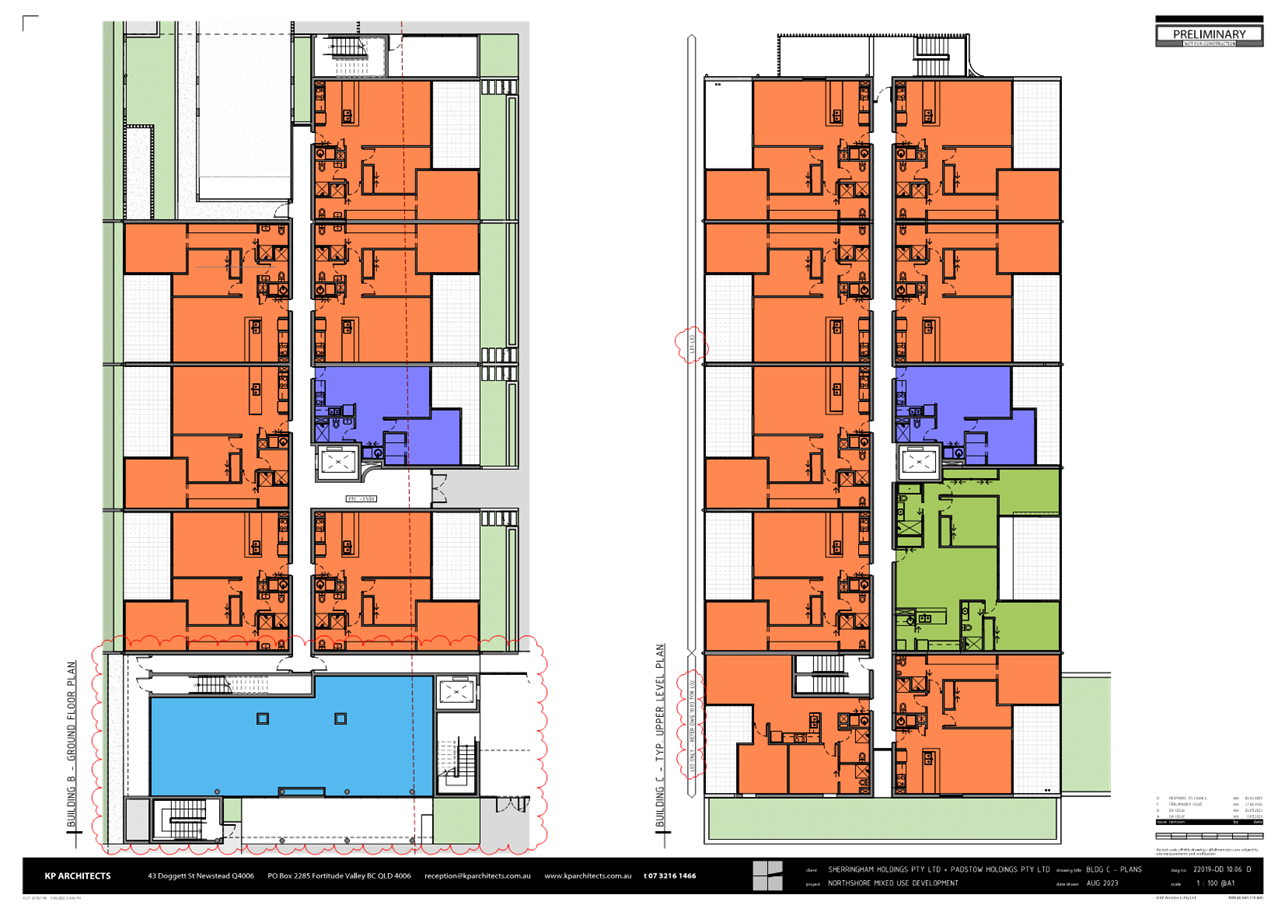
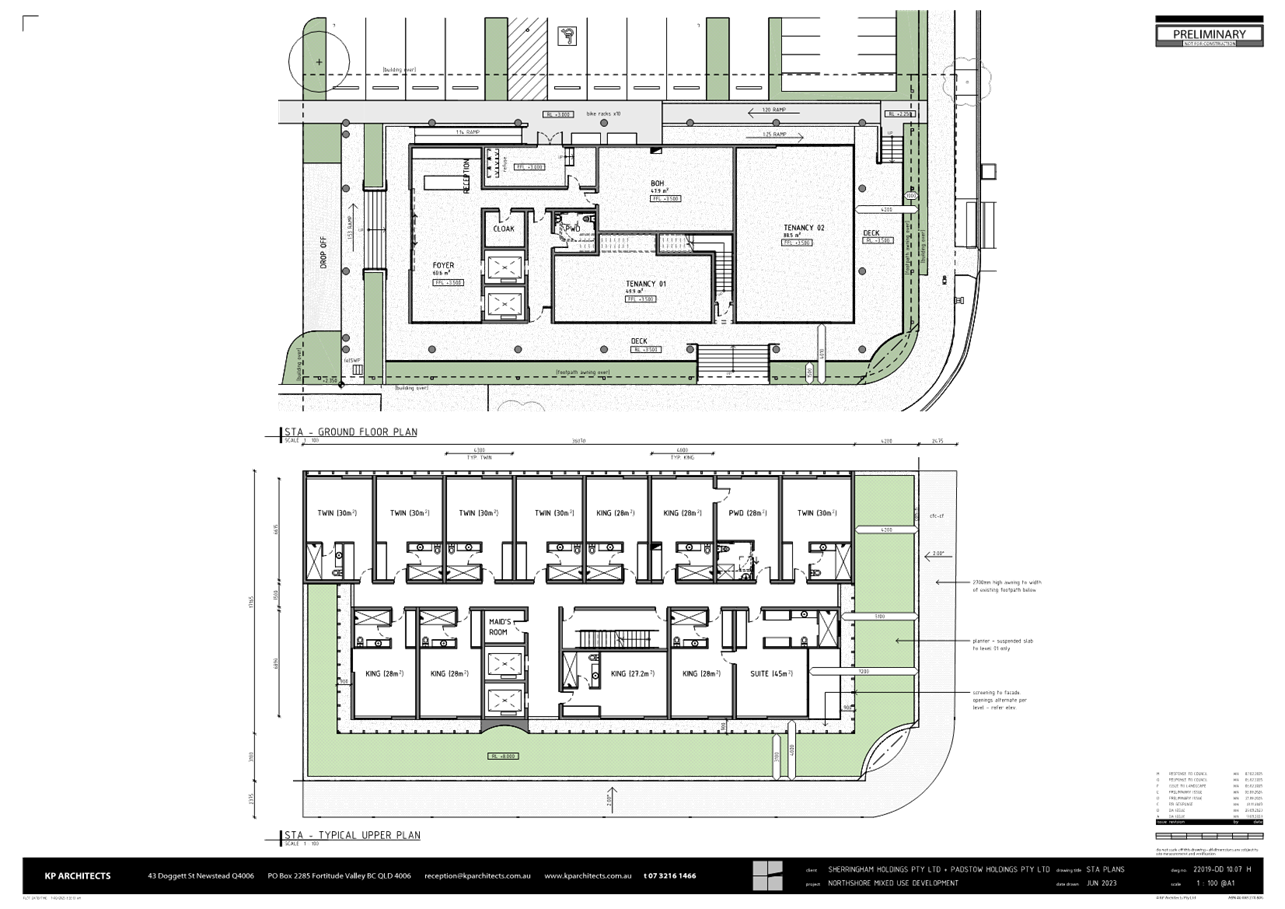
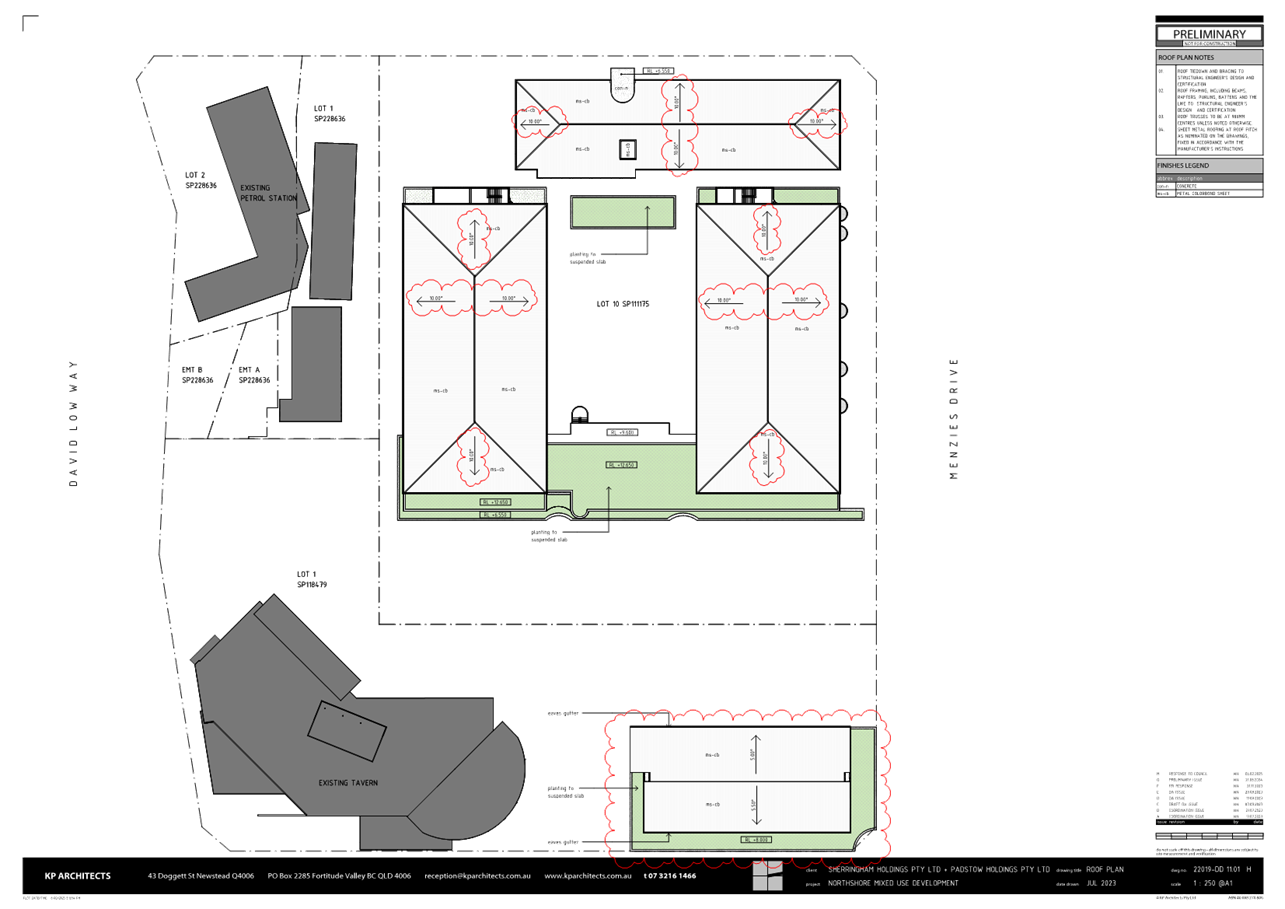
|
Ordinary Meeting Agenda Item 8.2 Development Permit for Material Change of Use of Premises to Establish a Food and Drink Outlet, Short Term Accommodation and Multiple Dwelling Units - 698-706 David Low Way and 11-13 Menzies Dr PACIFIC PARADISE QLD 4564 Attachment 3 Concurrence Agency Response (with conditions) |
24 July 2025 |

|
Ordinary Meeting Agenda Item 8.2 Development Permit for Material Change of Use of Premises to Establish a Food and Drink Outlet, Short Term Accommodation and Multiple Dwelling Units - 698-706 David Low Way and 11-13 Menzies Dr PACIFIC PARADISE QLD 4564 Attachment 4 Submissions Map |
24 July 2025 |
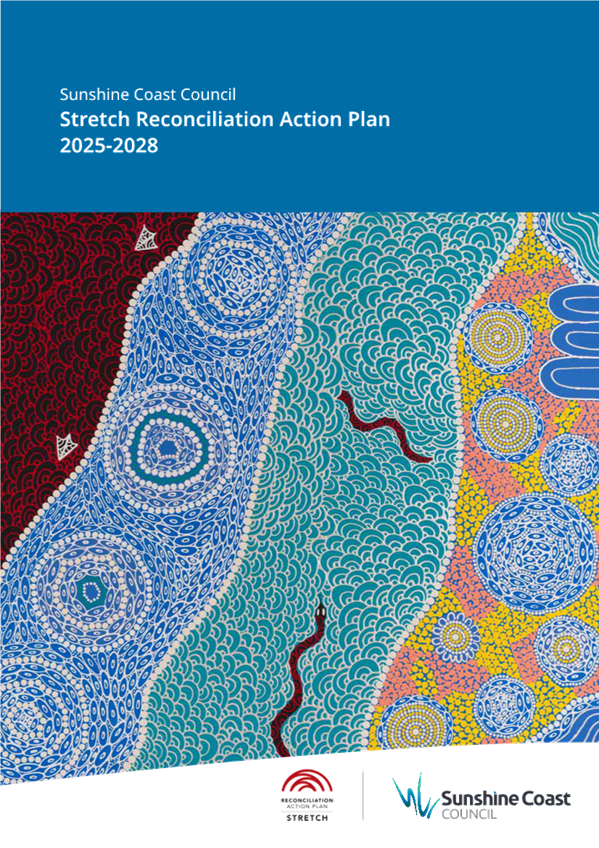
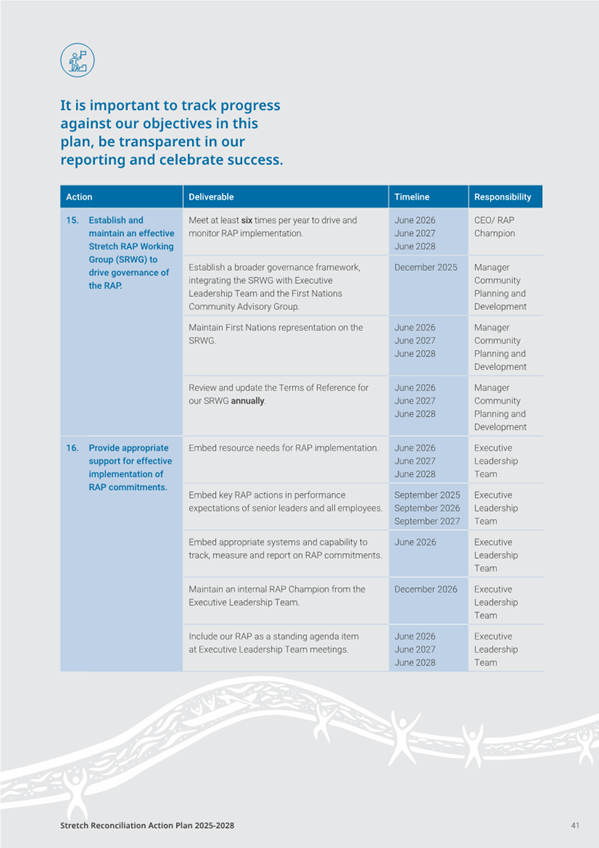
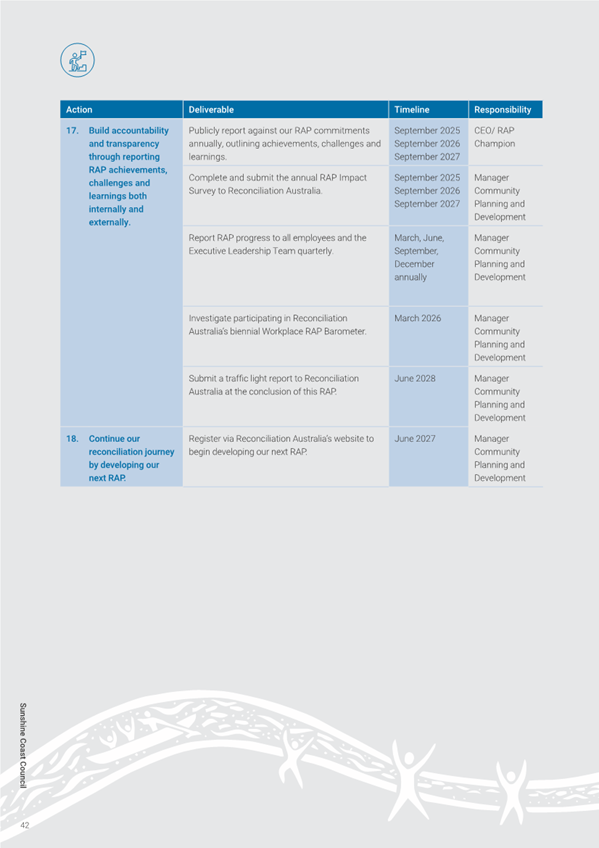
8.3 Stretch Reconciliation Action Plan 2025-2028
File No: Council Meetings
Author: First Nations Partnerships Lead
Economic & Community Development Group
Appendices: App
a - Stretch Reconciliation Action
Plan 2025-2028....... 171 ⇩

purpose
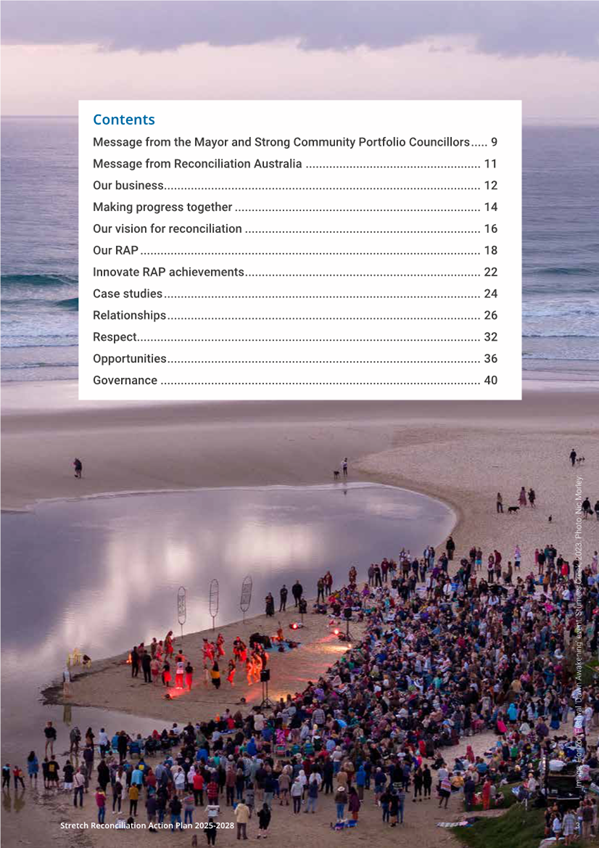
The purpose of this report is to seek Council adoption of the Stretch Reconciliation Action Plan 2025-2028 (Appendix A).
Executive Summary
A Reconciliation Action Plan (RAP) is Council’s formal document to advance reconciliation, providing a structured framework for meaningful enterprise-wide action.
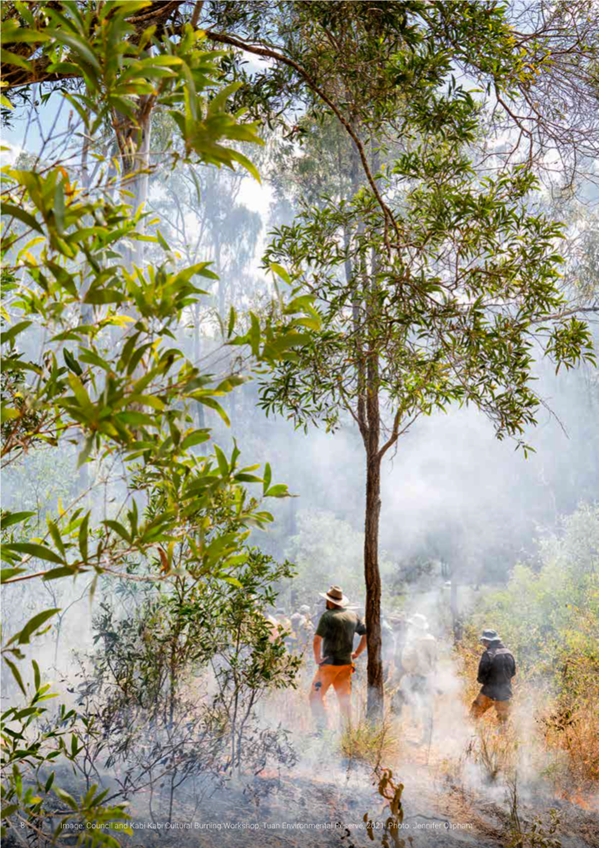
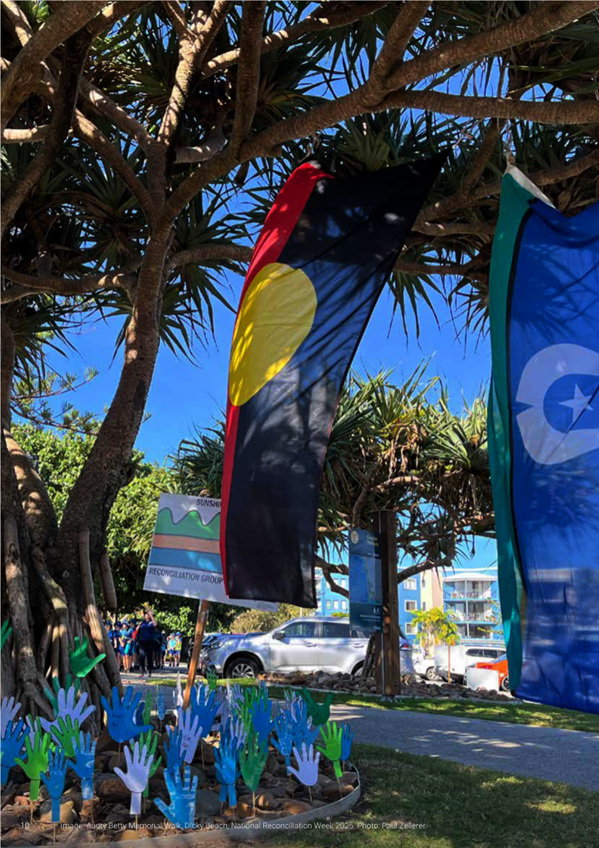
Since 2011, three previous iterations of the Reconciliation Action Plan have supported Council to build relationships with the First Nations (Aboriginal and/ or Torres Strait Islander) community and stakeholders, grow recognition and respect of First Nations cultures in our workplaces and create social and economic opportunities for First Nations peoples.
To progress Council’s reconciliation journey, the Stretch Reconciliation Action Plan 2025-2028 (Stretch RAP) (Appendix A) has been developed for Council’s consideration.
The Stretch Reconciliation Action Plan has been developed over the past 18 months in partnership with Reconciliation Australia. It is informed by extensive input and feedback from Council officers, stakeholders, and First Nations community partners.
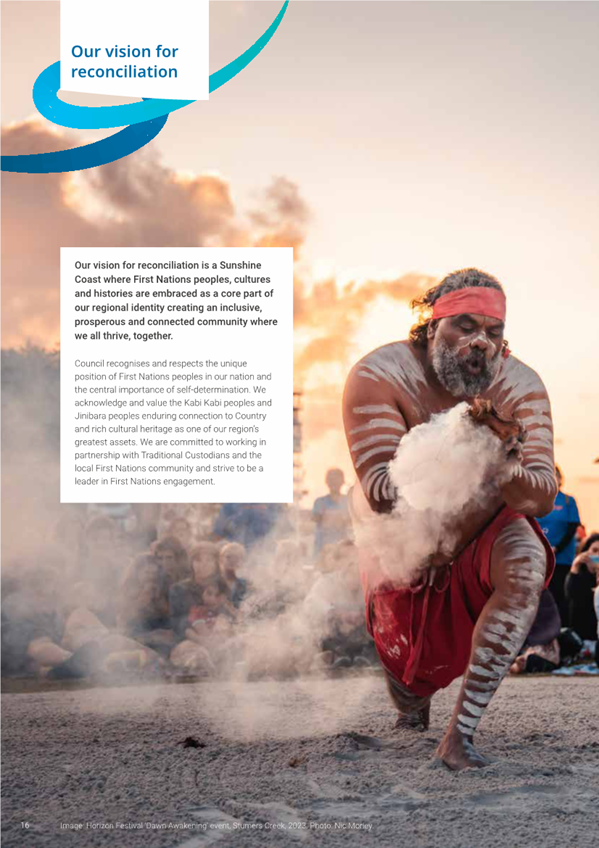
The plan sets a vision for reconciliation on the Sunshine Coast, deepening our commitment and further embedding reconciliation across our organisation and region. It focuses on tangible social and economic outcomes for First Nations peoples, introducing several measurable targets and high-impact actions.
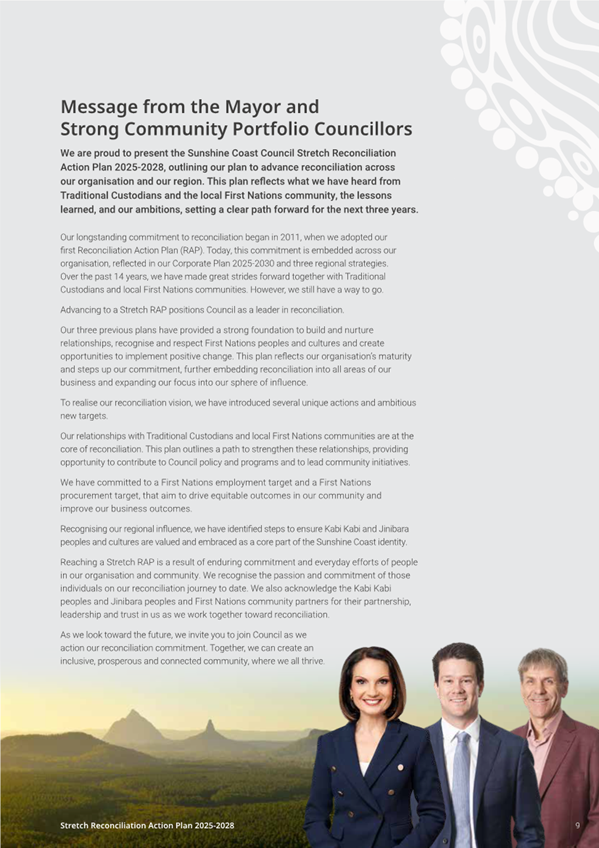
Advancing to a Stretch Reconciliation Action Plan positions Council as a leader in reconciliation. This plan signifies almost 15 years of Council’s enduring commitment to advance reconciliation and create an equitable and inclusive future for all.
That Council:
(a) receive and note the report titled “Stretch Reconciliation Action Plan 2025-2028”
(b) adopt the Stretch Reconciliation Action Plan 2025-2028 (Appendix A)
(c) authorise the Chief Executive Officer to refer the Stretch Reconciliation Action Plan 2025-2028 to Reconciliation Australia for final endorsement, and
(d) authorise the Chief Executive Officer to make non-material administrative amendments to finalise the Stretch Reconciliation Action Plan 2025-2028.
Finance and Resourcing
As the Stretch Reconciliation Action Plan 2025-2028 aligns to existing Council strategies and plans, no additional resources are required for implementation.
Any actions unable to be fully implemented within existing budget allocations will be subject to resource commitments being approved through Council’s normal budgetary processes.
Corporate Plan
Corporate Plan Goal: Strong community
Outcome: 1.3 - Inclusive communities
Operational Activity: 1.3.1 - Deliver prioritised actions set out in the Sunshine Coast Stretch Reconciliation Action Plan in partnership with Traditional Custodians and the First Nations community.
Consultation
Councillor Consultation
All Councillors were consulted and invited to provide input into the development of the Stretch Reconciliation Action Plan 2025-2028 (Stretch RAP). Councillors were provided with a summary of feedback from internal and external engagement, including feedback provided by Reconciliation Australia.
Further consultation was held with Strong Community Portfolio Councillors, Councillor D Law and Councillor T Bunnag on the final plan prior to the Ordinary Meeting.
Internal Consultation
A collaborative approach was undertaken to develop the Stretch Reconciliation Action Plan, with consultation with Council Officers from across Council.
Key internal engagement activities included:
· Establishment of the Stretch Reconciliation Action Plan Working Group to drive development and implementation of the Stretch Reconciliation Action Plan. The group is made up of 12 managers and senior leaders from across all areas of the organisation, representatives from the First Nations Employee Network and the First Nations Partnerships Lead. This group was engaged at each stage to provide input and feedback, meeting seven times throughout development.
· Initial consultation workshops with managers and relevant officers from 13 key business areas within Council to understand key priorities, challenges and opportunities.
· A workshop with the First Nations Employee Network focusing on employment opportunities and workplace cultural safety.
· A series of seven workshops with Council officers from key group to draft actions based on topic areas. Between 10-20 managers, relevant officers and First Nations employees from across Council attended each workshop. The workshops were led by members of the Stretch Reconciliation Action Plan Working Group.
· Direct engagement with the managers who have responsibility of implementation of actions to finalise the action plan. The following managers provided input:
o Manager Business Innovation
o Manager Community Planning and Development
o Manager Design and Placemaking
o Manager Environment and Sustainability Policy
o Manager Environmental Operational
o Manager Arts, Heritage and Libraries
o Manager Parks and Gardens
o Manager Sport and Community Venues
o Manager Strategic Planning
o Sunshine Coast Program Lead - Brisbane 2032
o Head of Communications
o Chief Economic Development Officer
o Head of People and Culture
o Head of Property.
The Executive Leadership Team were also consulted during development of the Stretch Reconciliation Action Plan.
External Consultation
The Stretch Reconciliation Action Plan was developed in partnership with Reconciliation Australia, who provided ongoing guidance to ensure Council met the standard of a Stretch Reconciliation Action Plan. This included two full reviews of the draft plan, incorporating advice on terminology and language, cultural protocols and potential actions and targets.
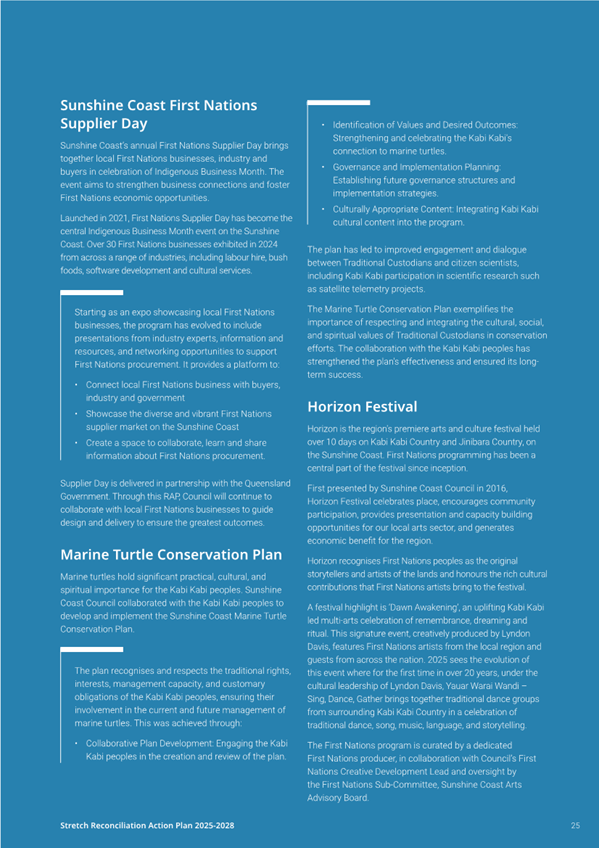
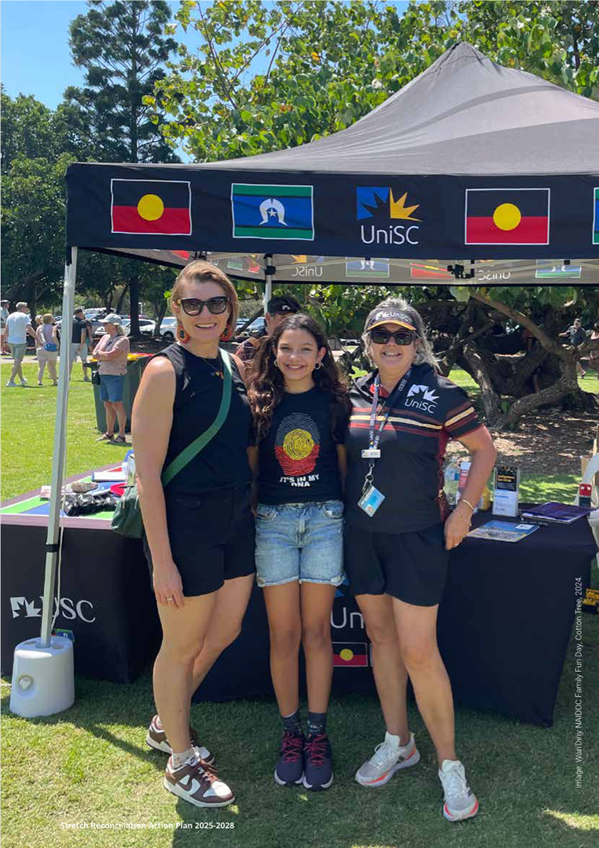
Meetings were also held in early development with key stakeholder organisations, including surrounding Councils, Queensland Government agencies, community centres and UniSC, to refine priorities and identify opportunities for partnership.
Community Engagement
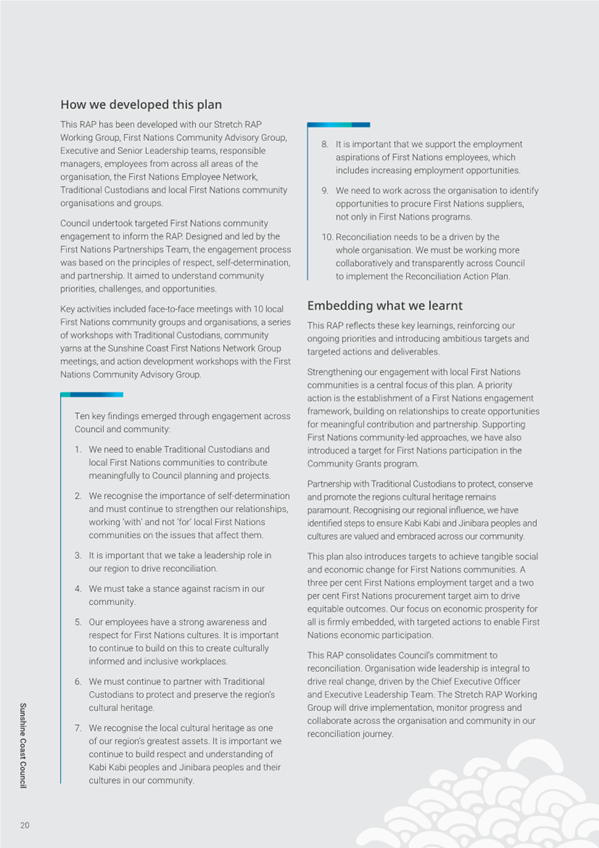
Council undertook targeted engagement with the local First Nations community to inform the development of the Stretch Reconciliation Action Plan. The engagement process was culturally informed and based on the principles of respect, self-determination, and partnership.
Key First Nations community engagement activities included:
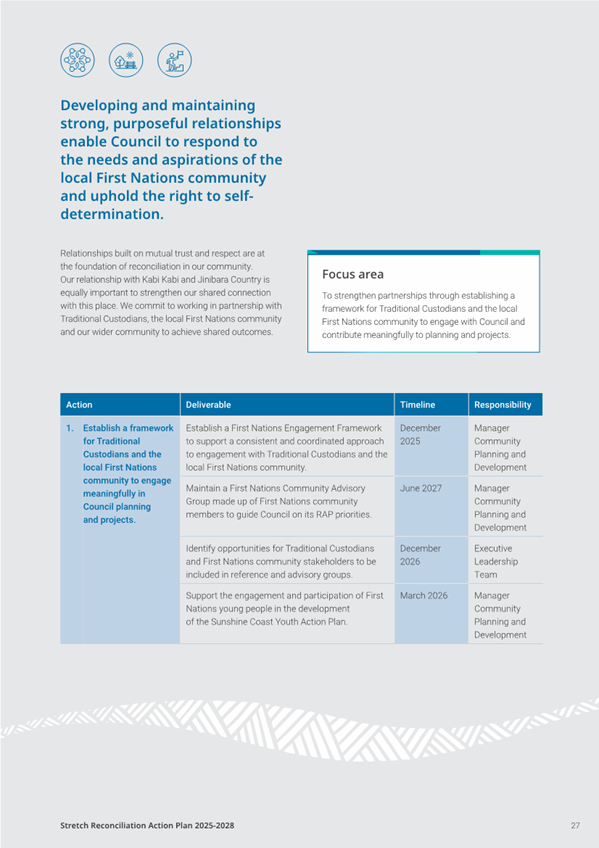
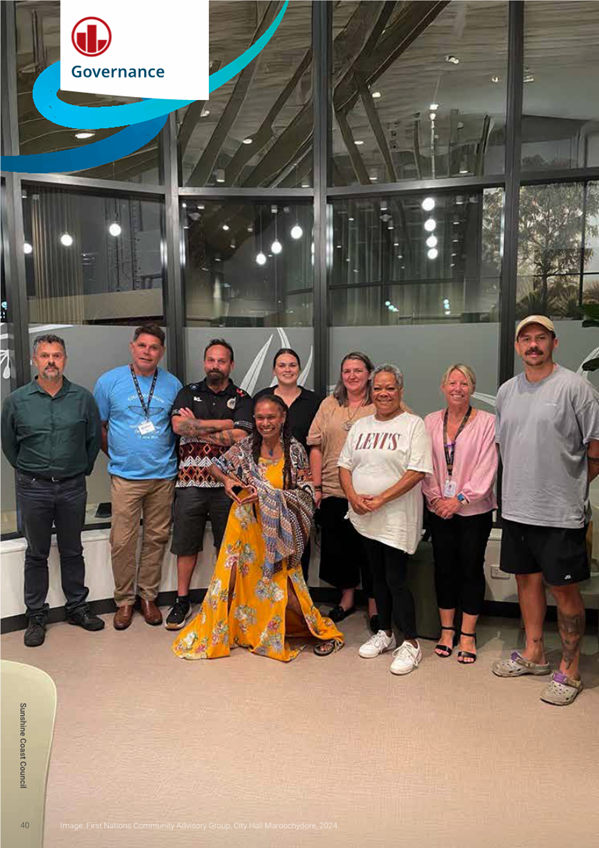
· Establishment of the First Nations Community Advisory Group to work alongside Council and guide development and implementation of the Stretch Reconciliation Action Plan. The group is made up of ten Aboriginal and Torres Strait Islander community members and Jinibara and Kabi Kabi Traditional Custodians. The group met four times during development focusing on setting priorities, drafting potential actions and providing advice on language and cultural protocol.
· Face-to-face meetings with eight local First Nations community groups and organisations in early development to refine priorities and identify opportunities for partnership.
· Two workshops at the Sunshine Coast First Nations Network Group (SC1NG). These workshops focused on identifying key community priorities and strengthening Council engagement with the First Nations community.
· Series of three workshops (six total) with the two Native Title Representative Bodies, Jinibara Aboriginal Peoples Corporation and Kabi Kabi Aboriginal Peoples Corporation. These focused on setting shared priorities, establishing engagement protocols and reviewing draft actions.
The input received from First Nations community partners was valuable, insightful and comprehensive. The community identified significant priorities for Council, including:
· opportunity to contribute meaningfully to Council planning and projects
· support for self-determination through stronger partnerships and empowering community-led approaches
· addressing increasing experiences of racism within First Nations community
· protecting, preserving and promoting Kabi Kabi and Jinibara cultural heritage
· recognition and respect for First Nations cultures within our workplaces and communities
· employment opportunities with Council, including for young First Nations people
· greater transparency of Council’s work and outcomes impacting First Nations peoples.
· greater focus on tangible outcomes and goals to drive social and economic change for First Nations peoples.
ProposaL
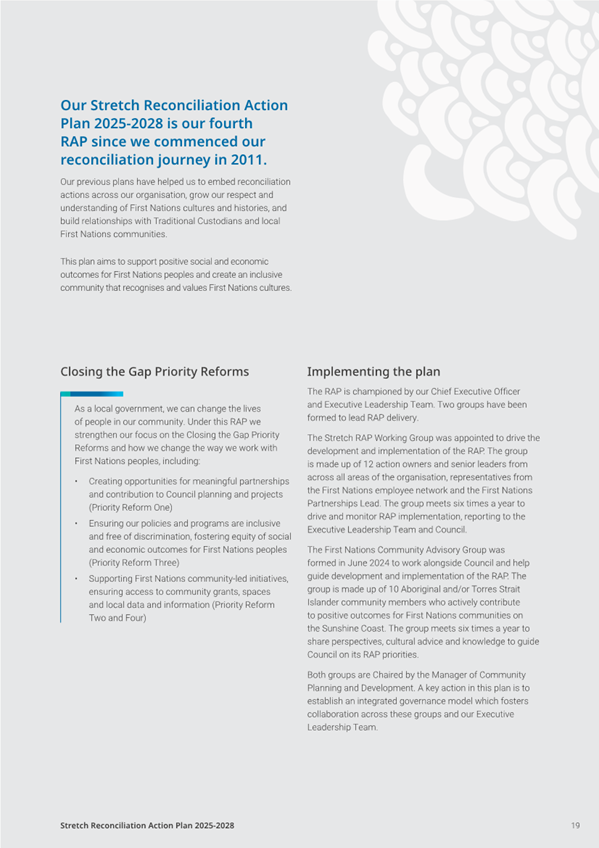
The Stretch Reconciliation Action Plan 2025-2028 (the Stretch RAP) (Appendix A) is Council’s fourth plan since commencing its reconciliation journey in 2011. Following finalisation of the most recent Innovate Reconciliation Action Plan 2021-2022 (the Innovate RAP) in December 2023, Reconciliation Australia endorsed Council to commence development of the Stretch Reconciliation Action Plan.
Progression to a Stretch Reconciliation Action Plan positions Council as a leader in reconciliation, reaching the second highest tier in Reconciliation Australia’s framework; Reflect, Innovate, Stretch, Elevate. This places Council in the top 20% of organisations with Reconciliation Action Plans nationally. Organisations at this level are recognised as having strong approach to advancing reconciliation internally and meaningful engagement with First Nations stakeholders.
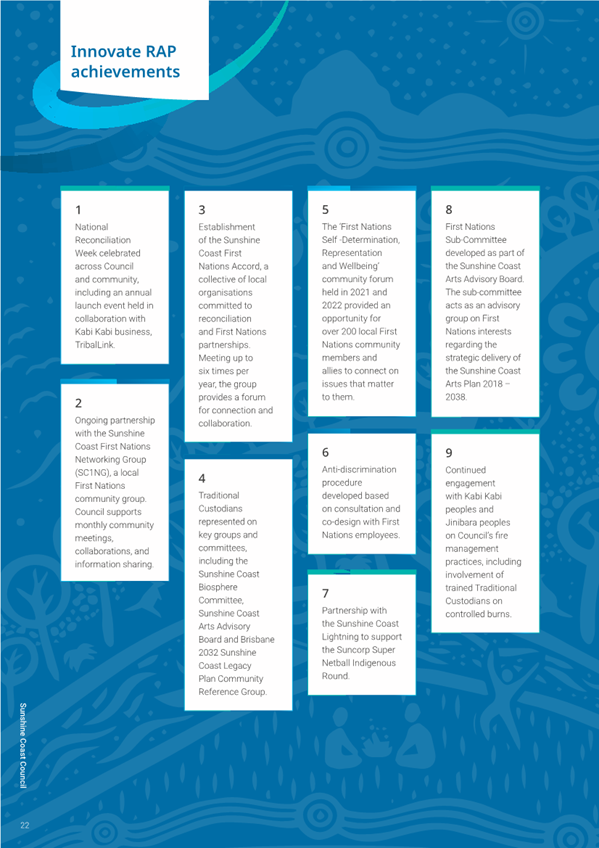
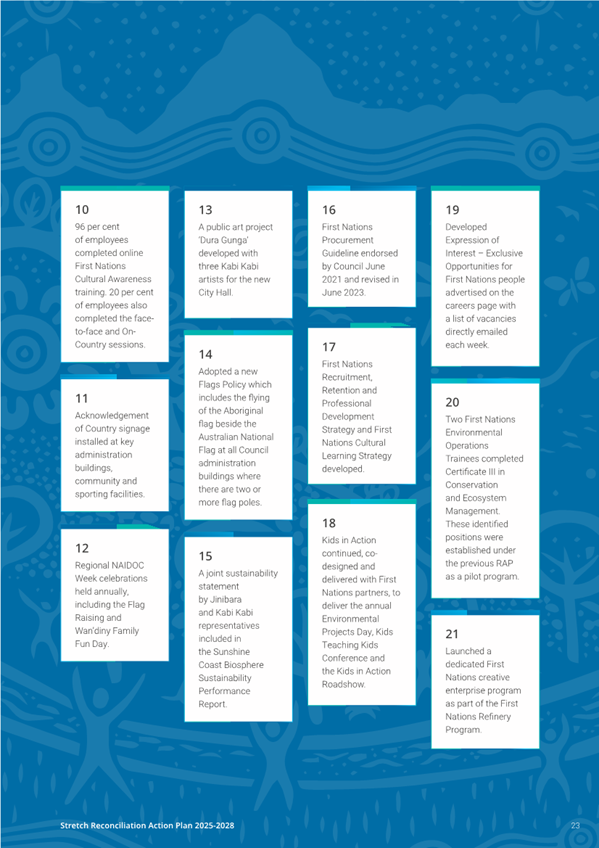
Council’s key achievements under the Innovate Reconciliation Action Plan are outlined in the Stretch Reconciliation Action Plan 2025-2028 (Appendix A).
Developing the Stretch Reconciliation Action Plan 2025-2028 (Stretch Reconciliation Action Plan)
A project was undertaken over the past 18 months to develop the Stretch Reconciliation Action Plan. The key elements of the project included:
· Reconciliation Australia endorsement: Reconciliation Australia is the lead body for reconciliation nationally and key partner in the development of the Stretch Reconciliation Action Plan. Reconciliation Australia guided Council throughout development, ensuring the plan met the minimum elements required through providing a designated template, resources and a series of reviews. Reconciliation Australia granted endorsement of the Stretch Reconciliation Action Plan in June 2025, conditional on Council’s adoption.
· Establishment of a new governance framework: The Reconciliation Action Plan is championed by the Chief Executive Officer and overseen by Council’s Executive Leadership Team. Two groups were formed to drive Reconciliation Action Plan delivery, chaired by the Manager Community Planning and Development.
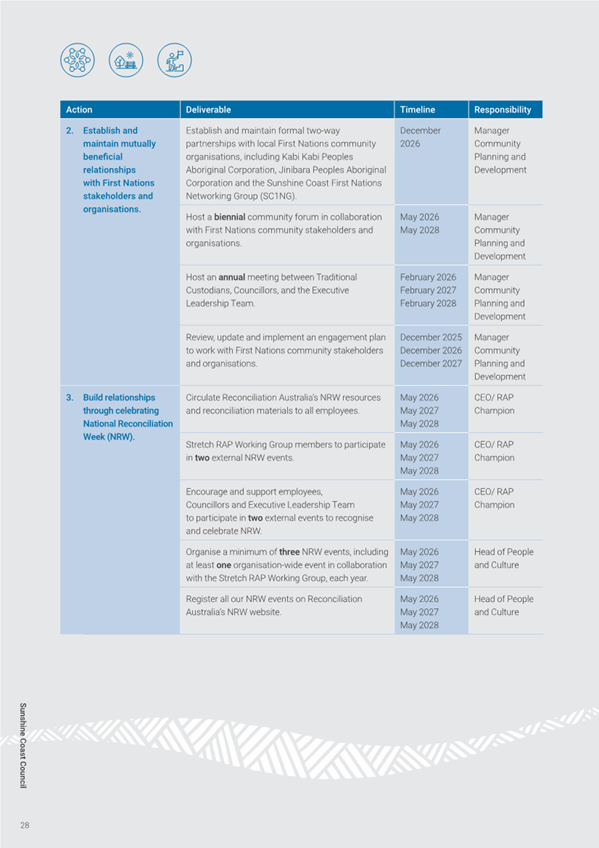
The Stretch Reconciliation Action Plan Working Group, comprising 12 managers and senior leaders from across all areas of the organisation, representatives from the First Nations Employee Network and the First Nations Partnerships Lead, is responsible for driving and monitoring Stretch Reconciliation Action Plan implementation and internal reporting.
The First Nations Community Advisory Group, comprised of 10 Aboriginal and/or Torres Strait Islander community members on the Sunshine Coast, is responsible for sharing perspectives, cultural advice and knowledge to guide Council on its Stretch Reconciliation Action Plan priorities.
· Internal and First Nations community engagement: A range of consultation was undertaken with internal Council and First Nations community stakeholders to inform the Stretch Reconciliation Action Plan. This included the Stretch Reconciliation Action Plan Working Group, First Nations Community Advisory Group, Council officers from across the organisation, Council’s First Nations Employee Network, Traditional Custodians and local First Nations community organisations and groups. Input from engagement helped to shape the actions, vision and focus areas and language and terminology used.
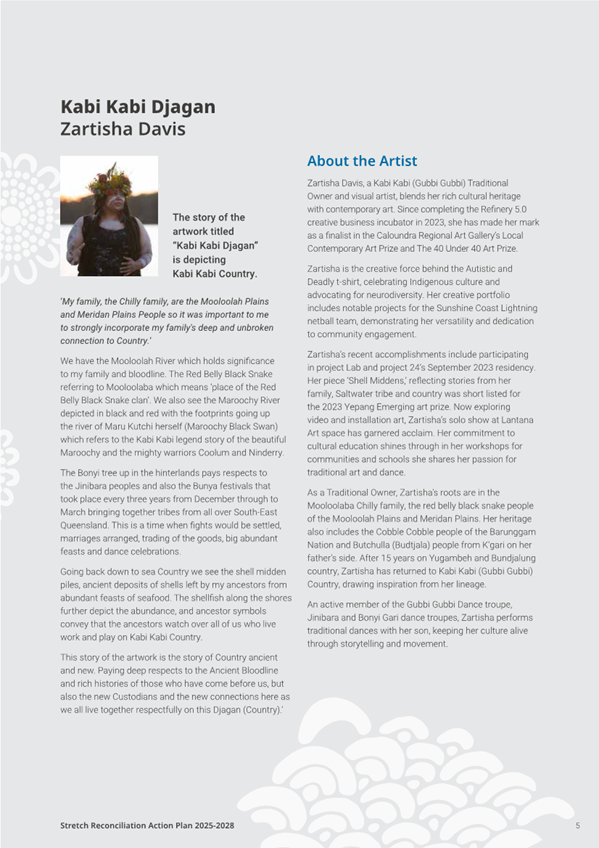
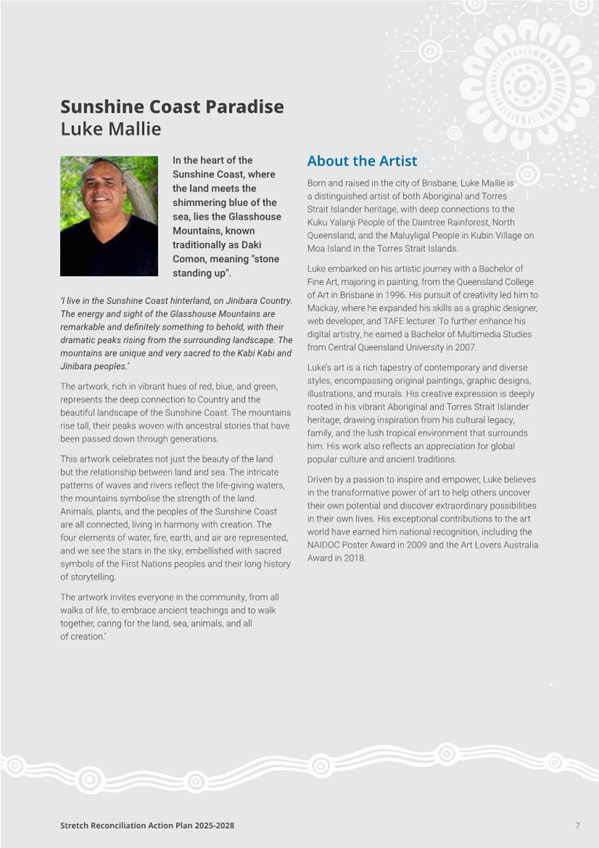
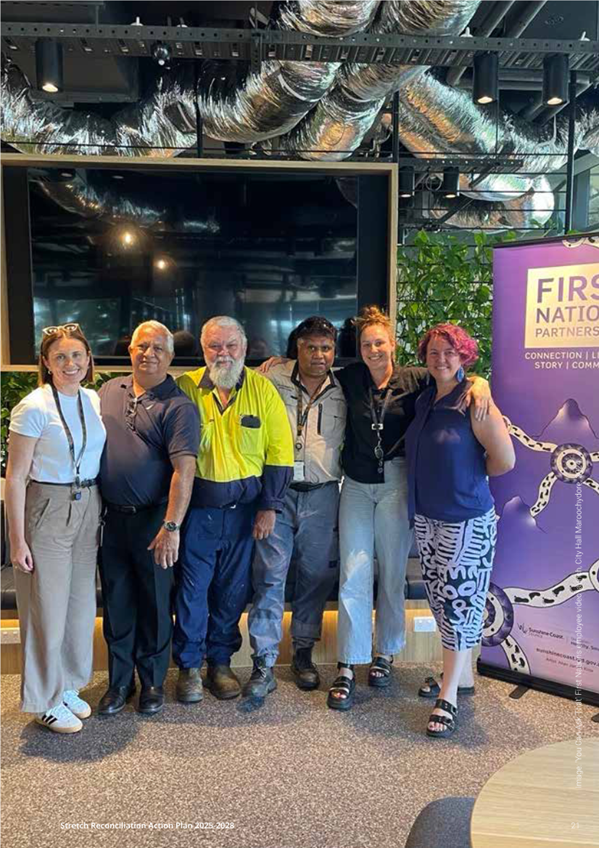
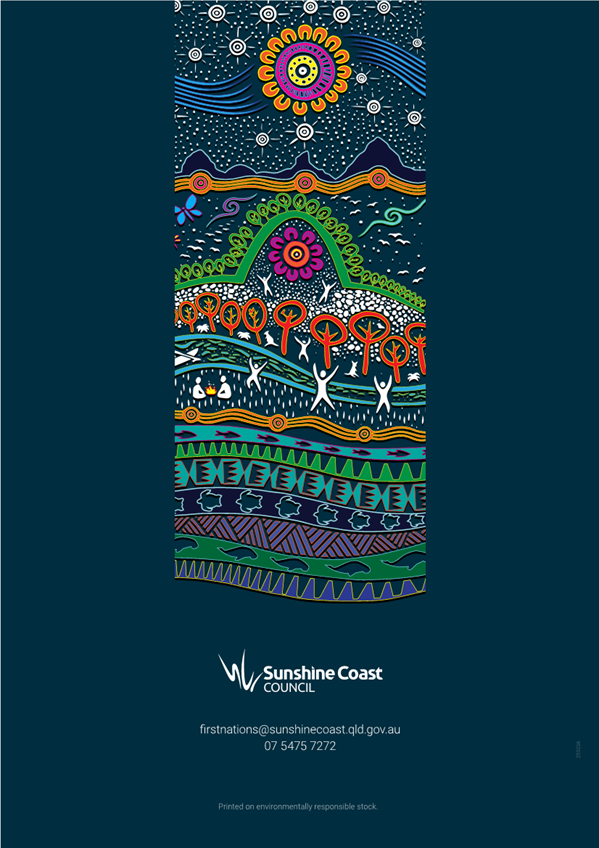
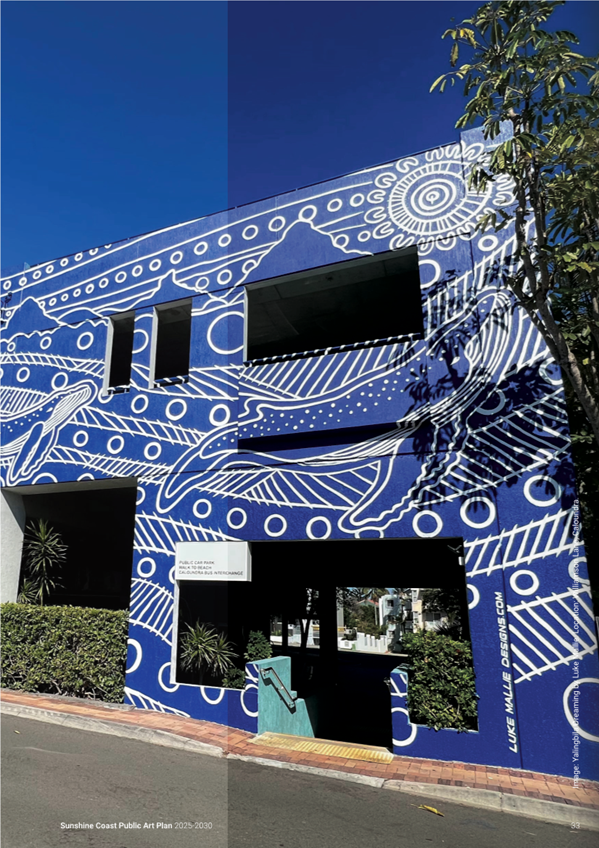
· Commissioning Stretch Reconciliation Action Plan artwork: Two new artworks were commissioned for use in the Stretch Reconciliation Action Plan and promotional material. An Expression of Interest process was undertaken inviting Aboriginal and/or Torres Strait Islander artists living on the Sunshine Coast to create a work that reflected the themes of Country or reconciliation. The two selected artists were Zartisha Davis (Kabi Kabi/Gubbi Gubbi) and Luke Mallie (Aboriginal and Torres Strait Islander). The artworks now form part of Council’s galleries collection.
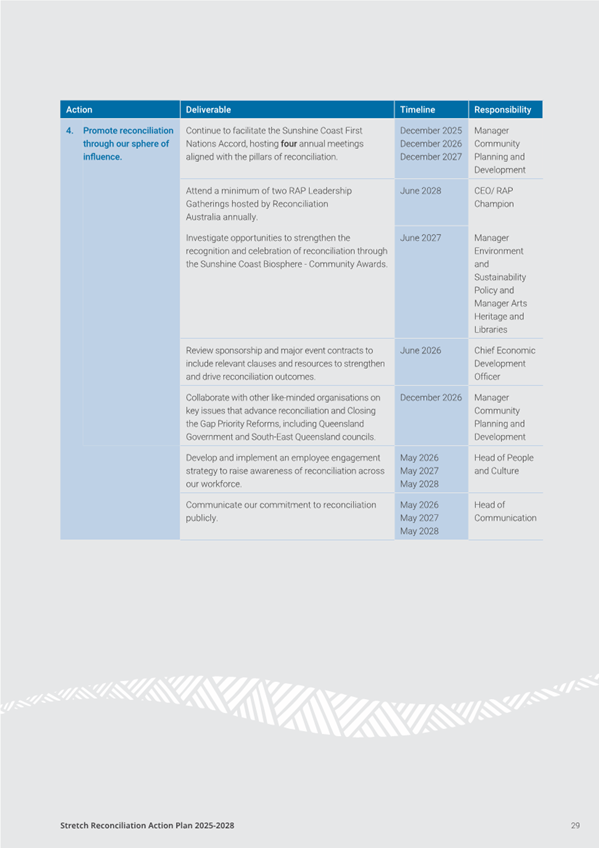
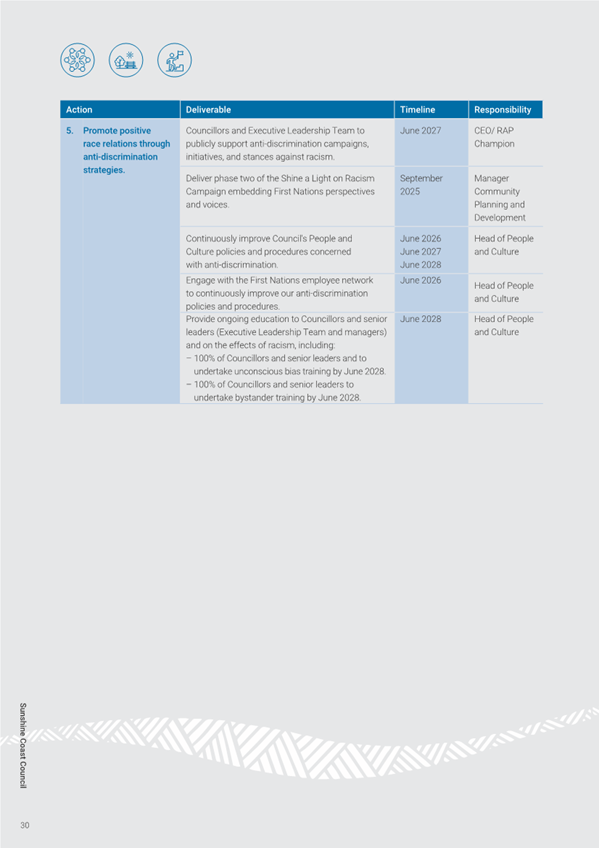
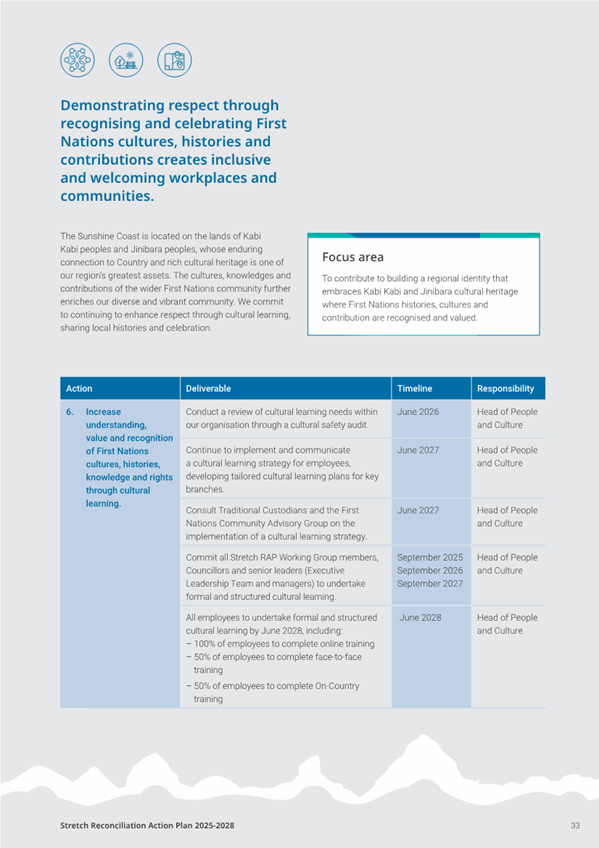
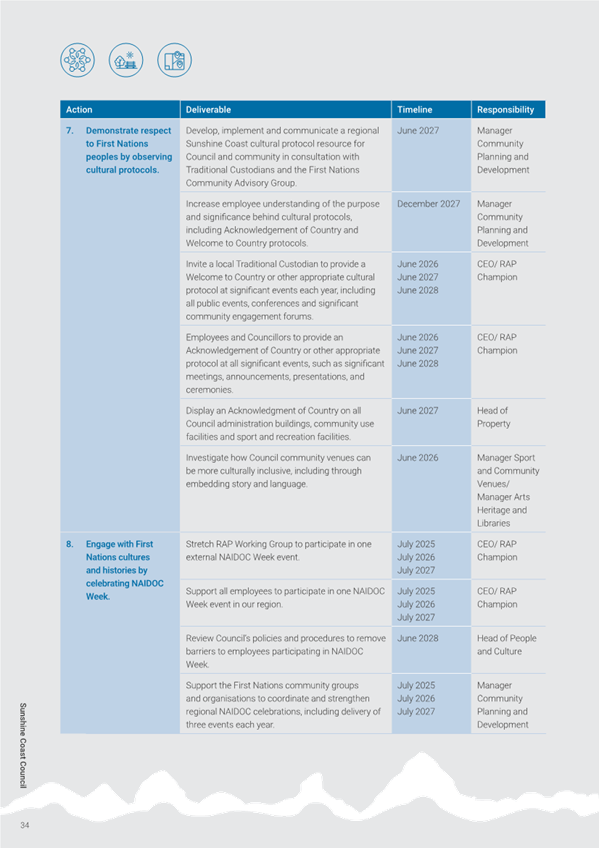
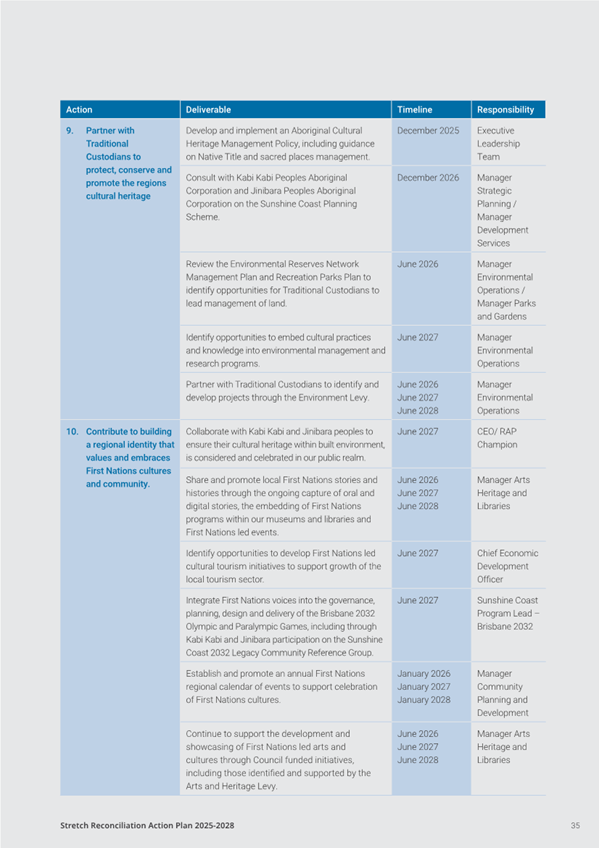
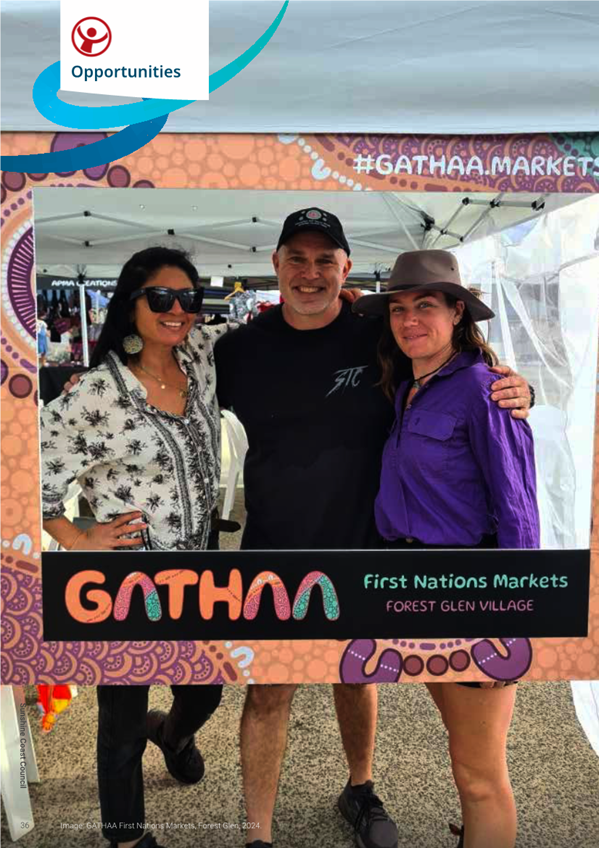
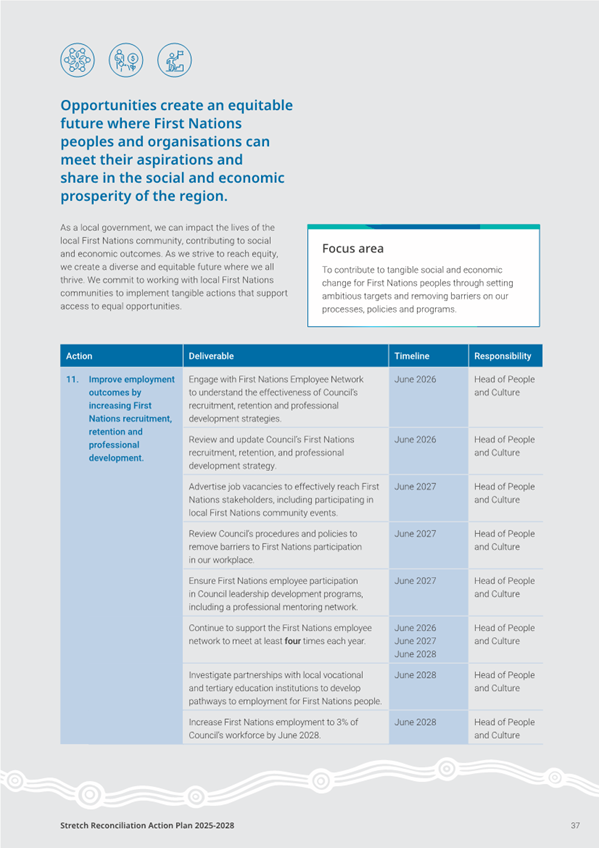
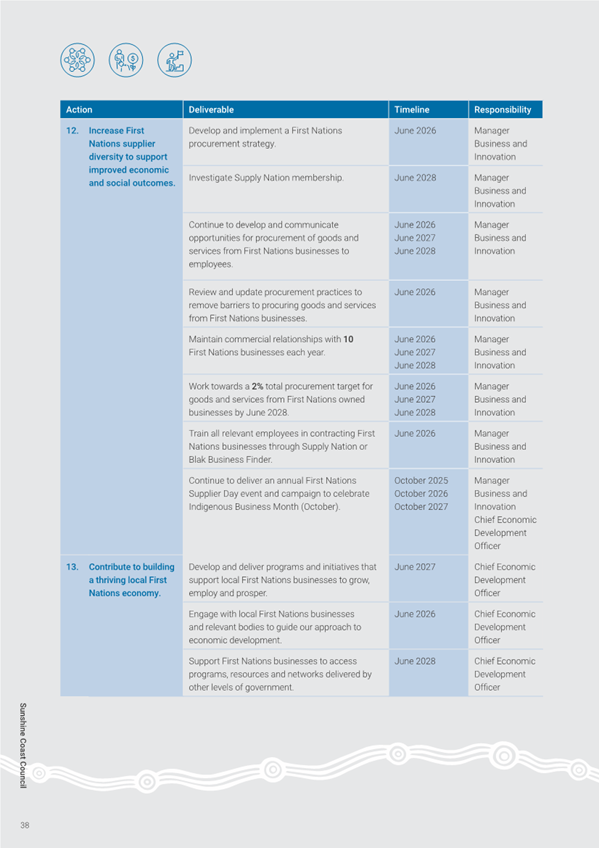
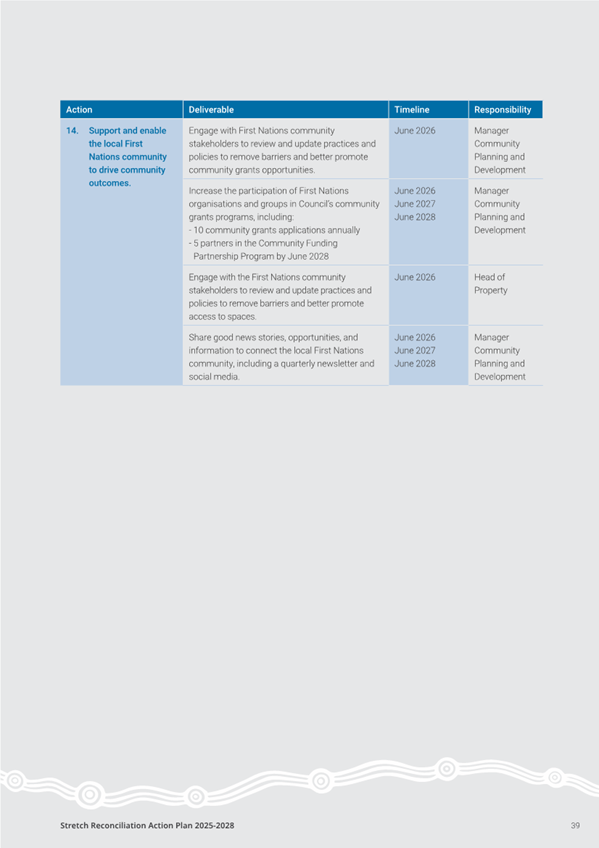
The Stretch Reconciliation Action Plan outlines 18 actions and 89 deliverables under the four reconciliation pillars: Relationships, Respect, Opportunities and Governance. Actions are enterprise-wide, aligning to and reinforcing objectives under Council’s three regional strategies and Corporate Plan.
The Stretch Reconciliation Action Plan focuses on embedding reconciliation into business as usual through long-term strategies, high impact commitments and measurable targets and goals. It sets a clear vision and practical steps for Council, its partners and the First Nations community to take in the next three to work toward advancing reconciliation.
While the framework and many actions remain the same as the previous Innovate Reconciliation Action Plan, there are several key changes reflecting the requirements of a Stretch Reconciliation Action Plan and the consultation feedback.
These key updates and focus areas of the Stretch Reconciliation Action Plan include:
|
Refreshed reconciliation vision |
Council’s reconciliation vision has been updated to align with priorities identified through engagement and to reflect Council’s regional impact as a leader in reconciliation. Council’s commitment to being a leader in First Nations engagement remains. |
|
Introduction of measurable targets |
Targets have been introduced across five key areas; anti-racism training, cultural awareness training, workforce representation, procurement and community grants and partnerships. The targets have been informed by measures including the current state, population parity and aspirational outcomes. Targets are a key feature of a Stretch Reconciliation Action Plan, enabling organisations to measure the impact of actions. |
|
Tailored actions and deliverables |
The actions and deliverables in the plan have been tailored to align to the core business of Council, including the addition of five unique actions. These actions reflect priorities identified through engagement including community engagement, cultural heritage, regional identity, economic development and community-led outcomes. |
|
Stronger partnerships and engagement |
There is a stronger focus on sustainable, reciprocal relationships with First Nations community stakeholders throughout the plan. This includes partnerships and engagement with Traditional Custodians, First Nations businesses and suppliers, First Nations community-led groups and organisations and the broader First Nations community. |
|
Leadership in sphere of influence |
The plan reflects a greater focus on opportunities for Council to influence the broader region. This includes forming strategic partnerships to drive reconciliation, promoting reconciliation and anti-discrimination, and alignment with closing the Closing the Gap Reform priorities. |
|
Strengthening accountability and transparency |
The requirement for accountability and transparency becomes greater with introduction of targets and long-term measures. This includes ensuring all actions are assigned to responsible managers and progress against the plan is reported regularly. |
Legal
There are no legal implications relevant to this report.
The Stretch Reconciliation Action Plan complies with, and supports the objectives of the following legislation:
· Local Government Act 2009 (QLD)
· Human Rights Act 2019 (QLD)
· The Aboriginal Cultural Heritage Act 2003 (QLD)
· Anti-Discrimination Act 1991 (QLD)
· The Native Title Act 1993 (Cth).
Policy
The Stretch Reconciliation Action Plan aligns with and reinforces objectives under Council’s endorsed regional strategies and Corporate Plan.
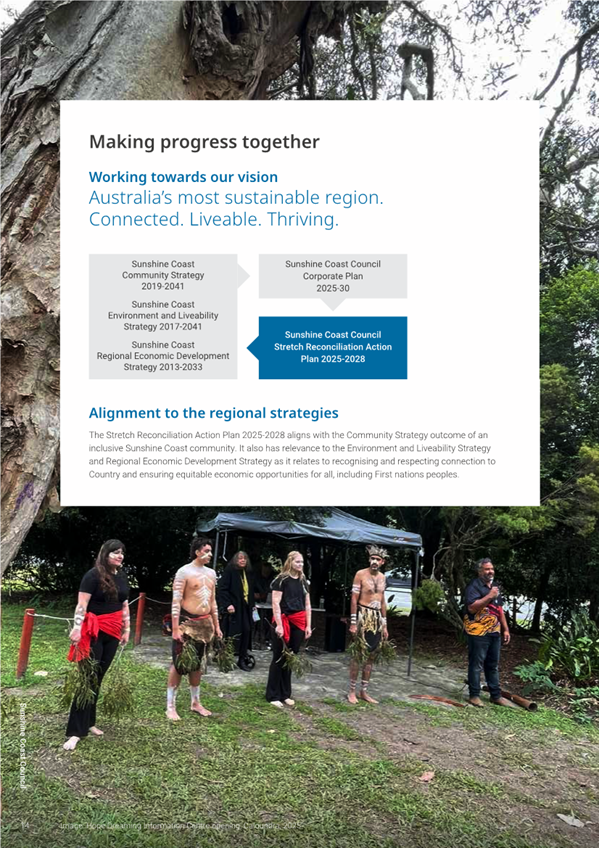
It directly supports to the Sunshine Coast Community Strategy 2019-2041 outcome of an inclusive Sunshine Coast community. It also has relevance to the Environment and Liveability Strategy and Regional Economic Development Strategy as it relates to recognising and respecting connection to Country and ensuring equitable economic opportunities for all.
Risk
There is a risk that if the Stretch Reconciliation Action Plan is not adopted Council does not have a structured framework for taking meaningful coordinated action toward its commitment to reconciliation.
Ordinary Meeting 25 March 2021 (OM21/21)
That Council:
(a) receive and note the report titled “Stretch Reconciliation Action Plan 2025-2028”
(b) adopt the Sunshine Coast Innovate Reconciliation Action Plan 2021-2022 (Appendix A)
(c) authorise the Chief Executive Officer to refer the Sunshine Coast Innovate Reconciliation Action Plan 2021-2022 to Reconciliation Australia for endorsement
(d) authorise the Chief Executive Officer to make minor administrative amendments to finalise the Sunshine Coast Innovate Reconciliation Action Plan 2021-2022 and
(e) refer the additional budget request of $155,000 for consideration in the 2021/22 budget processes.
Related Documentation
· Sunshine Coast Innovate Reconciliation Action Plan 2021-2022
· Sunshine Coast Community Strategy 2019-2041
· Sunshine Coast Council Corporate Plan 2025-2030.
Critical Dates
Implementation of the Stretch Reconciliation Action Plan will commence upon endorsement by Council and Reconciliation Australia.
Implementation
Should the recommendation be accepted by Council, it is noted that the Chief Executive Officer will:
· oversee finalisation of and refer the Stretch Reconciliation Action Plan 2025-2028 to Reconciliation Australia for final endorsement, and
· make the Stretch Reconciliation Action Plan 2025-2028 publicly available on Council’s website.
|
Ordinary Meeting Agenda Item 8.3 Stretch Reconciliation Action Plan 2025-2028 Appendix A Stretch Reconciliation Action Plan 2025-2028 |
24 July 2025 |





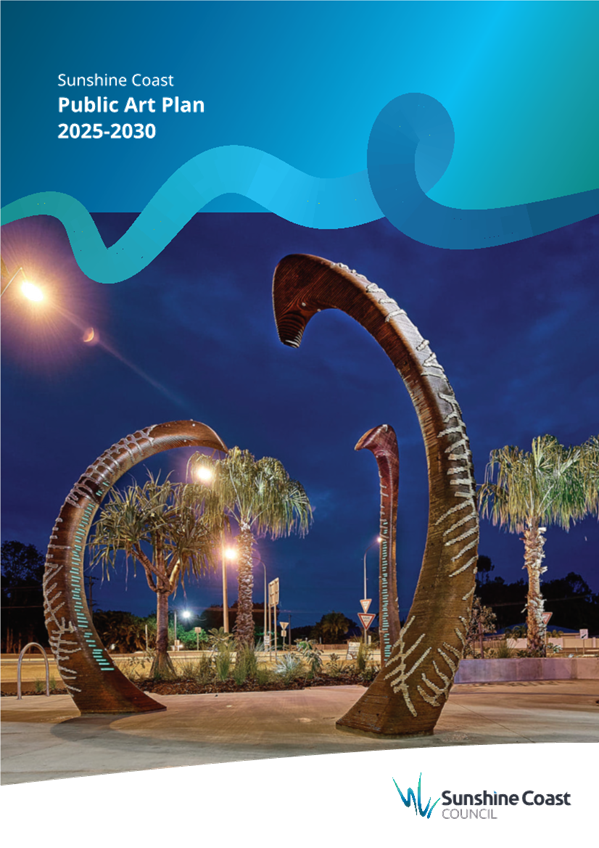
8.4 Sunshine Coast Public Art Plan 2025-2030
File No: Council Meetings
Author: Coordinator Creative Arts and Events
Economic & Community Development Group
Appendices: App
a - Sunshine Coast Public Art
Plan 2025-2030............ 223 ⇩
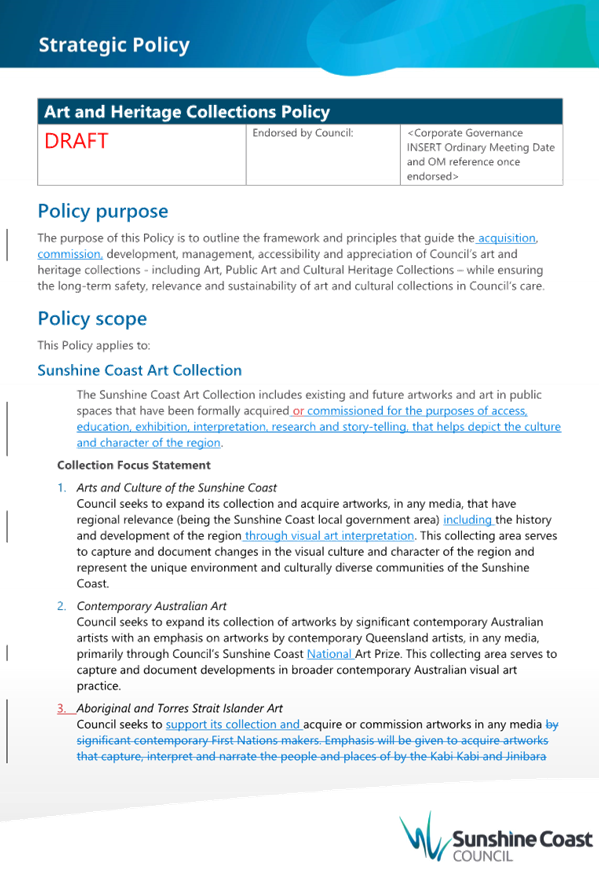
App
b - Art and Heritage Collections
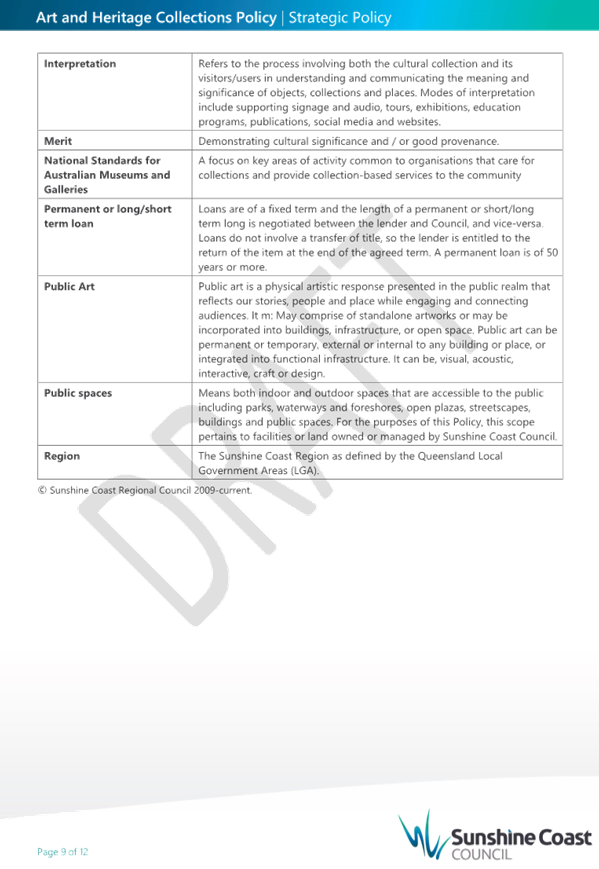
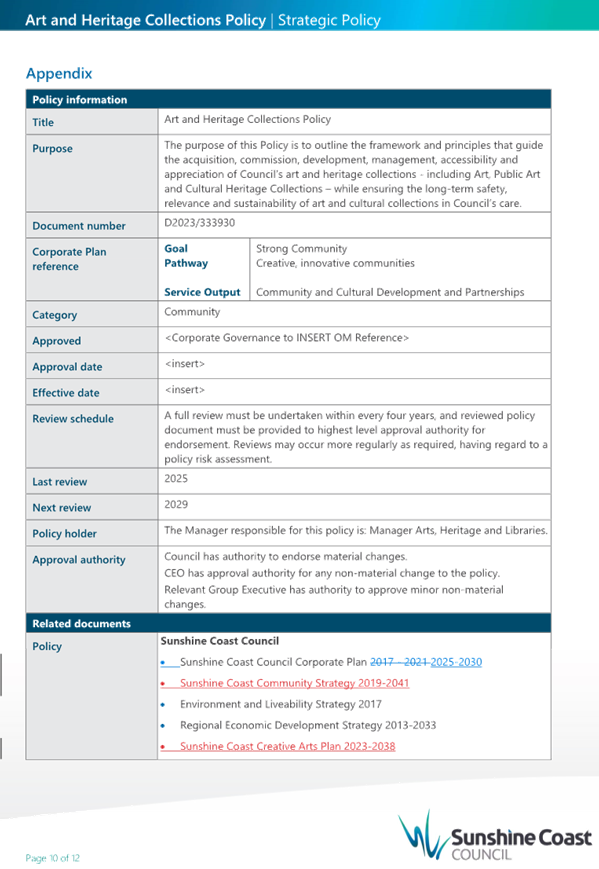
Policy 2025............... 261 ⇩
Attachments: Att
1 - Art and Heritage Collections
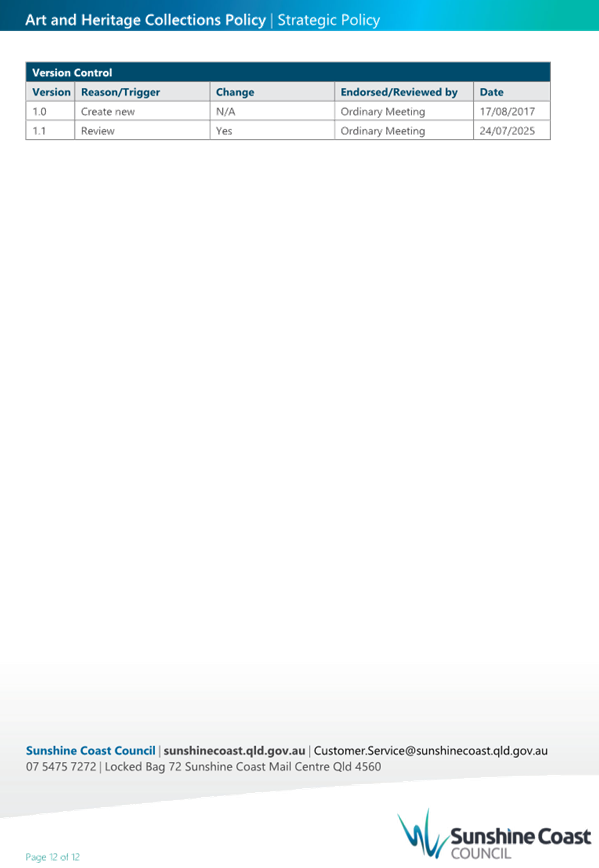
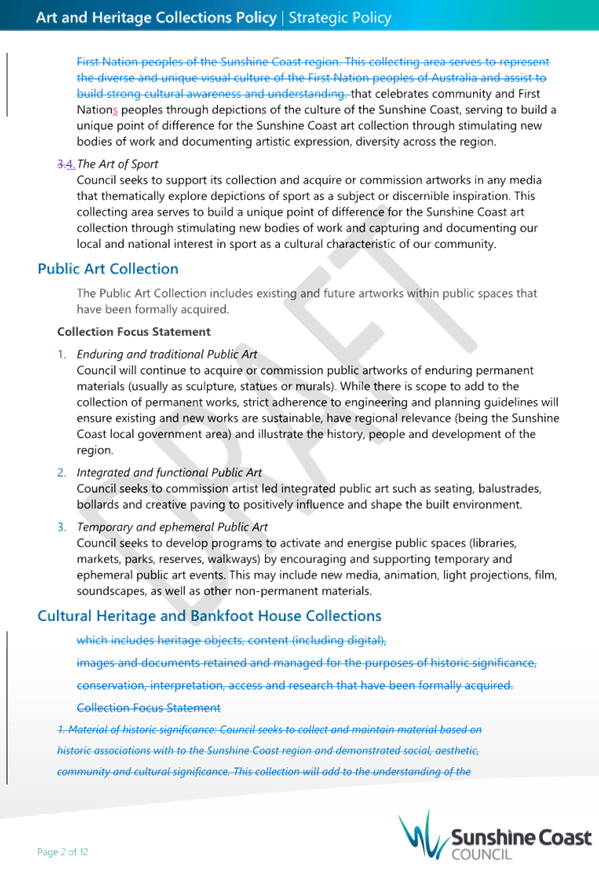
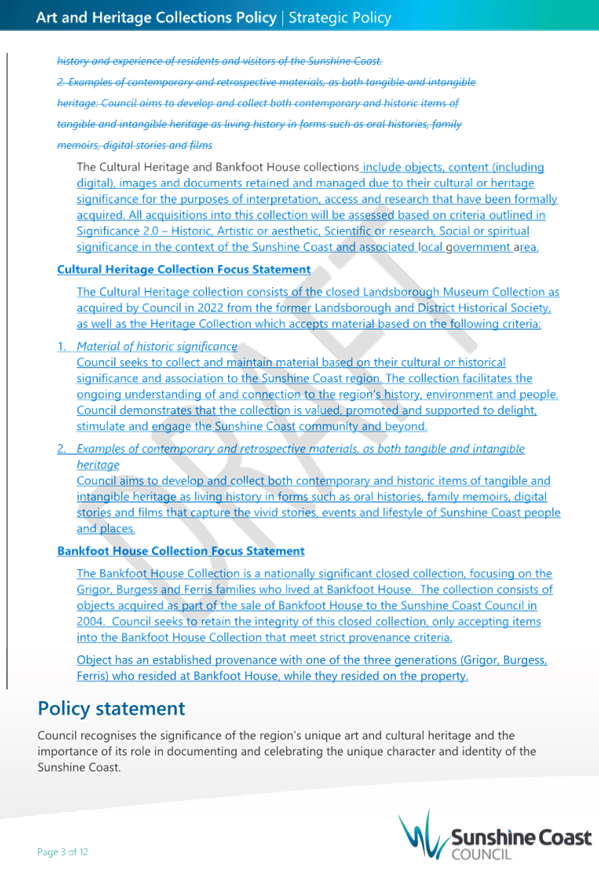
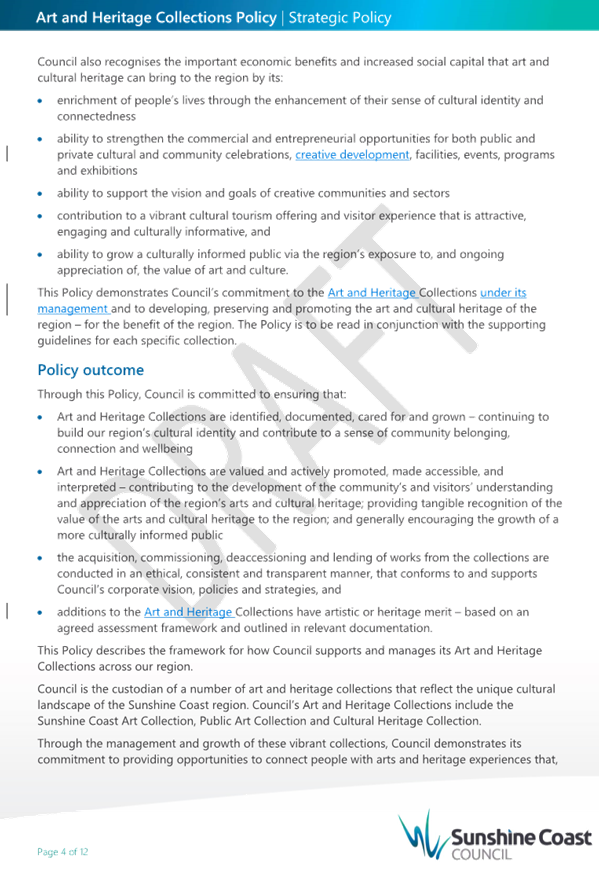
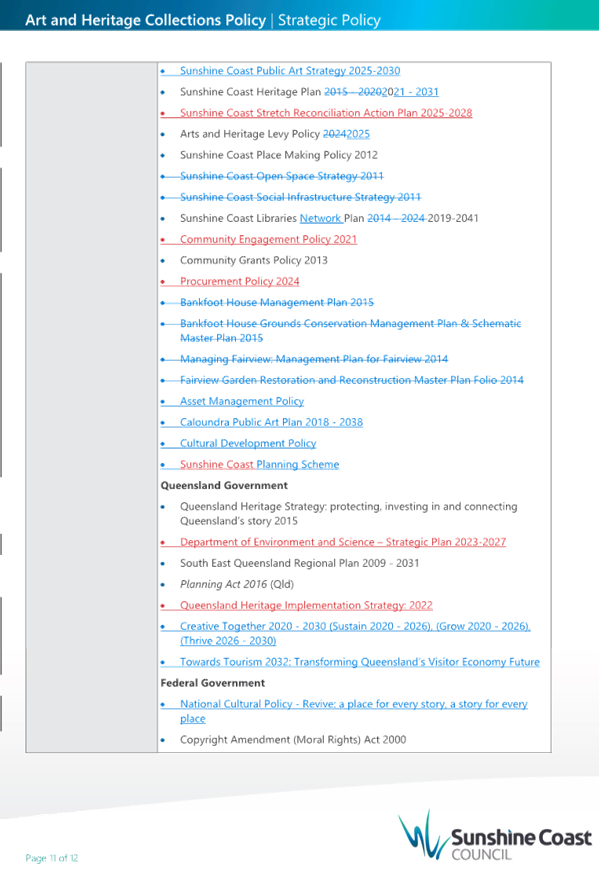
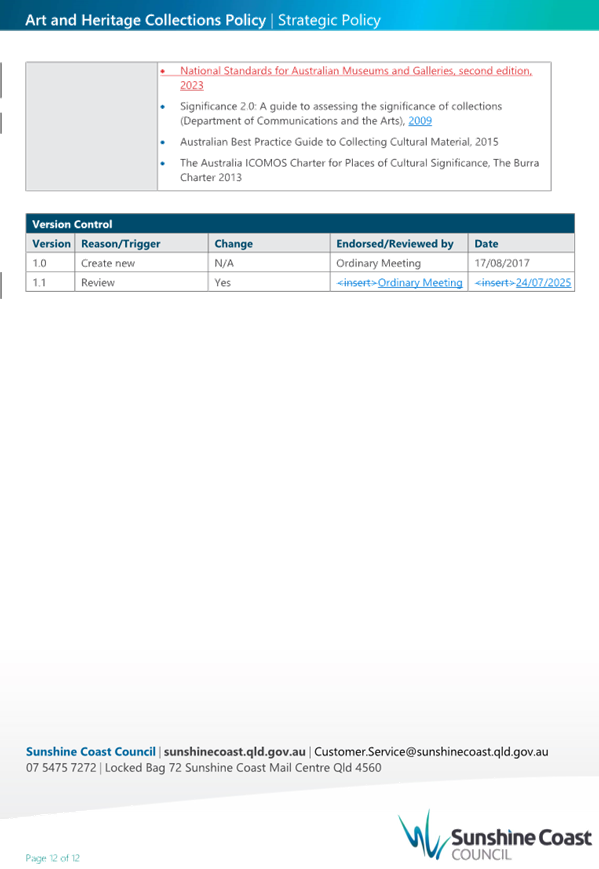
Policy 2025 (Tracked changes) 273 ⇩

purpose
This report provides the draft Sunshine Coast Public Art Plan 2025-2030 (Appendix A) for Council’s consideration. The Plan seeks to guide Council’s approach to public art in the region and how opportunities and challenges for the delivery and maintenance of public art are addressed, including improving collaboration with public and private partners and managing the collection into the future.
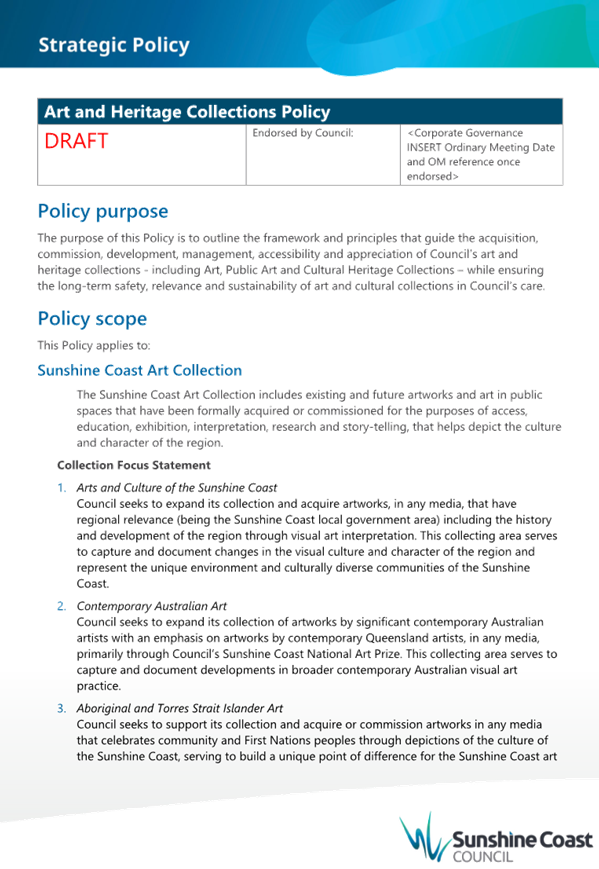
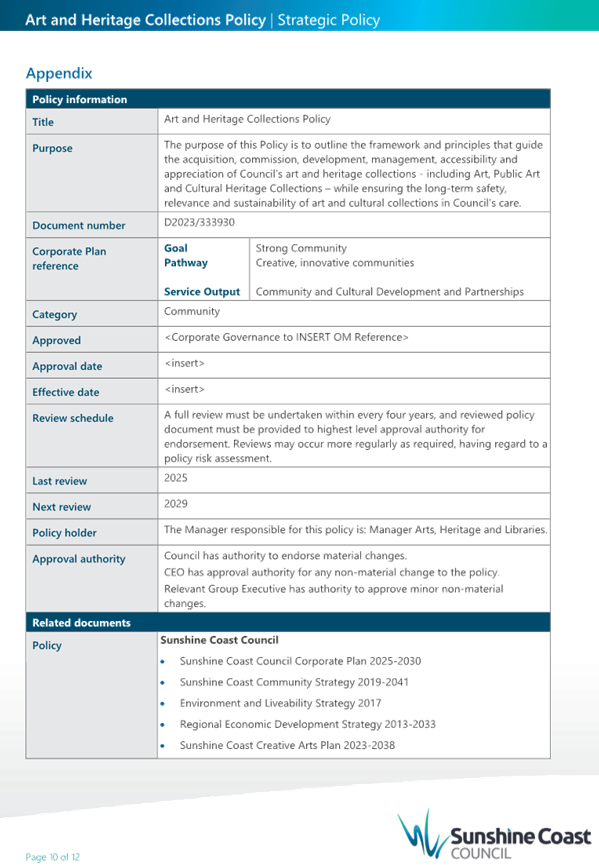
This report also seeks endorsement of the updated Art and Heritage Collections Policy 2025 (Appendix B).
Executive Summary
The Sunshine Coast Art Collection plays a significant role in celebrating the identity, culture and history of the community. The collection, managed by Council on behalf of the community, recorded a growing inventory of distinct and diverse works that are an important and enduring cultural asset.
In 2024, the Sunshine Coast Art Collection (art and public art) was valued at $6.6 million, an increase of more than $2.5 million since 2019. Of this, the public artworks are valued at $3.8 million.
With significant population growth, urban and greenfield development in the region, public art will have an important part to play in developing the cultural experiences in, and liveability of, our communities.
The Sunshine Coast Public Art Plan 2025-2030 (Appendix A) comes at an important time for arts and culture in the region, as public art is becoming a key consideration for many new developments. This includes Council’s own masterplans and urban designs in which public art is identified as delivering not only cultural benefits, but also social, economic and environmental benefits to the community.
The Sunshine Coast Public Art Plan will provide a framework to:
· enable a more focussed and considered approach to the development and distribution of public art so that it is meaningful and accessible to many
· ensure commissions reflect the richness and diversity of the region’s artistic practice while also growing and developing our public art sector
· provide opportunities for our First Nations community to have more prominent representation within the public art collection and programming and
· work collaboratively across Council and with our private and public partners to achieve the region’s vision and goals for the arts which is articulated in the Sunshine Coast Creative Arts Plan 2023-2038.
The five-year Sunshine Coast Public Art Plan includes actions to guide the development, planning, maintenance and promotion of our region’s public art collection.
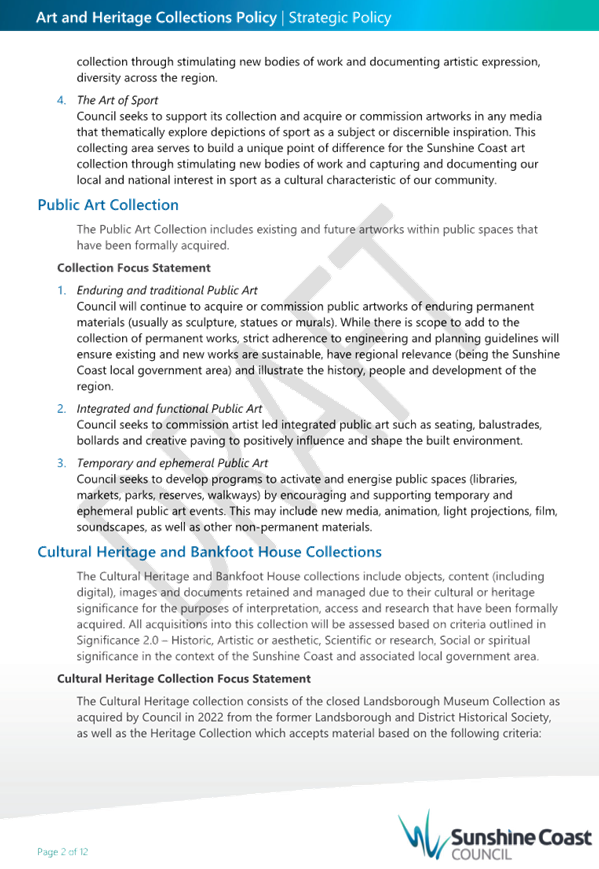
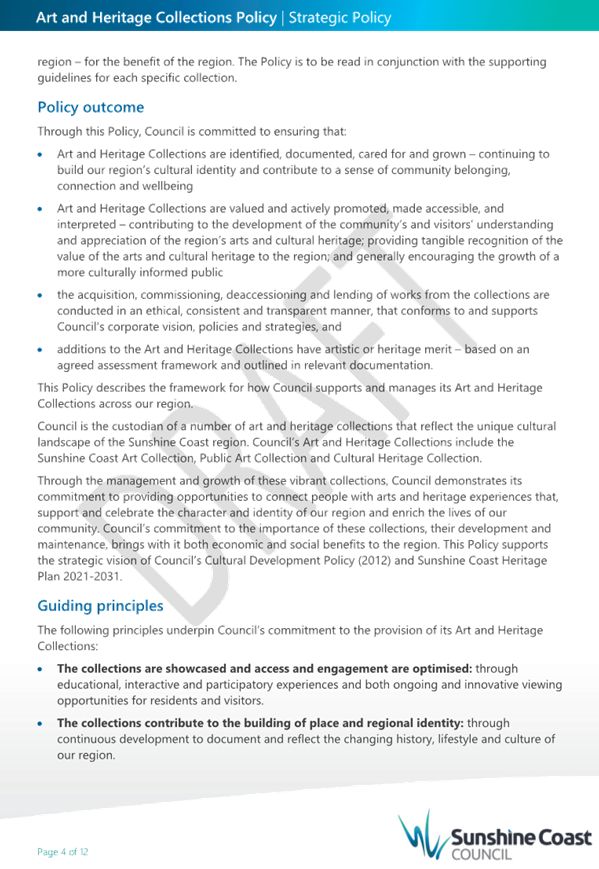
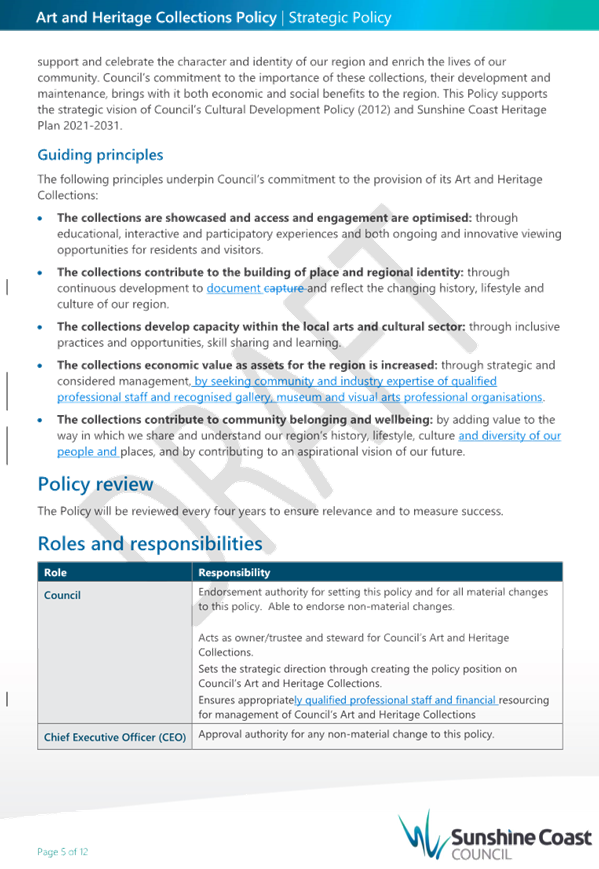
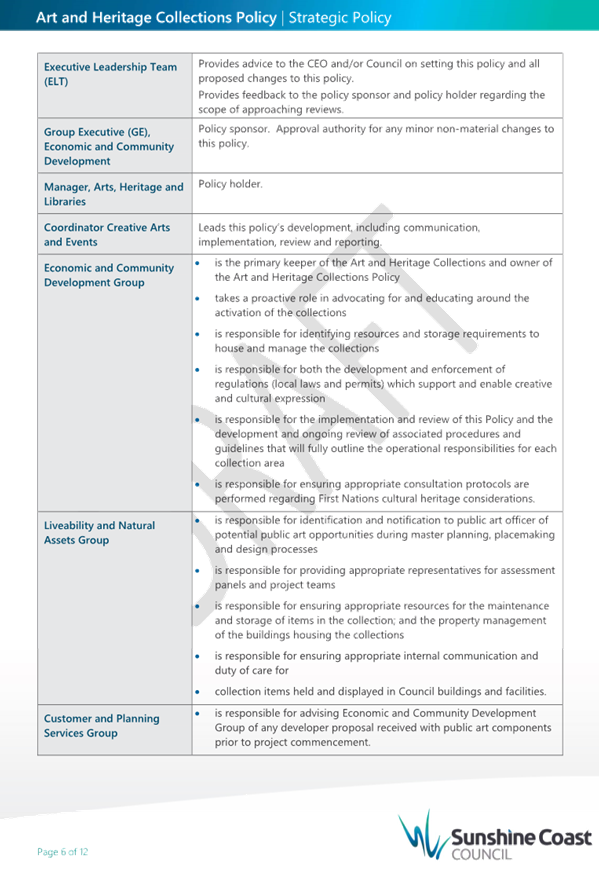
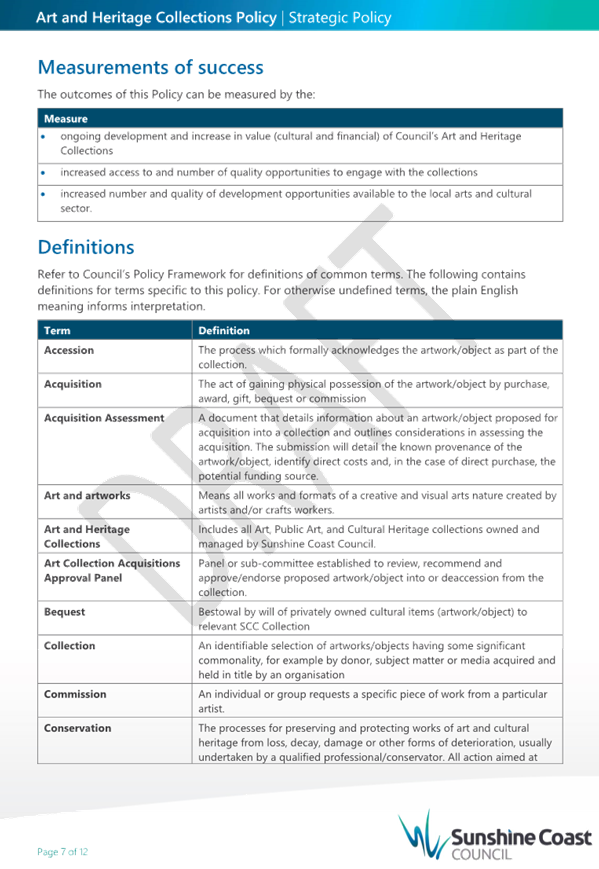
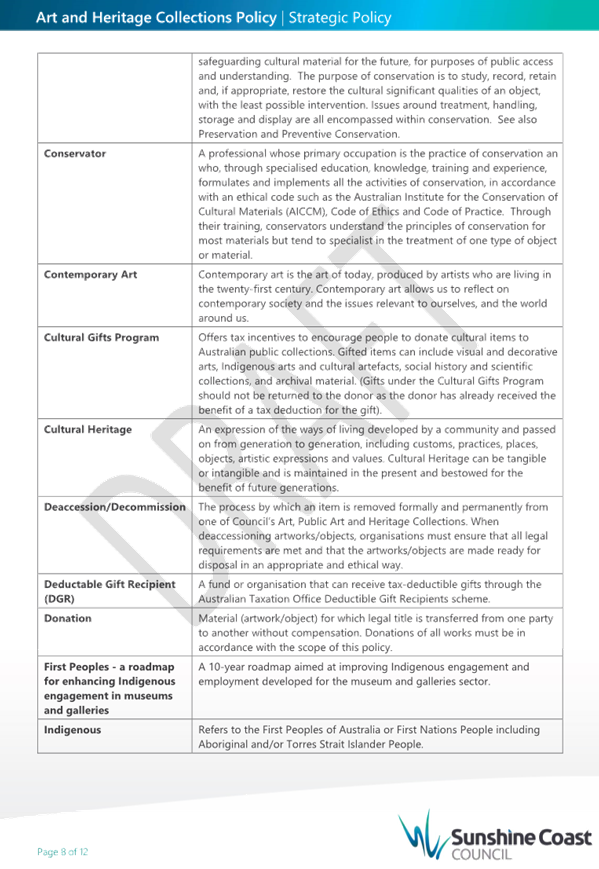
The Art and Heritage Collections Policy, previously endorsed in 2017 (Attachment 1), outlines the framework and principles required to manage Council’s three Art and Heritage Collections, namely:
· Sunshine Coast Art Collection
· Public Art Collection, and
· Cultural Heritage and Bankfoot House Collections.
The Art and Heritage Collections Policy is particularly relevant to the Sunshine Coast Public Art Plan and has been reviewed and updated to align with Council’s priorities. The updated Art and Heritage Collections Policy 2025 (Appendix B) is also presented for Council’s consideration.
The Art and Heritage Collections Policy 2025 sets the direction in relation to the collections, guiding their development, management and accessibility while also developing a public appreciation for the collections.
A minimal budget is provided to maintain the Sunshine Coast Art Collection.
Without a commissioning budget, the collections are developed via planning instruments (Public Art), the cultivation of donations, which are accepted only if they align to the Art and Heritage Collections Policy collection areas, and acquisitive art competitions such as the Sunshine Coast National Art Prize.
That Council:
(a) receive and note the report titled “Sunshine Coast Public Art Plan 2025-2030”
(b) adopt the Sunshine Coast Public Art Plan 2025-2030 (Appendix A) and
(c) adopt the Art and Heritage Collections Policy 2025 (Appendix B) to replace the Art and Heritage Collections Policy 2017.
Finance and Resourcing
This report has no financial impacts; however, Council will need to consider the ongoing operational costs of maintaining its growing collections as part of future budget considerations.
While the Sunshine Coast Public Art Plan has no budget requests, Focus Area 1 contains:
Action 1.4: ‘Review public art opportunities in the Planning Scheme to incorporate public and private developer commitment and contribution, including a percent-for-art scheme and framework.’
This percent-for-art scheme and framework will be captured and taken to community consultation via the upcoming Planning Scheme review. It is envisaged, if this framework is supported and endorsed, that it will provide a contribution to the funding required to deliver the Sunshine Coast Public Art Plan.
Corporate Plan
Corporate Plan Goal: Strong community
Outcome: 1.5 - Creative, innovative communities
Operational Activity: 1.5.2 - Deliver priority projects as outlined in the Sunshine Coast Heritage Plan 2021-2031 and annual Heritage Levy Program, including a Regional Collections store and managing Council's museums and cultural collections; programming of Landsborough Museum and Bankfoot House, and deliver grants for the heritage sector and our First Nations traditional owners.
Consultation
Councillor Consultation
All Councillors were consulted regarding the Sunshine Coast Public Art Plan 2025-2030.
Internal Consultation
· Chief Executive Officer
· Group Executive, Economic and Community Development
· Manager Arts, Heritage and Libraries
· Coordinator Cultural Heritage Services
· Manager and Curator, Caloundra Regional Gallery
· Senior Collections Curator
· Public Art Curator
· Manager Strategy and Policy
· Governance Policy Lead
· Drafting Lead, New Planning Scheme, Strategic Planning
· Principal Strategic Planner, Strategic Planning
External Consultation
· Sunshine Coast Arts Advisory Board
· First Nations representatives
· Local creative practitioners, and
· Representatives of the local planning and development industry (public and private sectors).
Community Engagement
There has been no broad community engagement, however the proposed future Planning Scheme consultation is relevant to this report, specifically as it applies to the ‘Percent-for-Art Scheme’ (Sunshine Coast Public Art Plan 2025-2030: Action 1.4).
Proposal
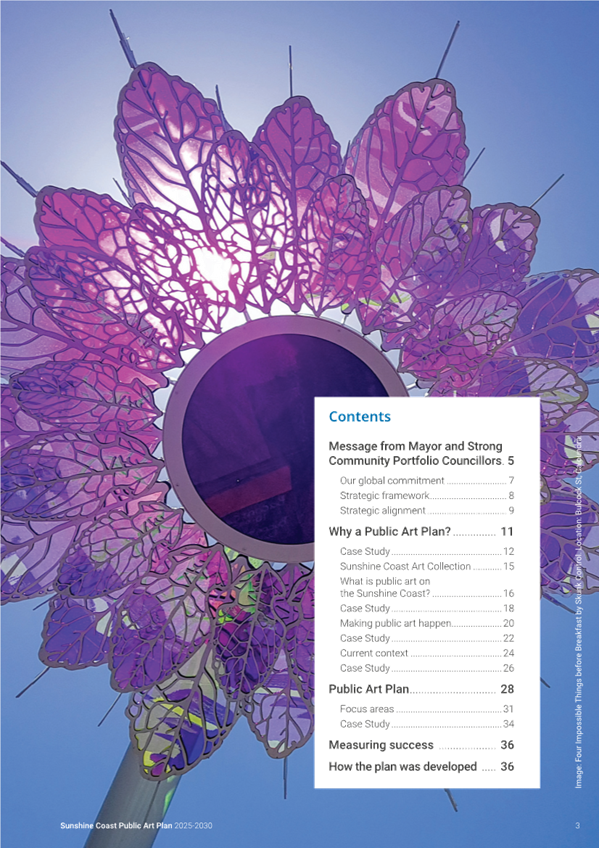
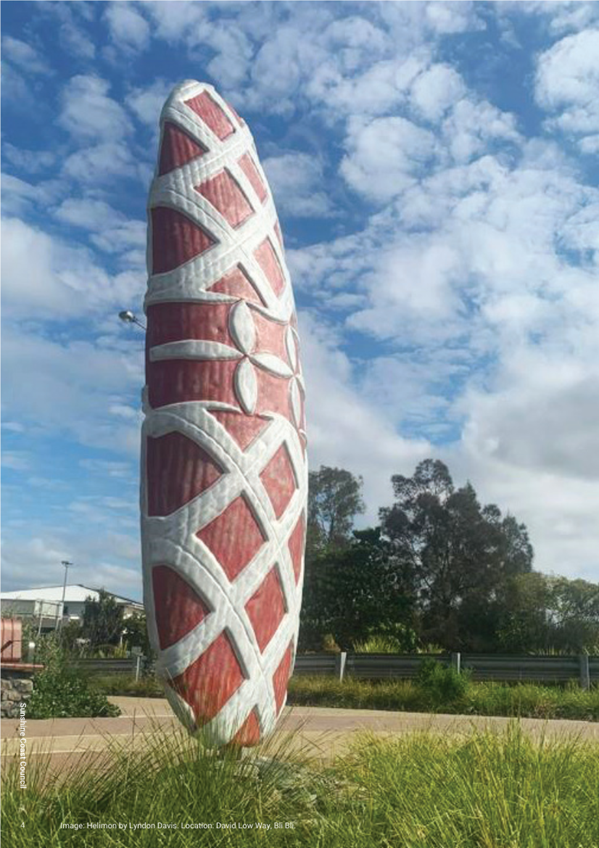
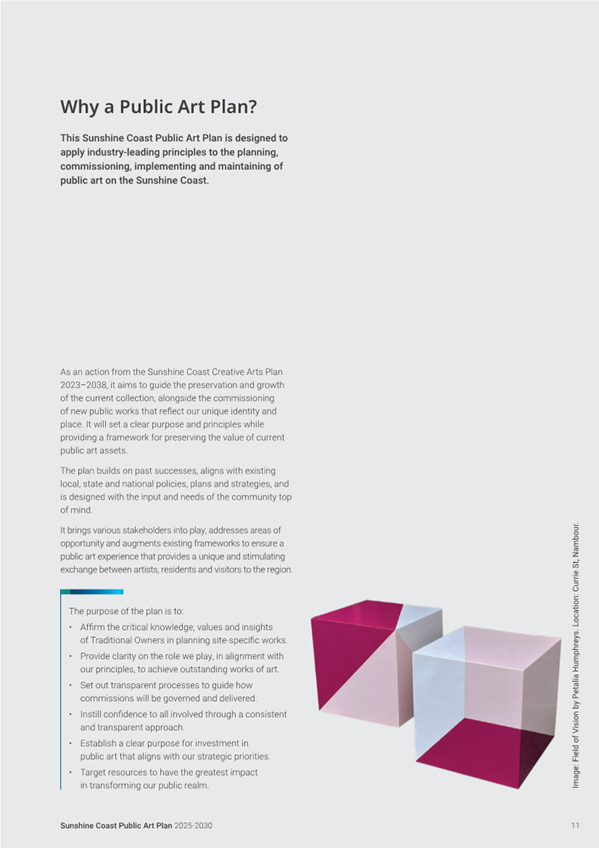
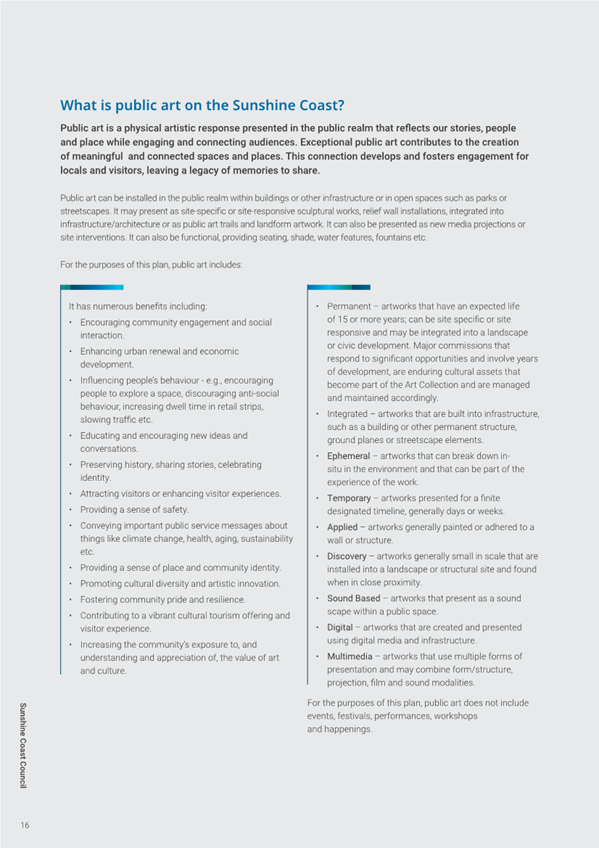
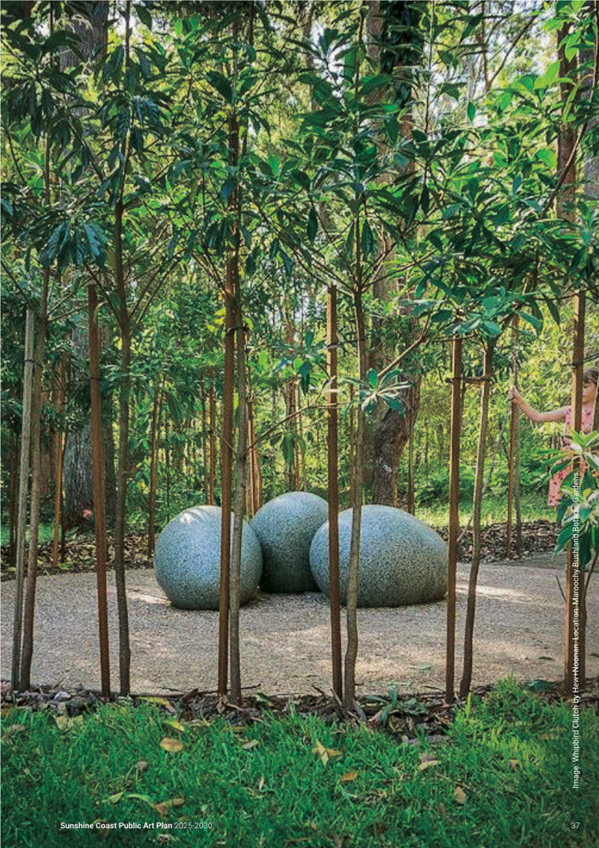
The Sunshine Coast Public Art Plan 2025-2030 (Appendix A) is provided for Council’s consideration. The Plan is designed to apply industry-leading principles to the planning, commissioning, implementing, management, promotion and maintaining of public art on the Sunshine Coast.
It will guide the commissioning and implementation of new public artworks, so that they reflect our unique identity and place, and set both a clear purpose and principles as our blueprint for future investment in public art. It will also encourage positive engagement and interactions with public art via promotion, programming and maintenance of the collection so that it is available for all to enjoy now and into the future.
It acknowledges the various stakeholders, addresses areas of opportunity, and augments existing frameworks to ensure a public art experience that provides a unique and stimulating exchange between artists, and residents and visitors to our region.
The rationale for developing the Plan is to:
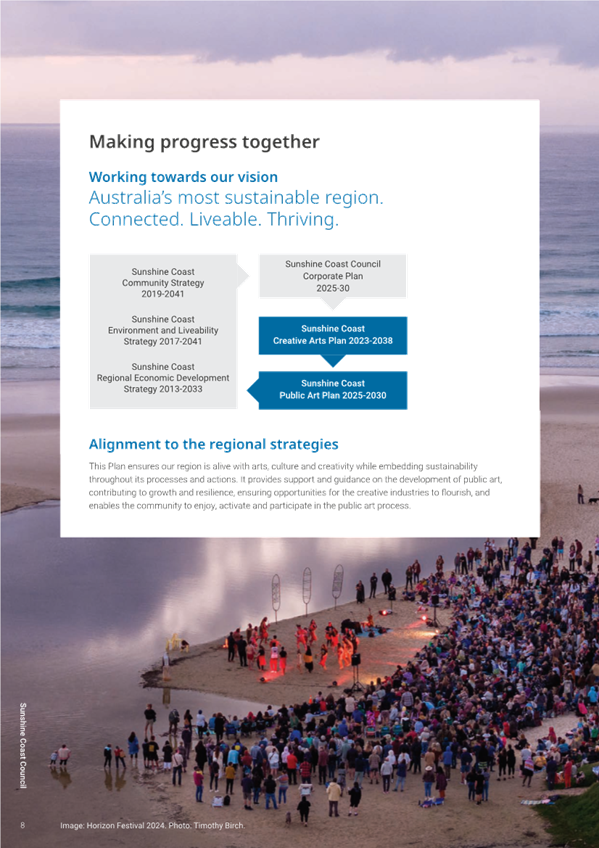
· provide clarity on the role we play, and in alignment with the Sunshine Coast Creative Arts Plan 2023-2038 principles, to achieve outstanding works of art
· establish transparent processes to guide how commissioned artwork will be governed and delivered
· affirm the critical knowledge, values and insights of Traditional Custodians in planning site-specific works
· instil confidence that a consistent and transparent approach is used
· establish a clear purpose behind the investment in public art that aligns with our strategic priorities and
· focus resources to have the greatest impact when it comes to transforming the region’s public art realm.
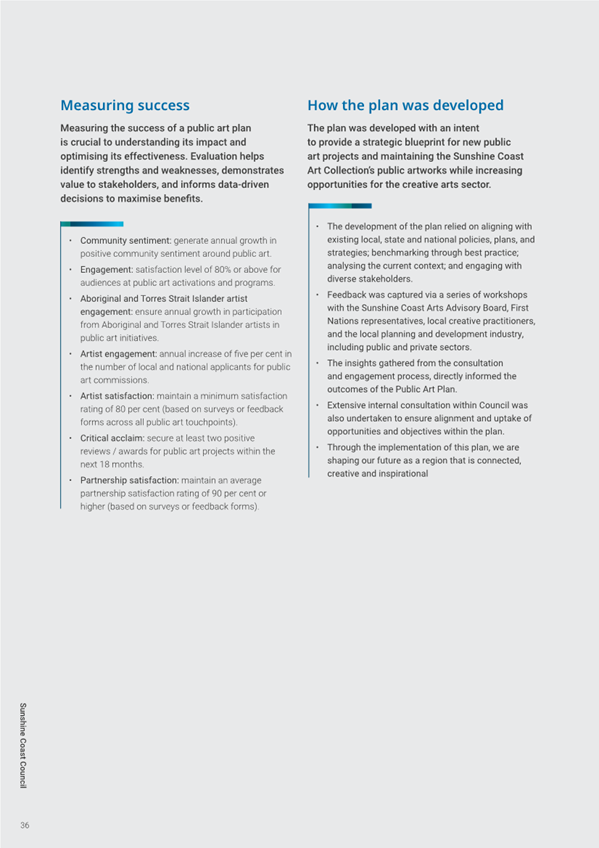
The development of the Sunshine Coast Public Art Plan aligns with existing local, state and national policies, plans, and strategies.
Its development included:
· benchmarking – finding and reflecting on best practice
· analyses of the current context within the region and the sector and
· engaging with diverse internal and external stakeholders.
Consultation to date has revealed the challenges and opportunities specific to public art.
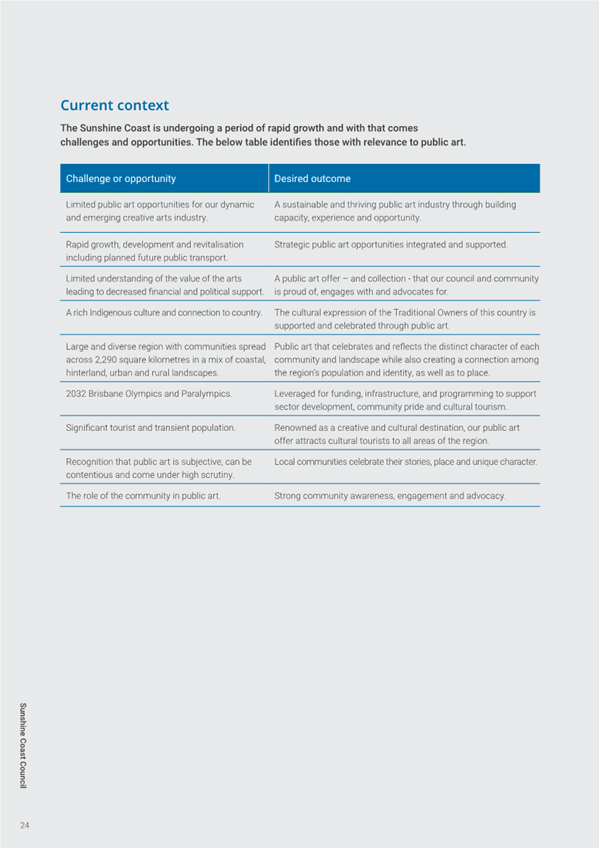
|
Challenge or opportunity |
Desired outcome |
|
Limited public art opportunities for our dynamic and emerging creative arts industry |
A sustainable and thriving public art industry through building capacity, experience and opportunity. |
|
Rapid growth, development and revitalisation including planned future public transport |
Strategic public art opportunities integrated and supported. |
|
Limited understanding of the value of the arts leading to decreased financial and political support |
A public art offer – and collection - that our Council and community is proud of, engages with and advocates for. |
|
A rich Indigenous culture and connection to country |
The cultural expression of the Traditional Custodians of this country is supported and celebrated through public art. |
|
Large and diverse region with communities spread across 2,290 square kilometres in a mix of coastal, hinterland, urban and rural landscapes |
Public art that celebrates and reflects the distinct character of each community and landscape while also creating a connection among the region’s population and identity, as well as to place. |
|
Brisbane 2032 Olympic and Paralympic Games |
Leveraged for funding, infrastructure, and programming to support sector development, community pride and cultural tourism. |
|
Significant tourist and transient population |
Renowned as a creative and cultural destination, our public art offer attracts cultural tourists to all areas of the region. |
|
Recognition that public art is subjective, can be contentious and come under high scrutiny |
Local communities celebrating their stories, place and unique character. |
|
The role of the community in public art |
Strong community awareness, engagement and advocacy. |
Table 1. Public art challenges, opportunities and desired outcomes
Consultation, research and benchmarking has informed the Sunshine Coast Public Art Plan. It is guided by a curatorial vision of:
Art for conversation
Sunshine Coast public art will spark meaningful conversations, challenge perspectives, tell the stories of a vibrant and diverse community of communities, enhance public space, increase a sense of belonging and celebrate heritage and identity.
Our cultural landscape will inspire curiosity, creativity, and connection, celebrating the rich history and culture of the region while embracing the modern and eclectic spirit of a sustainable Sunshine Coast.
The Sunshine Coast Public Art Plan outlines four focus areas that support a commitment to excellence, community and creativity. The focus areas are intended to inform decision-making, inspire actions, and ensure that public art reflects the region’s spirit and character:
1. Governance – We provide the frameworks to ensure our public spaces continue to be a source of pride and inspiration for the community and visitors to the region.
2. Capacity development – Our artists share knowledge, gain experience and create opportunities that support the growth and development of our region’s arts industry.
3. Promotion and advocacy – Our artists bring meaning to place with experimental and innovative works that inspire, challenge and engage audiences.
4. Public art collection – We document and celebrate the character and identity of the Sunshine Coast for current and future generations.
Art and Heritage Collections Policy
The Art and Heritage Collections Policy was last reviewed and endorsed by Council in 2017 and has been reviewed and updated to align with Council priorities, plans and strategies, including the Sunshine Coast Public Art Plan 2025-2030.
This report seeks to replace the current Art and Heritage Collections Policy 2017 with the Art and Heritage Collections Policy 2025 (Appendix B).
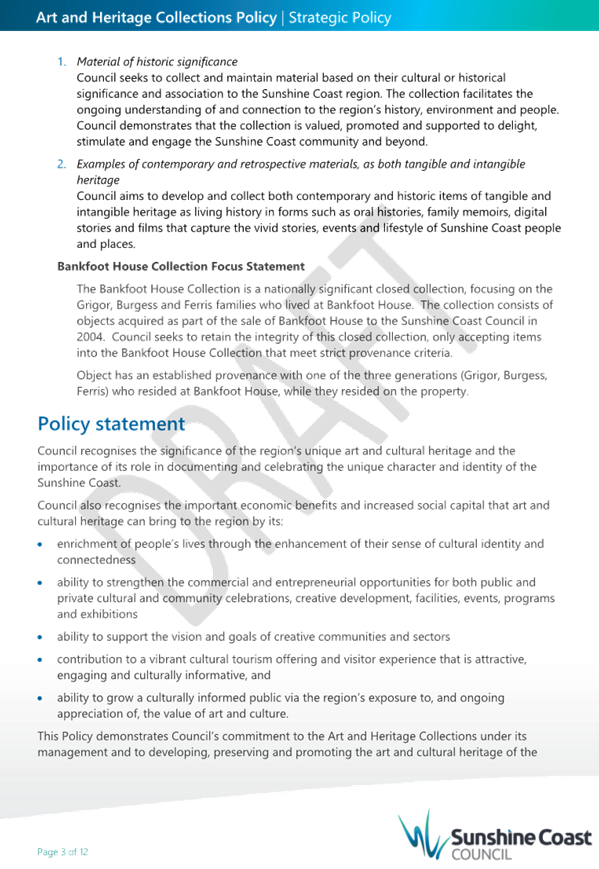
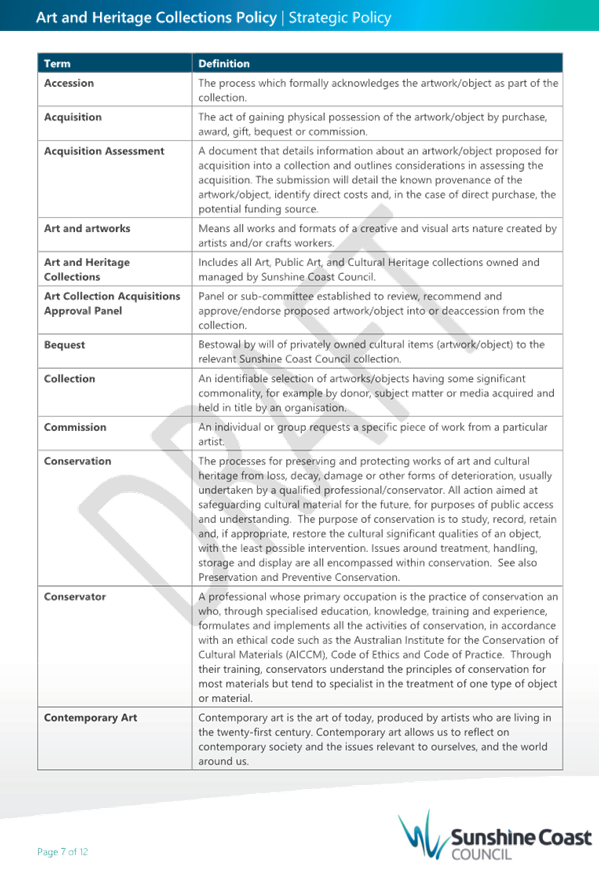
The Art and Heritage Collections Policy outlines a framework, and principles required to manage Council’s three Art and Heritage Collections, namely:
· Sunshine Coast Art Collection
· Public Art Collection, and
· Cultural Heritage Collection.
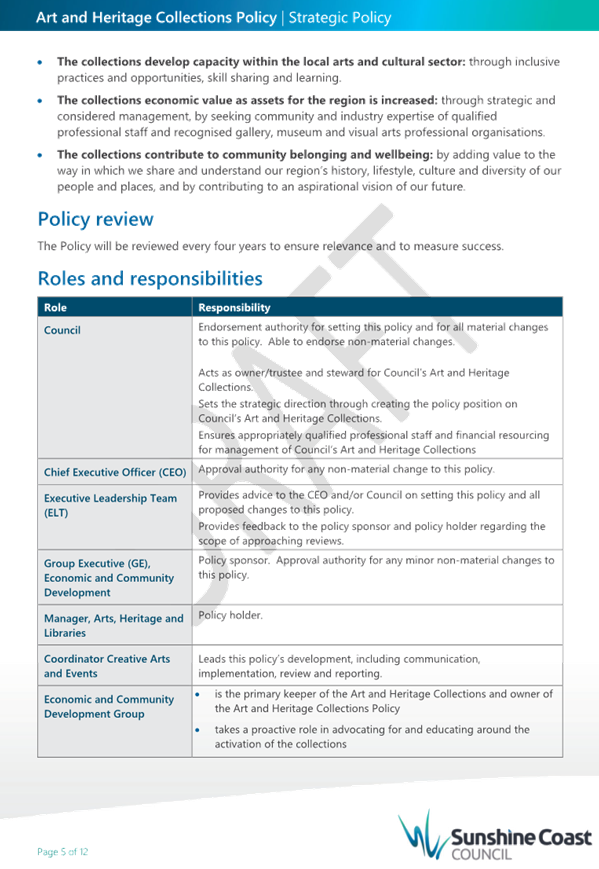
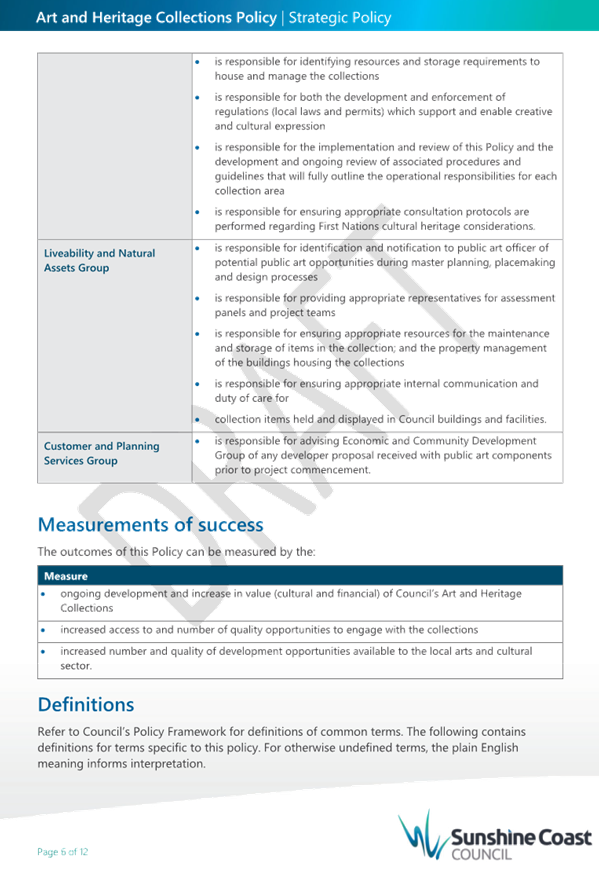
The Art and Heritage Collections Policy sets the policy direction in relation to the collections to guide their development, management and accessibility while also developing a public appreciation for the collections. The Art and Heritage Collections Policy is considered critical to ensuring the long-term safety, relevance and sustainability of art and cultural collections in Council’s care.
Through the Art and Heritage Collections Policy, Council will be able to ensure:
· Art and Heritage Collections are identified, documented, cared for and developed – continuing to build our region’s cultural identity and contribute to a sense of community belonging, connection and wellbeing.
· Art and Heritage Collections are valued and actively promoted, made accessible, and interpreted – contributing to the development of the community’s and visitors’ understanding and appreciation of the region’s arts and cultural heritage; providing tangible recognition of the value of the arts and cultural heritage to the region; and generally encouraging the growth of a more culturally informed public.
· The acquisition, commissioning, deaccessioning and lending of works from the collections are conducted in an ethical, consistent and transparent manner, that conforms to and supports Council’s corporate vision, policies and strategies.
· Additions to the collections have artistic or heritage merit – based on an agreed assessment framework and outlined in relevant documentation. To grow, activate and continue to develop programming around the collections, ongoing financial support will be required.
Legal
There are no legal implications relevant to this report.
Developers’ concerns have typically been resolved through revisions or adjustments to the schemes. Councils have often responded by introducing more flexibility, such as allowing contributions to public art funds instead of direct commissioning.
Policy
The Art and Heritage Collections Policy 2025 has been reviewed and updated to ensure alignment with the Sunshine Coast Public Art Plan 2025-2030.
Risk
Without an endorsed position on the provision and care of public art in the region, there is a risk that a non-strategic approach to the delivery and support of public art will occur.
Previous Council Resolution
Ordinary Meeting 17 August 2017 (OM17/145)
That Council:
(a) receive and note the report titled “Art and Heritage Collections Policy”
(b) revoke the current Public Art Policy (2011)
(c) adopt the Art and Heritage Collections Policy (Appendix A) as amended, noting the addition of a Fourth Collection Focus Area “The Art of Sport” and
(d) authorise the Chief Executive Officer to make minor amendments as required to finalise the Art and Heritage Collections Policy 2017.
Related Documentation
There is no related documentation relevant to this report, however it is to be noted that the Sunshine Coast Planning Scheme, currently out for consultation, is relevant to the Sunshine Coast Public Art Plan 2025-2030.
Critical Dates
There are no critical dates relevant to this report.
Implementation
Should the recommendation be accepted by Council, it is noted that the Chief Executive Officer will implement the Sunshine Coast Public Art Plan 2025-2030, as outlined in this report.
|
Ordinary Meeting Agenda Item 8.4 Sunshine Coast Public Art Plan 2025-2030 Appendix A Sunshine Coast Public Art Plan 2025-2030 |
24 July 2025 |


|
Ordinary Meeting Agenda Item 8.4 Sunshine Coast Public Art Plan 2025-2030 Appendix B Art and Heritage Collections Policy 2025 |
24 July 2025 |
|
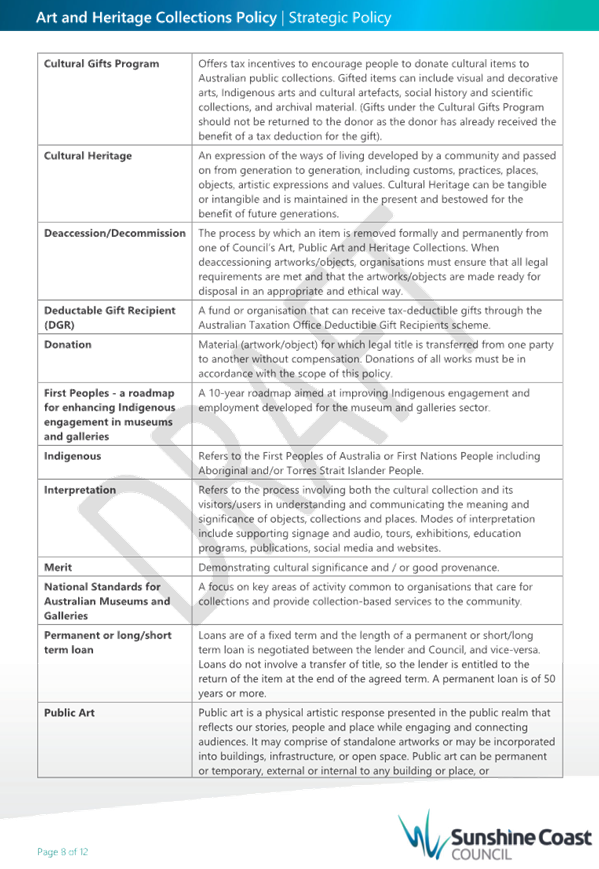
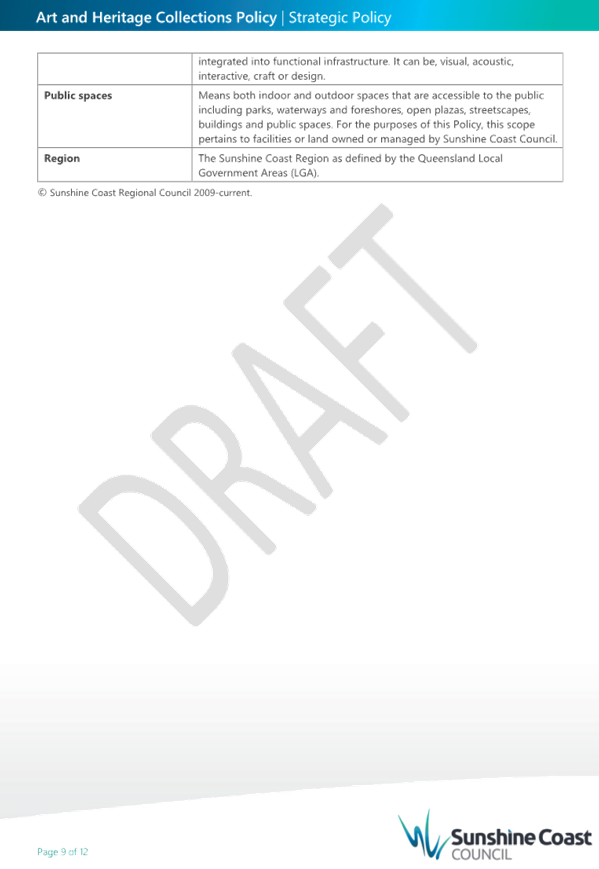
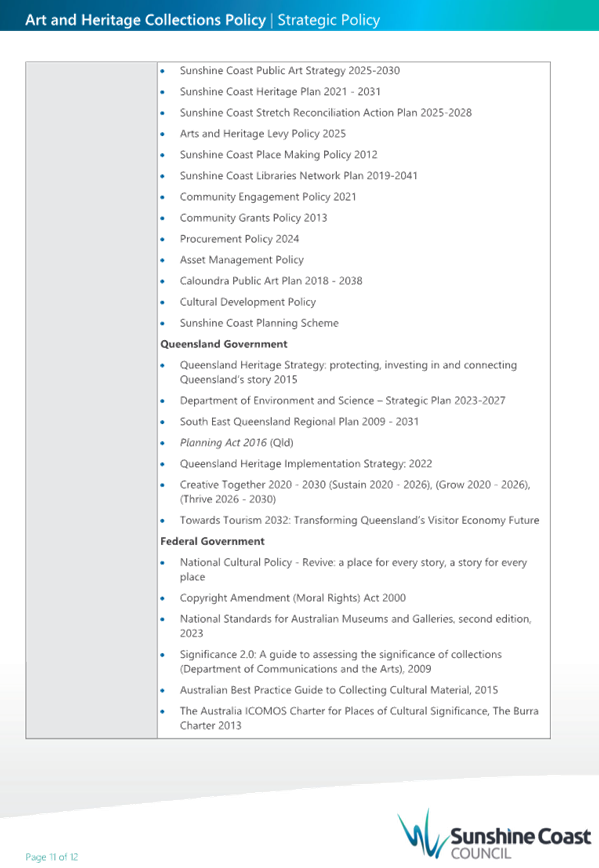
Ordinary Meeting Agenda Item 8.4 Sunshine Coast Public Art Plan 2025-2030 Attachment 1 Art and Heritage Collections Policy 2025 (Tracked changes) |
24 July 2025 |
File No: Council Meetings
Author: Manager Business and Innovation
Business Performance Group
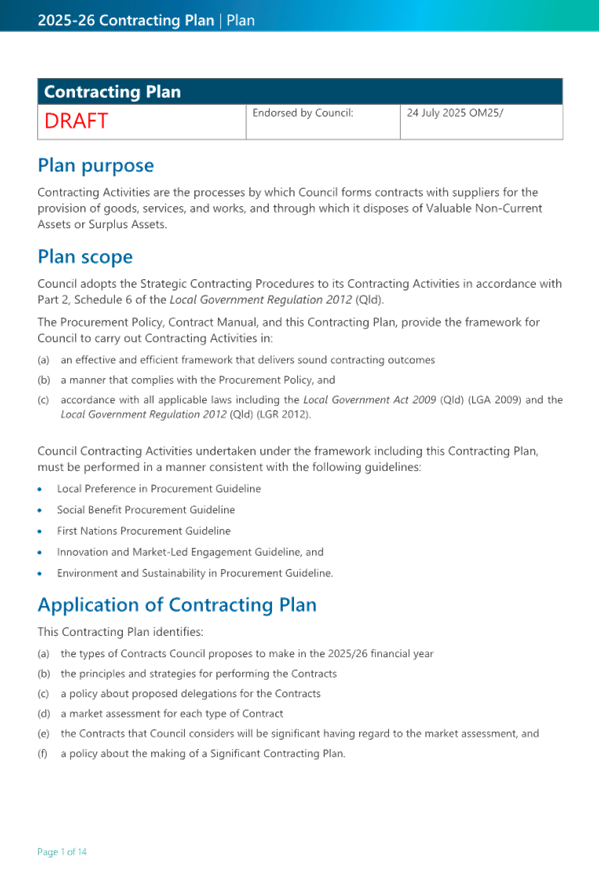
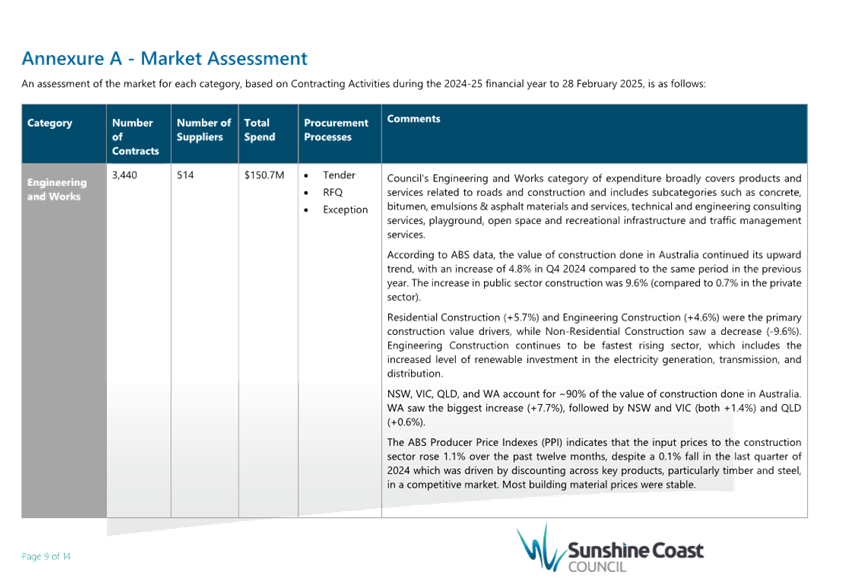
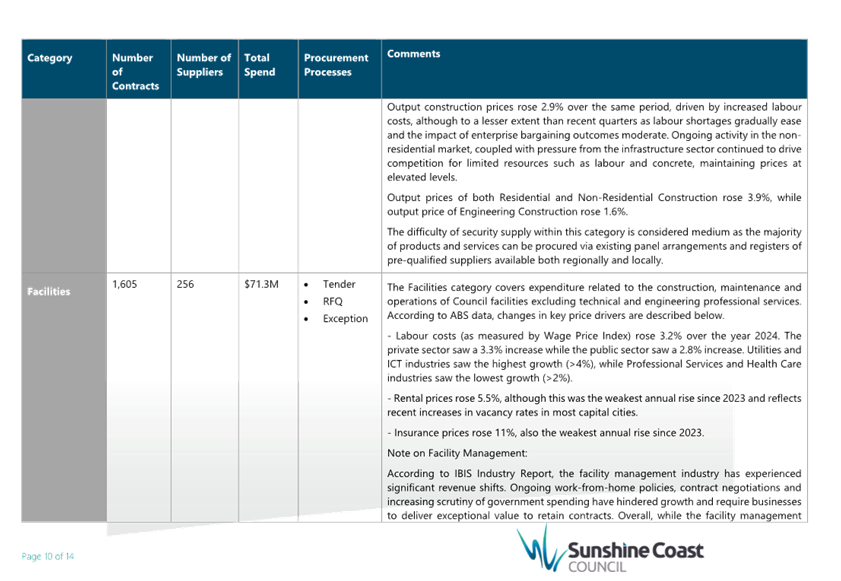
Appendices: App
a - 2025-26 Contracting Plan......................................... 291 ⇩

purpose
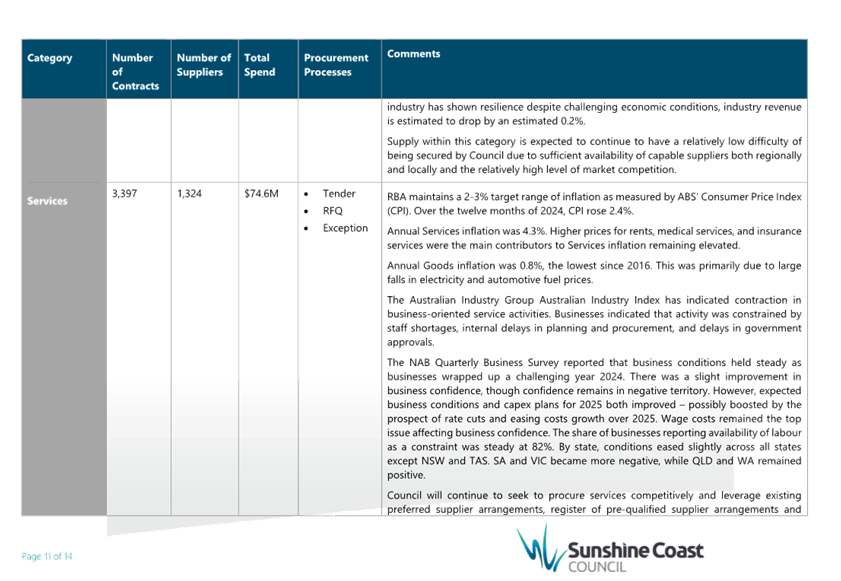
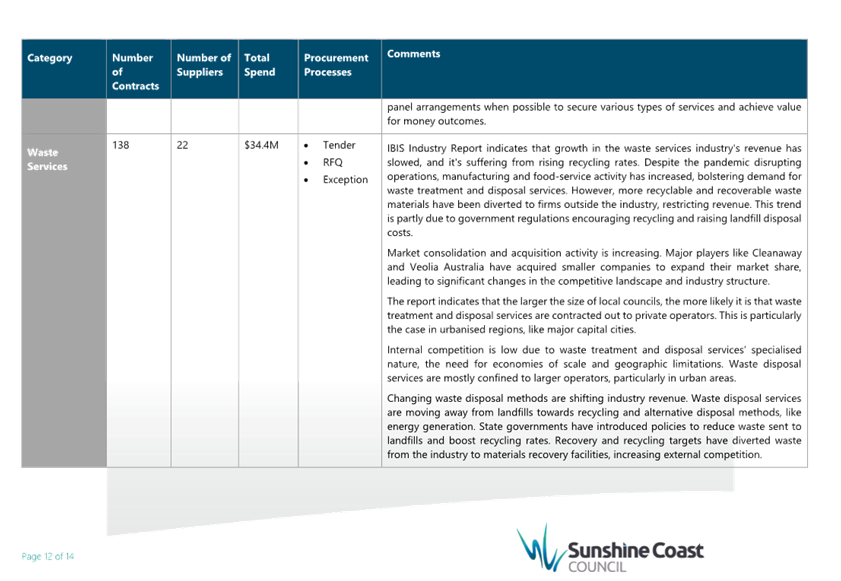
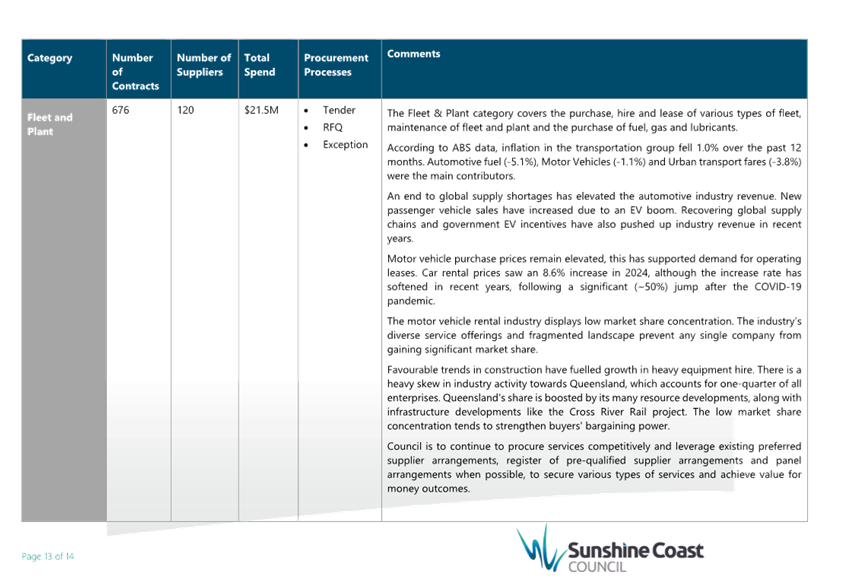
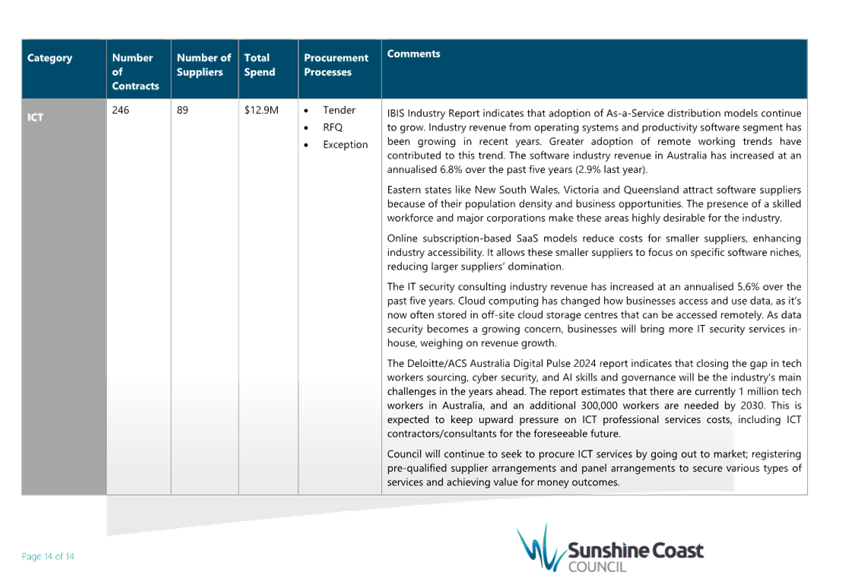
The purpose of this report is to present and have Council adopt the 2025-26 Contracting Plan in accordance with section 220 of the Local Government Regulation 2012 (the Regulation).
Executive Summary
At the Ordinary Meeting of 17 May 2018, Council resolved to adopt the Strategic Contracting Provisions to empower Council to pursue improved contracting outcomes.
Having adopted the Strategic Contracting Provisions, the Regulation requires Council to make and adopt a contracting plan each financial year.
The 2025-26 Contracting Plan is provided for Council’s consideration as Appendix A.
That Council:
(a) receive and note the report titled “2025-26 Contracting Plan” and
(b) adopt the 2025-26 Contracting Plan (Appendix A).
Finance and Resourcing
Council may only enter into a contract for the provision of goods and services if the funds for that contract have been provided for in the annual budget.
Budget for each of the projects to which a Significant Contracting Plan relates, was secured upon adoption of the Sunshine Coast Council 2025-26 budget.
Corporate Plan
Corporate Plan Goal: Organisational Excellence
Outcome: We serve our community by providing this great service
Operational Activity: S31 - Financial Management - Strategic management of Council's finances, assets, procurement and contracts that support effective supplier relationship, resource allocation and financial sustainability.
Consultation
Councillor Consultation
· Councillor T Landsberg – Resilient Economy Portfolio Councillor
· Councillor J Natoli – Resilient Economy Portfolio Councillor
· Councillor E Hungerford – Organisational Excellence Portfolio Councillor
· Councillor J Broderick – Organisational Excellence Portfolio Councillor
Internal Consultation
Engagement has occurred with various officers from the following Branches:
· Project Delivery
· Property Management
· Waste and Resource Management
· Digital and Information Services
· Parks and Gardens
· Workplaces and Kawana Sports Precinct.
External Consultation
No external consultation was required in the preparation of this report.
Community Engagement
No community consultation was required in the preparation of this report.
Proposal
The Contracting Plan is a document which outlines the types of contracts that Council proposes to enter into during the financial year including principles and strategies for performing those contracts within the various markets being approached. The Contracting Plan must be consistent with, and support achievement of the strategic directions outlined in the Corporate Plan.
The Contracting Plan must include the contracts that Council considers will be significant together with a policy about the making of a Significant Contracting Plan.
Significant Contracts are contracts that:
· have an anticipated value of $5 million or more and/or
· are deemed Significant Contracts following assessment under the Procurement Profiling Matrix, and Risk Assessment Calculator.
The Regulation requires Council to make a Significant Contracting Plan for each significant contract before the contract starts.
Council has identified those Contracts which it considers will be Significant Contracts in the Contracting Plan. Each of these will require a Significant Contracting Plan to be prepared in accordance with the Contracting Plan prior to their commencement.
Table 1 below details each of the contracts identified as Significant Contracts in the 2025-26 Contracting Plan.
|
Contract |
Reason for Significant Contract |
Proposed Procurement Strategy |
|
Oval Avenue and Gosling St Upgrade |
>$5 million |
Public Tender |
|
Maintenance of Plant and Equipment – Aquatic Recreation Facilities |
>$5 million |
Public Tender |
|
Food Organic and Garden Organic Processing Services |
>$5 million |
Public Tender |
|
Mooloolaba Foreshore Central Meeting Place |
>$5 million |
Public Tender |
|
Telecommunications and Related Services |
>$5 million |
Exception - Arrangement |
|
Kings Beach Surf Life Saving Facility |
>$5 million |
Public Tender |
|
Caloundra Aerodrome |
>$5 million |
Public Tender |
|
Honey Farm Road (program of works) |
>$5 million |
Public Tender |
|
Security Services |
>$5 million |
Public Tender |
|
Turf Maintenance |
>$5 million |
Public Tender |
|
Slashing Services |
>$5 million |
Public Tender |
|
Asset Management Solution |
>$5 million |
Public Tender |
|
Holiday Park Management Services |
>$5 million |
Public Tender |
|
First Avenue Streetscape |
>$5 million |
Public Tender |
|
Caloundra Centre Activation - Precinct |
>$5 million |
Public Tender |
|
Camp Flat Road Upgrades |
>$5 million |
Public Tender |
|
Upgrade of Kawana Sports Field Drainage |
>$5 million |
Public Tender |
|
Computers and Peripherals |
>$5 million |
Exception - Arrangement |
|
Landfill Services |
>$5 million |
Public Tender |
|
Landfill Leachate Pre-Treatment |
>$5 million |
Public Tender |
|
Purchase of Landfill Equipment |
>$5 million |
Exception - Arrangement |
|
Construction of Coastal Path - Alex Bluff |
>$5 million |
Public Tender |
Table 1: Significant Contracts identified for 2025-26
Legal
Section 220(2) of the Local Government Regulation 2012 requires Council to make and adopt a contracting plan each financial year.
Human Rights Act 2019
The Procurement Policy and associated guidelines are consistent with the Human Rights Act 2019 (Qld) and make a contribution towards the protection and promotion of the right to recognition and equality before the law, and the cultural rights of Aboriginal and Torres Strait Islander peoples.
Policy
The Procurement Policy and Procurement and Disposal Framework will provide a structured framework for Council’s procurement and disposal contracting activities and ensure compliance with the relevant legislation.
Risk
The Procurement Policy and procurement and disposal framework mitigates the risks associated with undertaking the contracting activities associated with the identified Significant Contracts.
Previous Council Resolution
Ordinary Meeting 20 June 2024 (OM24/43)
That Council:
(a) receive and note the report titled “2024-25 Procurement Policy and Procurement and Disposal Framework” and
(b) adopt the Procurement and Disposal Framework inclusive of:
(i) Procurement Policy (Appendix A)
(ii) Contract Manual (Appendix B)
(iii) Contracting Plan (Appendix C)
(iv) Local Preference in Procurement Guideline (Appendix D)
(v) Social Benefit Procurement Guideline (Appendix E)
(vi) First Nations Procurement Guideline (Appendix F)
(vii) Innovation and Market-Led Engagement Guideline (Appendix G) and
(viii) Environment and Sustainability in Procurement Guideline (Appendix H).
Related Documentation
Local Government Act 2009
Local Government Regulation 2012
Internal and External Audit Reports conducted on procurement and contracting activities.
Critical Dates
The Local Government Regulation 2012 requires Council to adopt a Contracting Plan for each financial year.
The Contracting Plan and Significant Contracting Plans may only be adopted after the budget for the year is adopted.
Implementation
The Contracting Plan will come into effect upon adoption and remain in force until 30 June 2026.
The Chief Executive Officer will ensure that Council conducts its procurement and contracting activities in a manner consistent with the Procurement Policy and the procurement and disposal framework and each contracting activity, which has a Significant Contracting Plan, is undertaken in a manner consistent with the plan.
|
Ordinary Meeting Agenda Item 8.5 2025-26 Contracting Plan Appendix A 2025-26 Contracting Plan |
24 July 2025 |
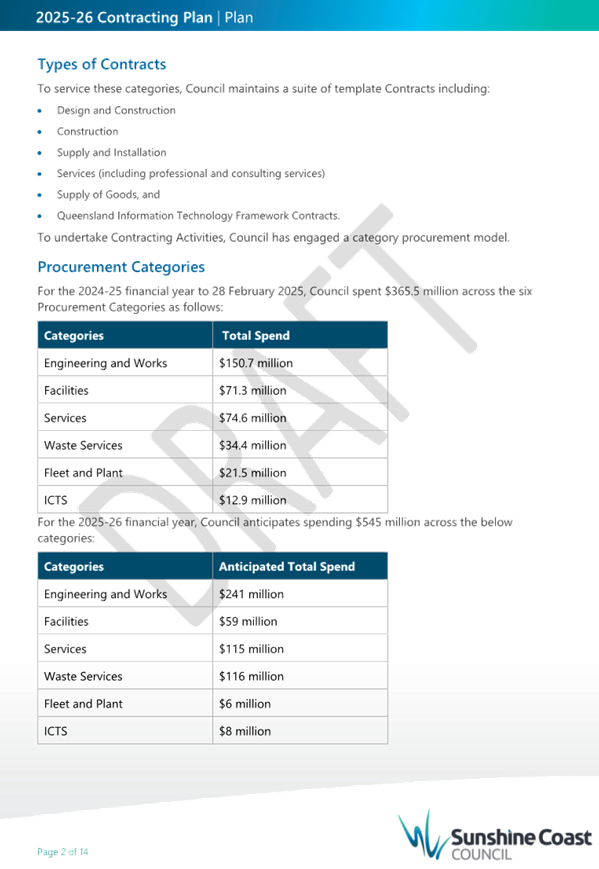
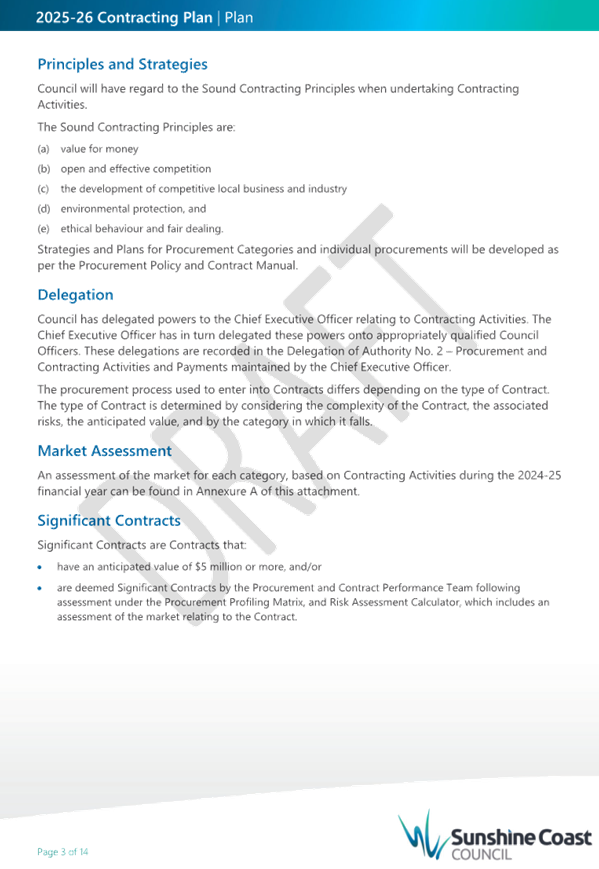
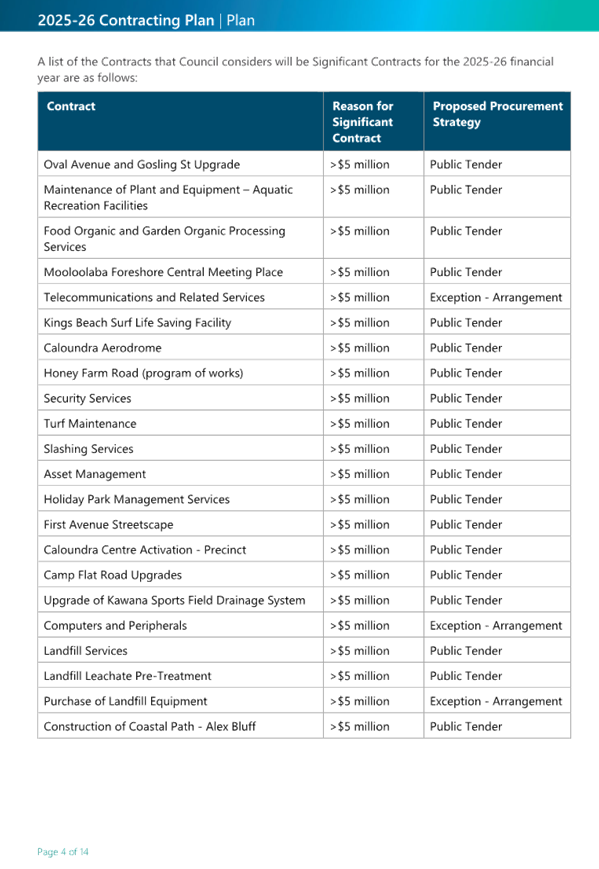
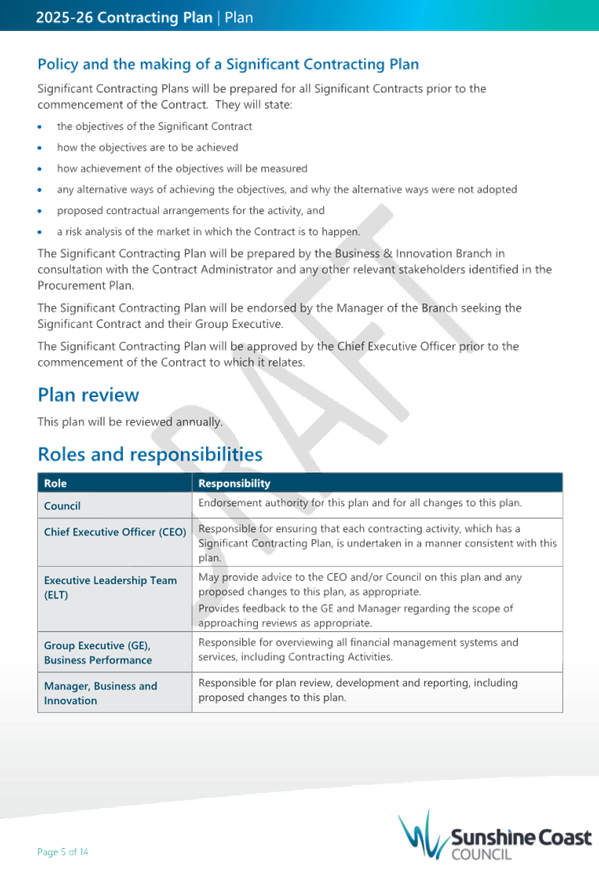
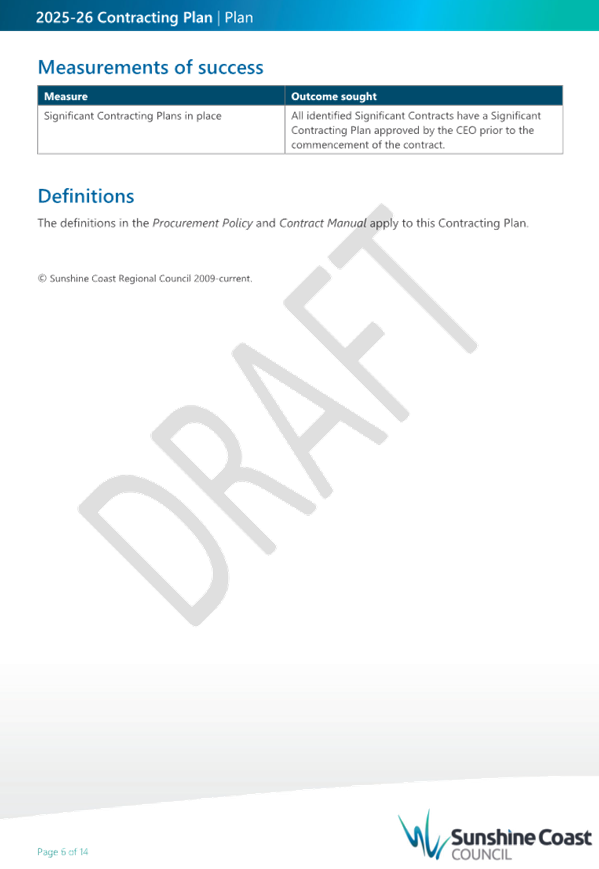
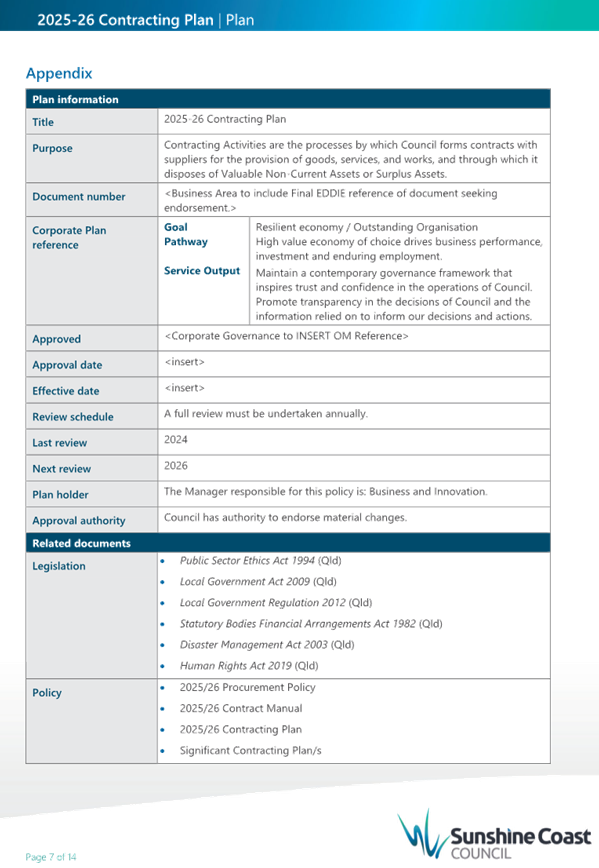
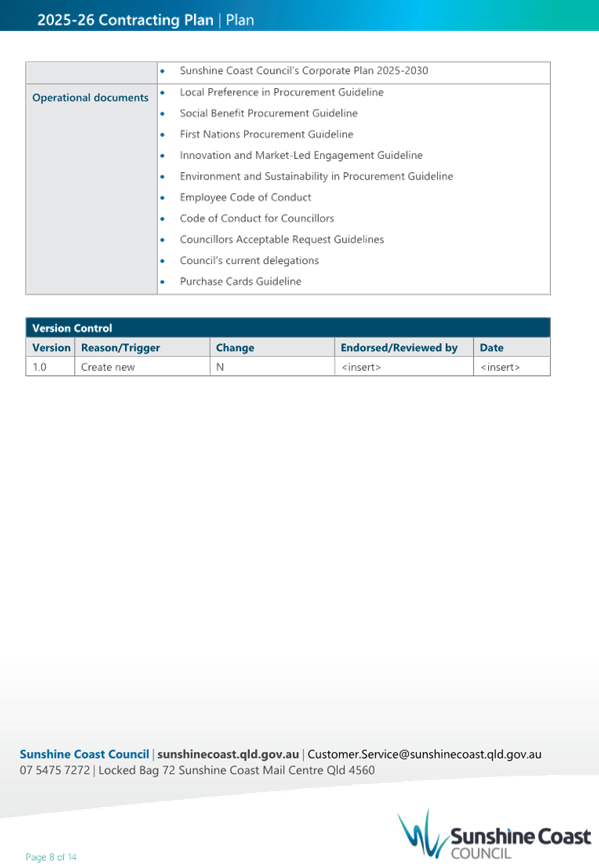
8.6 Interim June 2025 Financial Performance Report
File No: Council Meetings
Author: Coordinator Financial Services
Business Performance Group
Attachments: Att
1 - Interim June 2025 Financial
Performance Report... 311 ⇩
Att
2 - June 2025 Capital Grant
Funded Project Report...... 323 ⇩
purpose
To meet Council’s legislative obligations, a monthly report must be presented to Council on its financial performance and investments.
Executive Summary
This monthly financial performance report provides Council with a summary of an interim performance against budget as at 30 June 2025, in terms of the operating result and delivery of the capital program.
Operating Performance
Table 1: Operating Budget as at 30 June 2025
|
|
Original |
Current Budget $’000 |
|
Total Operating Revenue |
610,085 |
624,963 |
|
Total Operating Expenses |
587,086 |
613,910 |
|
Operating Result |
22,999 |
11,053 |
|
|
Year to Date |
Year to Date Budget |
Year to Date |
|
Total Operating Revenue |
605,816 |
624,963 |
627,905 |
|
Total Operating Expenses |
555,478 |
613,910 |
656,900 |
|
Operating Result |
49,339 |
11,053 |
(28,995) |
|
|
|
|
|
|
Total Cash Balance |
135,275 |
161,503 |
191,567 |
Details of the monthly financial report are contained in Attachment
1.
The monthly financial report includes several items where the year-to-date actuals include estimated accruals subject to finalisation of actuals during the year-end processing.
The estimated accruals include expected invoices dated 30 June for works completed for both operating and capital works received in July 2025, one week of employee costs up to 30 June paid in July and predicted depreciation.
Interim depreciation exceeded the budget by $33.4 million, primarily due to reported values throughout the 2024–25 financial year being understated relative to forecast actuals. Furthermore, the adopted depreciation budget did not adequately reflect the long-term costs associated with asset ownership and renewal
Year-end processing includes finalisation of actual depreciation, roll back of June invoices receipted in July, finalisation of asset revaluations, restricted cash closing balance and waste and long service leave provisions.
A forecast for the 2024-25 financial year has been included in this month’s report. An independent detailed review of the financial report has been completed.
A reconciliation between the interim June results and the audited financial statements will be presented to Council at the next available Ordinary Meeting after the conclusion of the audit.
That Council receive and note the report titled “Interim June 2025 Financial Performance Report”.
Finance and Resourcing
This report sets out the details of Council’s financial performance and investments for the month ending 30 June 2025 and meets Council’s legislative reporting requirements.
Corporate Plan
Corporate Plan Goal: Organisational excellence
Outcome: We serve our community by providing this great service
Operational Activity: S31 - Financial Management - Strategic management of Council's finances, assets, procurement and contracts that support effective supplier relationship, resource allocation and financial sustainability.
Consultation
Councillor Consultation
Consultation has been undertaken with the Organisational Excellence Portfolio Councillors, E Hungerford and J Broderick.
Internal Consultation
This report has been written in conjunction with advice from:
· Chief Financial Officer and
· Executive Leadership Team
External Consultation
No external consultation is required for this report.
Community Engagement
No community engagement is required for this report.
Legal
This report ensures that Council complies with its legislative obligations with respect to financial reporting in accordance with Section 204 of the Local Government Regulation 2012.
Investment of funds is in accordance with the provisions of the Statutory Bodies Financial Arrangements Act 1982 and the associated Regulations and the Local Government Act 2009.
Policy
Sunshine Coast Council’s 2024-25 Investment Policy, and
Sunshine Coast Council’s 2024-25 Debt Policy.
Risk
The reported interim Actual Year to Date financial result includes several items that include estimated accruals subject to finalisation of actuals during the year-end processing.
Material items that may be impacted include material and services, recurrent capital expenses and depreciation.
Interim Capital expenditure actuals include estimated accruals subject to finalisation of actuals during the year-end processing.
Contributed Assets remain subject to adjustment as part of the year end processing.
Previous Council Resolution
Ordinary Meeting 27 March 2025 (OM25/19)
That Council:
(a) receive and note the report titled “Budget Review 3 2024-25”
(b) adopt Appendix A as tabled, pursuant to sections 169 and 170 of the Local Government Regulation 2012, Council’s amended budget for 2024-25 financial year incorporating:
(i) the statement of income and expenditure
(ii) the statement of financial position
(iii) the statements of changes in equity
(iv) the statement of cash flow
(v) the relevant measures of financial sustainability
(vi) the long-term financial forecast
(vii) Council’s 2024-25 Capital Works Program, endorse the indicative four-year program for the period 2026 to 2029, and note the five-year program for the period 2030 to 2034
(c) note the following documentation applies as adopted December 2024
(i) the Debt Policy
(d) note the following documentation applies as adopted 20 June 2024
(i) the Revenue Policy
(ii) the total value of the change, expressed as a percentage, in the rates and utility charges levied for the financial year compared with the rates and utility charges levied in the previous budget, and
(iii) the Revenue Statement
(iv) the rates and charges to be levied for the 2024-25 financial year and other matters as adopted 20 June 2024
(v) the Strategic Environment Levy Policy
(vi) the Strategic Arts and Heritage Levy Policy
(vii) the Strategic Transport Levy Policy
(viii) Prescribed Services Charge Plan (No. 2) 2024-25 Financial Year and
(e) endorse the 2024-25 Minor Capital Works Program (Appendix B).
Ordinary Meeting 12 December 2024 (OM24/124)
That Council:
(a) receive and note the report titled “Budget Review 2 2024-25”
(b) adopt Appendix A as tabled, pursuant to sections 169 and 170 of the Local Government Regulation 2012, Council’s amended budget for 2024-25 financial year incorporating:
(i) the statement of income and expenditure
(ii) the statement of financial position
(iii) the statements of changes in equity
(iv) the statement of cash flow
(v) the relevant measures of financial sustainability
(vi) the long-term financial forecast
(vii) Council’s 2024-25 Capital Works Program, endorse the indicative four-year program for the period 2026 to 2029, and note the five-year program for the period 2030 to 2034
(viii) the Debt Policy
(c) note the following documentation applies as adopted 20 June 2024
(i) the Revenue Policy
(ii) the total value of the change, expressed as a percentage, in the rates and utility charges levied for the financial year compared with the rates and utility charges levied in the previous budget, and
(iii) the Revenue Statement
(iv) the rates and charges to be levied for the 2024-25 financial year and other matters as adopted 20 June 2024
(v) the Strategic Environment Levy Policy
(vi) the Strategic Arts and Heritage Levy Policy
(vii) the Strategic Transport Levy Policy
(viii) Prescribed Services Charge Plan (No. 2) 2024-25 Financial Year and
(d) endorse the 2024-25 Minor Capital Works Program (Appendix B).
Ordinary Meeting 26 September 2024 (OM24/82)
That Council:
(a) receive and note the report titled “Budget Review 1 – 2024-25” and
(b) adopt Appendix A as tabled, pursuant to sections 169 and 170 of the Local Government Regulation 2012, Council’s amended budget for 2024-25 financial year incorporating:
i. the statement of income and expenditure
ii. the statement of financial position
iii. the statement of changes in equity
iv. the statement of cash flow
v. the relevant measurers of financial sustainability
vi. the long-term financial forecast
vii. Council’s 2024-25 Capital Works Program, endorse the indicative four-year program for a period 2026 to 2029, and note the five-year program for the period 2030 to 2034
(c) note the following documentation applies as adopted 22 June 2024
i. the Debt policy
ii. the Revenue policy
iii. the total value of change, expressed as a percentage, in the rates and utility charges levied for the financial year compared with the rates and utility charges levied in the previous budget
iv. the Revenue statement
v. the rates and charges to be levied for the 2024-25 financial year and other matters as adopted 22 June 2024
vi. the Strategic Environment Levy Policy
vii. the Strategic Arts and Heritage Levy Policy
viii. the Strategic Transport Levy Policy
ix. Prescribed Services Charge Plan (No. 2) 2024-25 Financial Year and
(d) endorse the Minor Capital Works Program (Appendix B).
Special Meeting 20 June 2024 (SM24/4)
That Council:
1. STATEMENT OF ESTIMATED FINANCIAL POSITION
receive and note Appendix A, pursuant to section 205 of the Local Government Regulation 2012, the statement of the financial operations and financial position of the Council in respect to the 2023-24 financial year.
2. ADOPTION OF BUDGET
adopt Appendix A as tabled, pursuant to sections 169 and 170 of the Local Government Regulation 2012, Council’s budget for 2024-25 financial year incorporating:
i. the statement of income and expenditure
ii. the statement of financial position
iii. the statement of changes in equity
iv. the statement of cash flow
v. the relevant measures of financial sustainability
vi. the long-term financial forecast
vii. the Debt Policy (adopted by Council resolution on 30 May 2024)
viii. the Revenue Policy (adopted by Council resolution on 30 May 2024)
ix. the total value of the change, expressed as a percentage, in the rates and utility charges levied for the financial year compared with the rates and utility charges levied in the previous budget
x. the Revenue Statement
xi. Council’s 2024-25 Capital Works Program, endorsing the indicative four-year program for the period 2026 to 2029, and noting the five-year program for the period 2030 to 2034
xii. the rates and charges to be levied for the 2024-25 financial year and other matters as detailed below in clauses 3 to 10
xiii. the 2024-25 Minor Capital Works Program
xiv. the Strategic Environment Levy Policy
xv. the Strategic Arts and Heritage Levy Policy
xvi. the Strategic Transport Levy Policy and
xvii. Prescribed Services Charge Plan (No. 2) 2024-25 Financial Year.
Related Documentation
2024-25 Adopted Budget
Critical Dates
There are no critical dates for this report.
Implementation
There are no implementation details to include in this report.
|
Ordinary Meeting Agenda Item 8.6 Interim June 2025 Financial Performance Report Attachment 1 Interim June 2025 Financial Performance Report |
24 July 2025 |
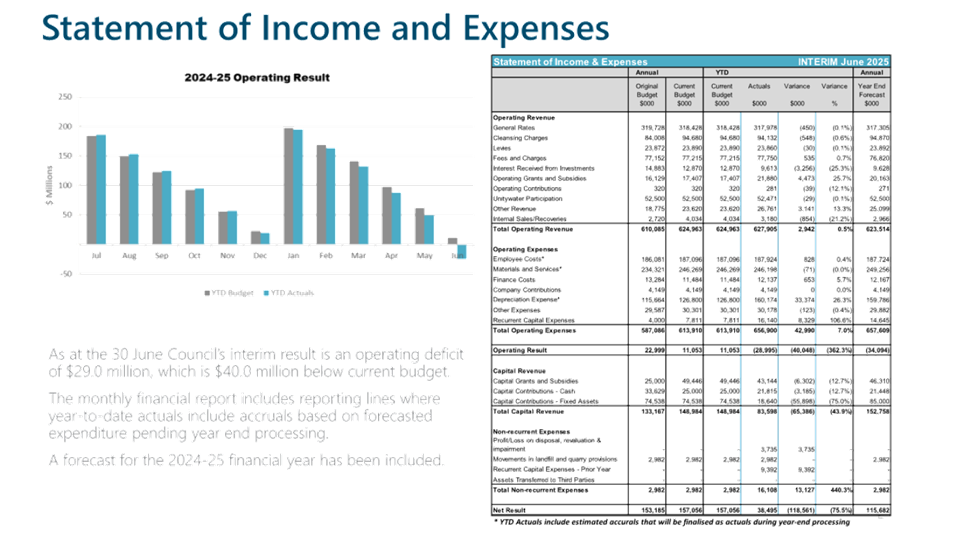
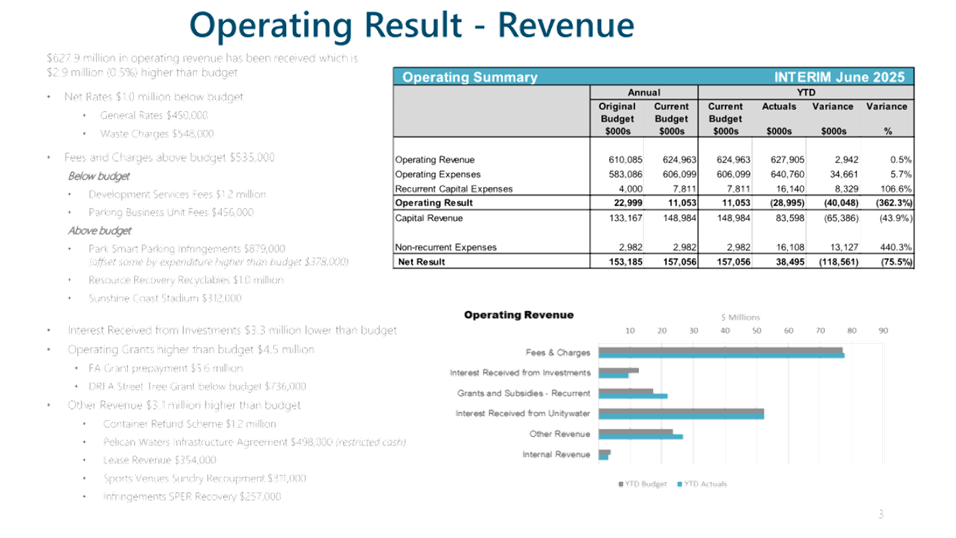
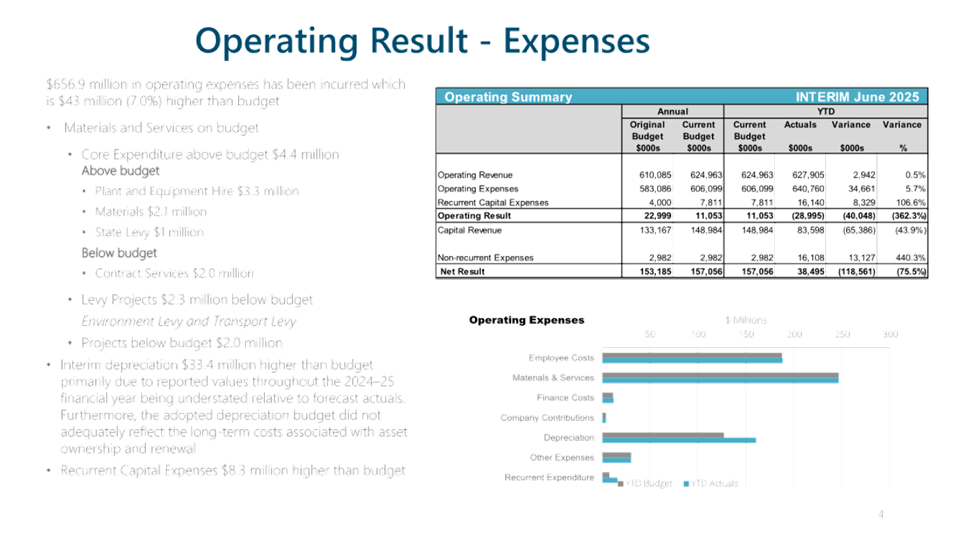
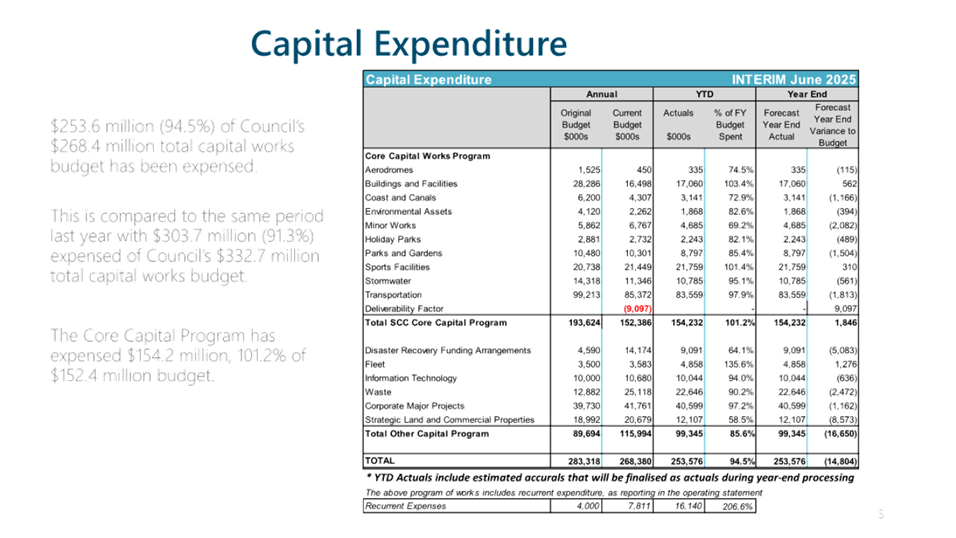
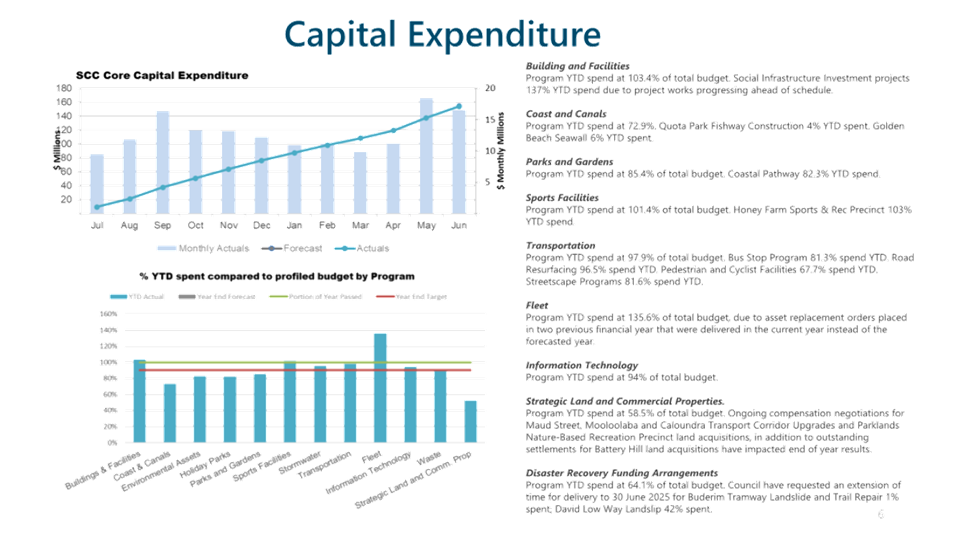
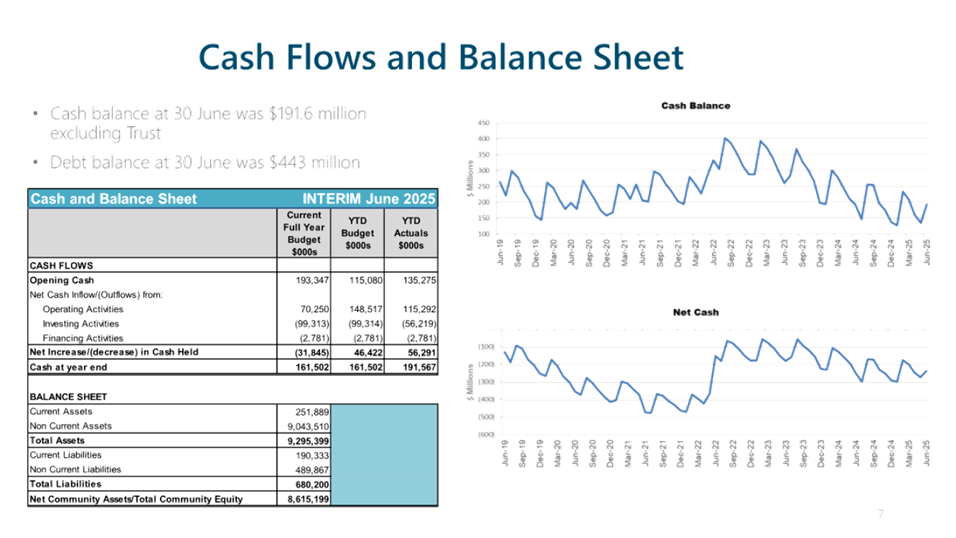
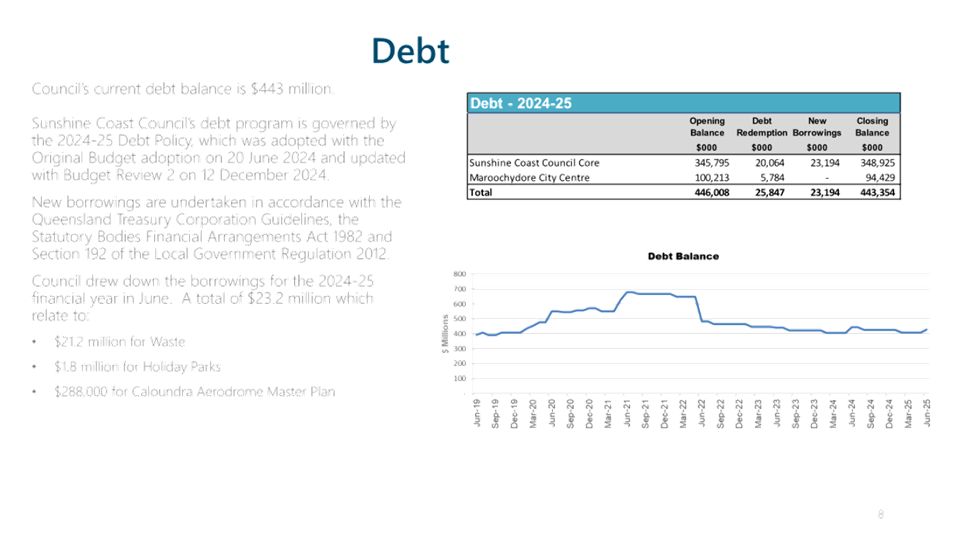
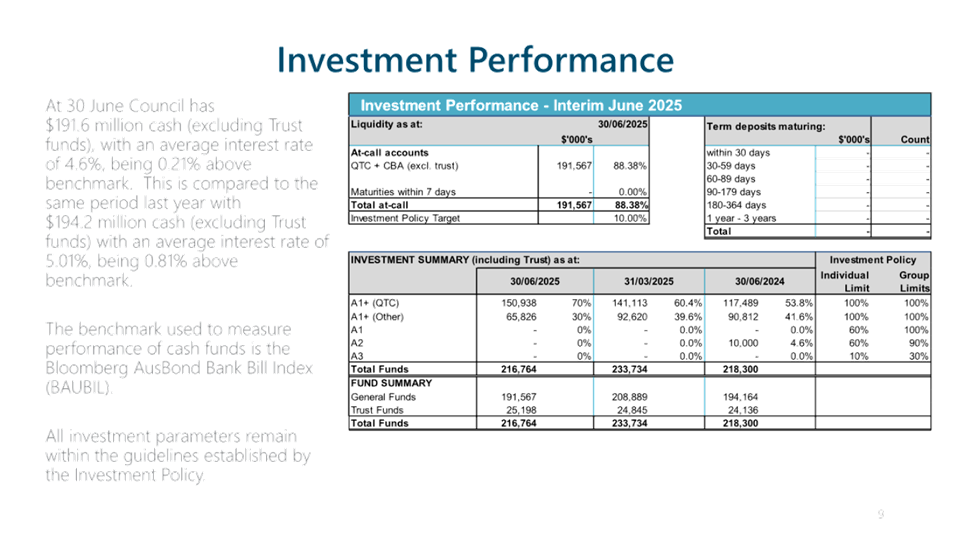
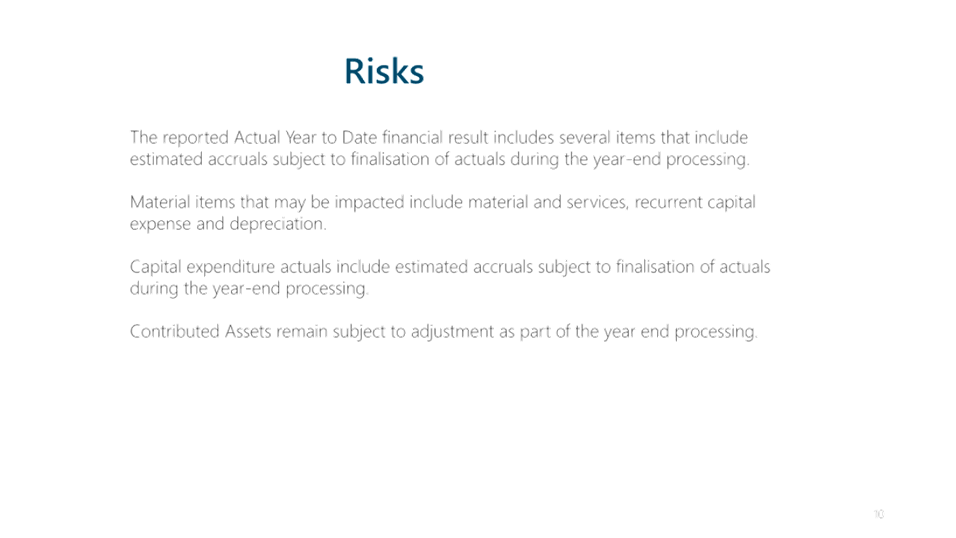
|
Ordinary Meeting Agenda Item 8.6 Interim June 2025 Financial Performance Report Attachment 2 June 2025 Capital Grant Funded Project Report |
24 July 2025 |
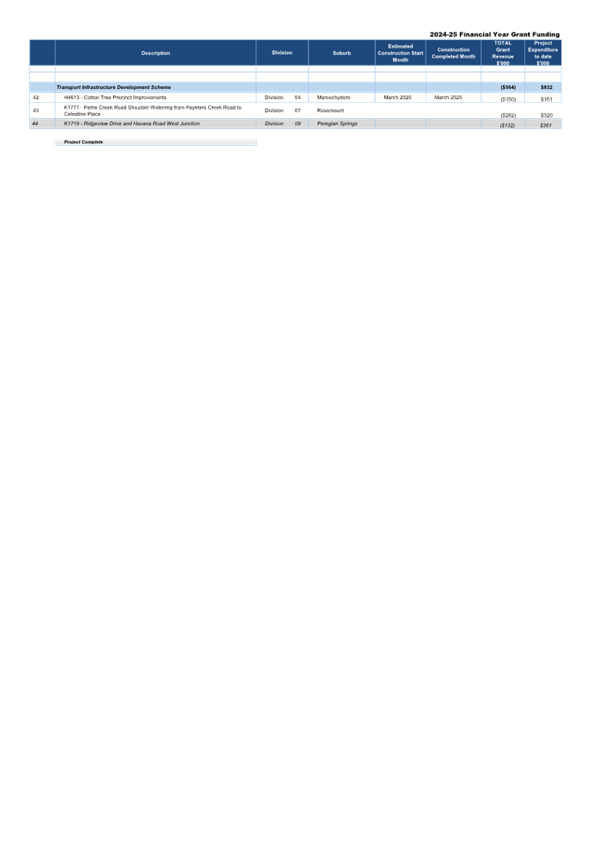
8.7 Motions for the 2025 Local Government Association of Queensland Annual Conference
File No: Council Meetings
Author: Coordinator Councillor Governance
Civic Governance Group
Attachments: Att
1 - Supported accommodation
models for people experiencing homelessness with complex needs........................................ 333 ⇩

Att
2 - Sea level rise benchmarks for
climate risk reduction 337 ⇩
Att
3 - Suppression and eradication
of fire ants.................. 341 ⇩
Att
4 - Roadside litter management...................................... 343 ⇩
Att
5 - Storage of recreational
vehicles on roads................ 347 ⇩
purpose
This report proposes five motions for submission to the Local Government Association’s 2025 Annual Conference.
Draft motions are prepared for Council’s review and endorsement prior to the Annual Conference to be held in October 2025.
Executive Summary
The 129th Local Government Association of Queensland Annual Conference will be held on the Gold Coast from 19 to 23 October 2025.
Each year, the Conference debates motions put forward by both the Local Government Association of Queensland Policy Executive and member Councils. Motions that are supported and resolved at the Annual Conference guide and inform the Local Government Association of Queensland’s Annual Advocacy Plan and Policy Statement.
Under the Local Government Association of Queensland Conference rules, any motion from a local government must be endorsed by the submitting Council at a Council meeting. To be considered at the 2025 Annual Conference, all motions must be received by the Local Government Association of Queensland by Monday, 28 July 2025.
The Conference agenda will prioritise motions that raise new issues of state-wide relevance or issues impacting a large portion or segment of local governments in Queensland. Motions must also be well formed and presented in a way that is most likely to garner the support of the broader membership of the Local Government Association of Queensland - namely the 77 local governments in Queensland.
Five motions are proposed for consideration by Sunshine Coast Council for submission to the Local Government Association of Queensland for consideration and debate at the 2025 Annual Conference.
The five motions relate to:
1. Funding to provide supported accommodation models to create increased viable pathways into housing for people experiencing homelessness with complex needs.
2. Guidance on Shared Socioeconomic Pathways and updated sea level rise benchmark(s) for climate risk reduction.
3. Enhancing Federal funding for local biosecurity efforts against fire ants.
4. Increased Federal support for roadside litter management.
5. Investigation into managing the storage of recreational vehicles on roads.
Details of each motion, including background information and desired outcomes, are attached as Attachments 1 to 5.
That Council:
(a) receive and note the report titled “Motions for the 2025 Local Government Association of Queensland Annual Conference”
(b) endorse the motion that calls on the State and Federal Governments to fund Housing First supported accommodation models
(c) endorse the motion that calls on the Queensland Government (in consultation with the Federal Government) to:
(i) Provide clear, consistent, and science-based guidance to local governments on the appropriate Shared Socioeconomic Pathway scenario(s) to use for climate risk reduction, adaptation planning, and infrastructure investment decisions, taking into account the recognition by the Intergovernmental Panel on Climate Change Sixth Assessment Report that low-likelihood, high-impact outcomes cannot be ruled out.
(ii) Request that this guidance be developed in consultation with local governments, climate scientists, and relevant agencies such as the CSIRO and Bureau of Meteorology, in alignment with best practice climate risk management, and Queensland Future Climate Projections based on Coupled Model Intercomparison Project Phase 6 and Shared Socioeconomic Pathway scenarios.
(iii) Further request that the Queensland Government provide guidance on appropriate sea level rise benchmarks for low-likelihood, high-impact sea level rise scenarios, as outlined in the Intergovernmental Panel on Climate Change Sixth Assessment Report for both:
(1) statutory planning processes; and
(2) design considerations for council owned assets and infrastructure
(d) endorse the motion that calls on the Federal Government to expand financial support for local governments in fire ant eradication and suppression treatment areas to include resources for meeting general biosecurity obligations
(e) endorse the motion that calls on the Federal Government to increase funding to local governments for litter management programs to address the environmental, amenity, and financial impacts of roadside litter by targeting products or services which generate common roadside waste such as plastics, wrappers, cigarettes and vapes
(f) endorse the motion that calls on the State Government to investigate and develop options for managing the storage of recreational vehicles on roads, addressing safety, parking capacity and amenity concerns; and
(g) forward the motions to the Local Government Association for inclusion in the 2025 Annual Conference agenda.
Finance and Resourcing
There are no financial or resourcing impacts for Council arising from submitting motions for consideration at the Local Government Association of Queensland Annual Conference.
Corporate Plan
Corporate Plan Goal: Organisational excellence
Outcome: We serve our community by providing this great service
Operational Activity: S26 - Elected Council - Providing community leadership, democratic representation, advocacy and decision-making.
Consultation
Councillor Consultation
All Councillors were invited to consider subject areas for potential conference motions.
Councillor D Law requested Council consider a motion that seeks to addresses homelessness. Fellow Strong Community Portfolio Councillor, Councillor T Bunnag was consulted in relation to this proposed motion.
Councillor M Suarez requested Council consider a motion that addresses future planning and asset management risks associated with potential sea level rise above current benchmarks. Fellow Environment and Liveability Portfolio Councillor, Councillor T Burns was consulted in relation to this proposed motion.
Councillor D Law requested Council consider a motion in relation to fire ant suppression and eradication. Environment and Liveability Portfolio Councillors, Councillor T Burns and Councillor M Suarez were consulted in relation to this proposed motion.
Councillor J Natoli requested Council consider a motion relating to roadside litter management. Environment and Liveability Portfolio Councillors, Councillor T Burns and Councillor M Suarez were consulted in relation to this proposed motion.
Councillor M Suarez requested Council consider a motion in relation to long term recreational vehicle parking on roads. Managing for Growth Portfolio Councillors, Councillor W Johnston and Councillor C Dickson were consulted in relation to this proposed motion.
Internal Consultation
The Executive Leadership Team were invited to consider subject matters for potential motions.
Specific engagement has occurred with:
· Group Executive Economic and Community Development (Homelessness motion)
· Group Executive Liveability and Natural Assets (Sea level rise benchmarks motion)
· Group Executive Customer and Planning Services (Fire Ants, Litter Management and Recreational Vehicle Parking motions)
· Manager Community Development (Homelessness motion)
· Manager Environment and Sustainability Policy (Sea level rise benchmarks motion)
· Manager Strategic Planning (Sea level rise benchmarks motion)
· Manager Customer Response (Fire Ants, Litter Management and Recreational Vehicle Parking motions)
· Manager Parking and Transport (Recreational Vehicle Parking motion)
· Coordinator Flooding and Stormwater Policy (Sea level rise benchmarks motion)
· Coordinator Sustainability (Sea level rise benchmarks motion)
External Consultation
Consultation with external parties has not been undertaken in relation to this report.
Community Engagement
Community engagement has not been undertaken in relation to this report.
Proposal
The next Local Government Association of Queensland Annual Conference is to be held on the Gold Coast from 19 to 23 October 2025.
The Local Government Association of Queensland Policy Executive and member Councils submit motions to the conference for debate. Motions supported at the conference form part of the Local Government Association of Queensland’s Annual Advocacy Plan and Policy Statement.
Local governments must first endorse motions before they are submitted to the Local Government Association of Queensland for inclusion in the conference agenda. All motions for this year’s conference must be received by the Local Government Association of Queensland by 28 July 2025.
Issues raised at the conference should be of state-wide relevance and generally will call for action by another tier of government.
On 15 May 2025, Councillors and the Executive Leadership Team were asked to commence consideration of potential motions. On 2 June 2025, the Local Government Association of Queensland formally called for motions from member councils.
Five motions are proposed for consideration by Council and, if endorsed, will be submitted to the Annual Conference for consideration.
Supported accommodation models for people experiencing homelessness
This motion calls on both the State and Federal Governments to fund Housing First supported accommodation models which create increased viable pathways into housing for people experiencing homelessness with complex needs.
The number of people sleeping rough and in vehicles in public places is rising. This creates a flow-on effect that increases the impact on council resources to manage public spaces for the whole community.
Social and community housing, as well as the private rental market, do not provide the adequate wraparound supports required for people who have experienced long term homelessness and complex trauma. Funding for alternative supported accommodation models is required for all local governments.
Sea level rise benchmarks for climate risk reduction
The desired outcome of this motion is that the Queensland Government will provide clear, consistent, and science-based guidance to local governments on:
1. which Shared Socioeconomic Pathway scenario(s) should be used for climate risk reduction, adaptation planning, and infrastructure investment decisions; and
2. how to incorporate low-probability, high-impact sea level rise scenarios, as identified in the Intergovernmental Panel on Climate Change Sixth Assessment Report, into statutory planning processes and for Council’s own adaptation planning to support proactive activities and decisions.
The guidance sought would help ensure that councils across Queensland (and Australia) are using consistent, and future-focused approaches to climate risk management, aligned with state, national and international best practice.
Shared Socioeconomic Pathways have been used in Intergovernmental Panel on Climate Change reports to explore how different scenarios might influence climate change impacts. They are essential tools used in climate modelling to assess future risks and inform adaptation strategies. While Queensland’s Future Climate resources and Australian Rainfall and Runoff industry best practice guidelines (flood and stormwater estimation) reference Shared Socioeconomic Pathways, there is currently no formal directive on which scenarios councils should use, leading to inconsistent planning approaches.
The Intergovernmental Panel on Climate Change Sixth Assessment Report highlights the potential for sea level rise to exceed 1.1 metres by 2100 under extreme scenarios, which is not currently reflected in Queensland’s benchmark of 0.8 metres. Incorporating these scenarios into planning frameworks will help councils take a proactive approach to risk management and improve long-term resilience.
Failure to consider these projections may expose councils to significant financial liabilities—not only from acute disasters such as floods and cyclones, but increasingly from chronic climate impacts such as tidal inundation, shoreline erosion, heat stress, drying soils and infrastructure degradation.
These cumulative costs can strain local government budgets and service delivery. Additionally, councils may face reputational damage for not aligning with the latest climate science, potentially undermining public trust, stakeholder confidence, and access to future funding.
A delayed revision of State Government mandated sea level rise could present significant and costly challenges to local governments that are advanced in coastal hazard adaptation infrastructure design.
Fire Ants
This motion calls on the Local Government Association of Queensland to advocate for increased Federal Funding for local governments due to their severe economic, environmental, and public health impacts. Fire ants can cause billions of dollars in damages, disrupt ecosystems, and pose significant health risks. Local governments in suppression treatment areas, need Federal support to meet their biosecurity obligations to contribute to an effective, coordinated eradication effort and prevent higher future costs at a national level.
Local governments are under pressure to balance resources across a diverse range of services and programs. The impacts of funding resources to support the eradication of fire ants can impact the delivery of other core services. Federal funding can provide the necessary support for coordinated and comprehensive eradication efforts, ensuring consistency and efficiency across regions. Investing in eradication now can prevent higher future costs and protection Australia’s economy, environment, and public health from the sever threats posed by fire ants.
While the Federal Government has committed significant funding to the national program and supporting local governments with the support of treatment material and training, this does not address the significant resource investment for local governments in the suppression areas. Funding should be targeted to local governments with biosecurity obligations within the suppression areas.
A motion similar to the one proposed in this report was submitted to, and endorsed by, the Australian Local Government Association National General Assembly which was held in Canberra from 24 to 27 June 2025. This matter now contributes to the Australian Local Government Association’s advocacy for local government priorities at a national level.
If this motion is endorsed at the Local Government Association of Queensland Annual Conference in October, this matter will form part of the Local Government Association of Queensland’s advocacy efforts enabling a second avenue for it to be brought before the Federal Government, providing stronger evidence of the importance of this matter to local government across Australia.
Roadside Litter
Councillor J Natoli requested a motion be proposed for submission to this year’s Local Government Association of Queensland Annual Conference seeking an increase in Federal funding to local governments for litter management programs which target those products or services which generate common roadside waste.
Economically, roadside litter can deter tourism and investment, reducing the amenity of regions and subsequently impacts local economies. Effective litter management aligns with national priorities such as environmental sustainability, public health, and community well-being. It supports the circular economy by promoting recycling and waste reduction, reducing the burden on landfills.
The true cost of managing litter is difficult to estimate. In reviewing the impacts of litter and illegal dumping in Queensland, the Queensland Government found that in 2018/2019 local governments spent $59.4 million to address litter and illegal dumping. A NSW Government report from 2016 estimated the cost of litter to local governments in NSW was approximately $135 million in 2024/2025, with community organisations, private businesses and the NSW Government bearing an additional $27 million for the same period. Much of the costs associated with dealing with these issues continue to be borne by local government today.
By addressing roadside litter as a national priority, the Australian Government can enhance environmental protection, boost local economies, and improve the quality of life for all Australians, demonstrating a commitment to sustainable and responsible governance.
Funding for litter programs could be provided by targeting products or services which generate common roadside waste such as plastics, wrappers, cigarettes and vapes.
As per the motion described above in relation to fire ants, a motion similar to this one was submitted to, and endorsed by, the Australian Local Government Association National General Assembly. This issue now contributes to the Australian Local Government Association’s advocacy to the Federal Government.
Should this motion be endorsed at the Local Government Association of Queensland Annual Conference, this matter will form part of the Local Government Association of Queensland’s advocacy agenda.
Recreational Vehicle parking
This motion seeks to address a matter that is increasingly causing concern across the community in relation to the storage of recreational vehicles on roads.
The motion calls on the State Government to investigate and develop options for managing the storage of recreational vehicles on roads which can have negative impacts in relation to safety, parking capacity and amenity.
Recreational vehicles (including caravans, trailers, boats, mobile homes, and other non-passenger vehicles) have been observed being parked (or “stored”) for long periods on the road, resulting in a large number of complaints from concerned residents.
The parking of recreational vehicles can obstruct visibility for drivers and pedestrians, creating potential safety hazards. Secondly, parking can be challenging in many locations across the region. The long-term parking of recreational vehicles can increase parking congestion leading to frustration for other residents. The visual amenity of these areas is also negatively impacted.
While Sunshine Coast Council has explored intervention options, the Transport Operations (Road Use Management) Act 1995 does not provide practical options for local governments to address this issue without affecting all vehicles parked in the local government area.
These five motions are commended to Council for endorsement and submission to the Local Government Association of Queensland for inclusion in the Annual Conference Agenda.
Legal
There are no legal implications associated with submitting the proposed motions to the Local Government Association of Queensland for consideration and debate at the Annual Conference.
Policy
The proposed motions in this report do not conflict with the adopted policy positions or objectives of Council. Should the proposed motions be approved by Council and resolved at the Local Government Association of Queensland Annual Conference, it will influence and shape future advocacy efforts of the Local Government Association of Queensland, which may result in policy and program decisions by the other tiers of government that will be advantageous to the interests of Council.
Risk
No discernible risks have been identified from potentially submitting the proposed motions to the Local Government Association of Queensland for consideration and debate at its Annual Conference.
Previous Council Resolution
Ordinary Meeting 24 July 2024 (OM24/54)
That Council:
(a) receive and not the report titled “Motions for the 2024 Local Government Association of Queensland Annual Conference” and
(b) endorse the following motion for forwarding to the Local Government Association of Queensland for inclusion in the 2024 Annual Conference agenda:
(i) That the Local Government Association of Queensland call on the State Government to introduce mandatory device limitations and standards to control the speed and capabilities of personal mobility devices (Appendix A).
Related Documentation
· Local Government Association of Queensland 2025 Annual Conference Agenda
· Constitution of the Local Government Association of Queensland
· Local Government Association of Queensland Policy Statement
· Local Government Association of Queensland Advocacy Action Plan 2025
Critical Dates
This report must be considered by Council at the July 2025 Ordinary Meeting to enable endorsed motions to be submitted to the Local Government Association of Queensland by 28 July 2025.
Implementation
Should the recommendation be accepted by Council, it is noted that the Chief Executive Officer will forward the approved motions to the Local Government Association of Queensland for consideration and inclusion the 2025 Annual Conference Agenda.
|
Ordinary Meeting Agenda Item 8.7 Motions for the 2025 Local Government Association of Queensland Annual Conference Attachment 1 Supported accommodation models for people experiencing homelessness with complex needs |
24 July 2025 |
|
Ordinary Meeting Agenda Item 8.7 Motions for the 2025 Local Government Association of Queensland Annual Conference Attachment 2 Sea level rise benchmarks for climate risk reduction |
24 July 2025 |
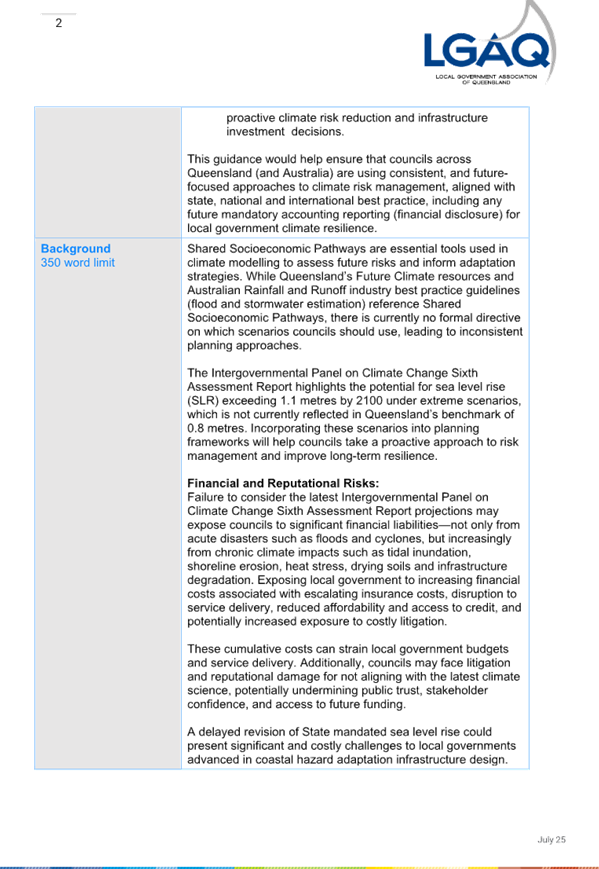
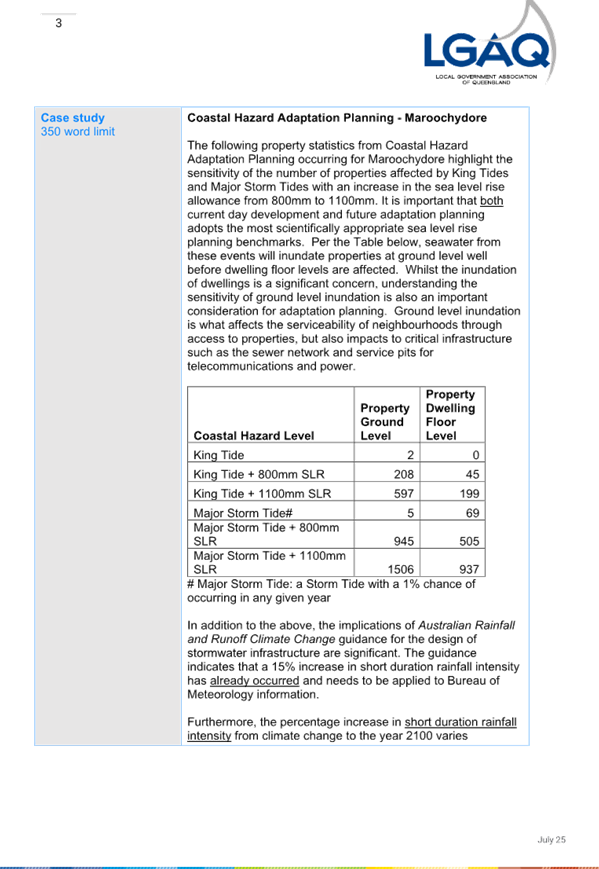
|
Ordinary Meeting Agenda Item 8.7 Motions for the 2025 Local Government Association of Queensland Annual Conference Attachment 3 Suppression and eradication of fire ants |
24 July 2025 |
|
Ordinary Meeting Agenda Item 8.7 Motions for the 2025 Local Government Association of Queensland Annual Conference Attachment 4 Roadside litter management |
24 July 2025 |
|
Ordinary Meeting Agenda Item 8.7 Motions for the 2025 Local Government Association of Queensland Annual Conference Attachment 5 Storage of recreational vehicles on roads |
24 July 2025 |
Petitions only eligible for submission if:
* Legible
* Have purpose of the petition on top of each page
* Contain at least 10 signatures
* Motion limited to:
· Petition received and referred to a future meeting
· Petition received and referred to the Chief Executive Officer for report and consideration of recommendation
11.1 Confidential - not for public release - Acquisition of Land - Buderim
File No: F2020/86062
Author: Principal Property Officer
In preparing this report, the Chief Executive Officer recommends it be considered confidential in accordance with Section 254J (3) (h) of the Local Government Regulation 2012 as it contains information relating to negotiations relating to the taking of land by the local government under the Acquisition of Land Act 1967 (Qld) (the Act).
This report is confidential in respect to the content and timeframes of negotiations with land owners and recognising that, until a voluntary acquisition is settled or a compulsory land acquisition is gazetted, the acquisition has no certainty.
Public disclosure at this time would potentially impact adversely on the negotiation process and Council’s ability to secure the land parcels at market value. Further, it would potentially impact the compulsory land acquisition process under the Act by prematurely releasing sensitive planning information that is still subject to change instead of as part of the resumption process under the Act, which formally commences with the serving of a Notice of Intention to Resume and associated background information, current at that time, to affected land owners.
11.2 Confidential - not for public release - Disposal (lease) to State of Queensland in Caloundra
File No: F2025/24424
Author: Coordinator Strategic Property
In preparing this report, the Chief Executive Officer recommends it be considered confidential in accordance with Section 254J (3) (g) of the Local Government Regulation 2012 as it contains information relating to negotiations relating to a commercial matter involving the local government for which a public discussion would be likely to prejudice the interests of the local government.
This matter is confidential as it concerns an ongoing commercial
negotiation and public disclosure at this time would potentially impact
adversely on the negotiation process and on achieving an outcome that
represents the best value for the ratepayers of the region.
This report contains a recommendation to release details containing the site
location and revenue from the lease disposal once negotiations have been
finalised and the lease has been registered with the Titles Registry.
The next Ordinary Meeting will be held on 21 August 2025.